Retail Software
 Distribution Software
 Retail Chain


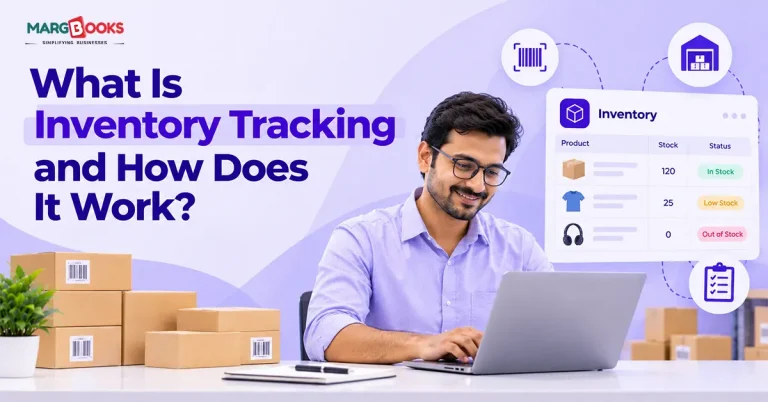
What Is Inventory Tracking and How Does It Work?

A friend of mine sells handmade candles online. Last winter, one of her scents went viral. She had 40 jars in stock, took 112 orders over a weekend, and spent the next two weeks writing apology emails and issuing refunds. The demand was great. The tracking was the problem.
That’s the short version of why inventory tracking matters. Too little stock and you lose sales. Too much and your cash is sitting on a shelf, gathering dust. Tracking is how you stay between those two. In this article, we are going to explore this part of business in detail.
What is Inventory tracking?
Inventory tracking is the process of keeping tabs on what you have, where it is, and how it moves in and out of your business. That’s it. Every sale, return, transfer, and delivery changes your numbers, and tracking is how those changes get recorded.
Three important terms are often confused by many people, namely inventory tracking, management, and control:
- Inventory tracking refers to knowing what items you have in stock and where those items are located.
- Inventory management refers to taking decisions regarding what should be done with the available information, meaning what items need to be ordered, when, and how many items should be ordered.
- Inventory control is the set of rules and actions that help in ensuring that inventory numbers are accurate and items are being kept safe.
- Therefore, monitoring is the first step in using inventory management because one cannot manage what is not visible.
- All business companies with physical products should know about inventory – companies that sell online, retail stores, restaurants, and manufacturers. It is clear for any person who has ever said, “I think we have some in the back”
Why it matters more than most people think
The clear advantage is the elimination of stockouts and excessive sales. Nevertheless, the subtler advantages are usually more valuable in the long run. Here are some reasons that contribute to the importance of inventory management.
Cash flow
Stock represents already spent money. Each item sitting idly for six months is cash not available for bills or advertising. Knowing what is being sold allows elimination of orders for unsold items.
Fewer surprises
Theft, damage, and mistakes lead to shrinkage, which has a worse impact than expected. You will not be able to see the leak without constant measurements of the water level.
Better decisions
With a collection of months of accurate information, you will begin to see seasonality, find the slowest sellers, and provide forecasts.
Better accuracy
This is necessary for financial reports and taxation.
Happy customers
Deliveries will be faster and more complete as long as you know your stock and location of each item.

How inventory tracking actually works
The workings of inventory control: Although the specifics differ among companies, the basic process is as follows:
1. Receipt
When shipments are delivered, they must be matched with the purchase order so that an actual record of what came is entered. Not what was expected to come at first. Suppliers sometimes make mistakes, and it is better to catch them when accepting the deliveries, rather than having to detect them months later.
2. Identifying products
Products have to get some kind of unique code that is usually a SKU (stock-keeping unit). This code can be either a barcode, QR code, or an RFID tag. The crucial thing is that a person or a machine can distinguish one product from another.
3. Storing products
Products are always put somewhere: in the warehouse, on the shelf, or into the box. For example, even if you have to state “somewhere in the garage,” it will still be better than not indicating where products are stored at all.
4. Recording all movements
Sales transactions, product returns, internal transfers of stock, damaged products, and giveaways – all movements will be captured. This is also where the majority of systems go wrong because the unimportant details are often missed by people.
5. Updating inventory levels
In a manual system, an individual’s hands are used to record a change in stock level. In a software program, stock levels will change automatically right after the sale is made, or a barcode is scanned.
6. Checking stock level
Good systems will always tell you when particular goods do not seem to be enough. The moment is also known as a reorder point, which depends on the rate of sale and time required for delivery.
7. Conducting audits
Even the best systems make mistakes from time to time. Cycle counting/counting a small area of stock on a regular basis or full physical inventory could help bring stock records in line with stock levels at the warehouse.
Inventory Tracking Methods and Technologies
There is no need for investment in high-tech equipment on the first day. Below are the alternatives and their ranks.
Using pen and paper or spreadsheets.
This is cost-free and allows flexibility. It is useful if you have a small inventory and just one location because it becomes unreliable when you add more locations, workforce or quantity; some people will forget to make updates, so you will never know if everything has been updated correctly or not.
Barcoding
This is a workhorse of inventory tracking. You scan a code using either a scanner or a camera, and that’s it! This method is cheap, fast, and accurate compared to the manual input method.
QR codes
They are similar to barcodes but offer even more possibilities. Anyone can scan those codes with a smartphone. They are widely used by small teams.
RFID
These are tags that can be read from a distance, so you won’t need to see them. Just scan your pallet in seconds! It is rather expensive and is mostly utilized by big companies like huge retailers or warehouses.
GPS Tracking and IoT Sensors.
These are useful when transporting products or when it comes to expensive items because it is important to not only know what you have but also where it is at the given moment.
Inventory Management Software
This is a conjunction of all things. Cloud-based inventory management software are connected to your e-store, point-of-sale system, as well as to the accounting software in order for one sale at one location to update everything everywhere.
A general principle is that spreadsheets are for initiation, barcodes plus software are those which are being used when growing, and RFID is for scaling.
Common Inventory Valuation and Tracking Systems
Some terms come up constantly once you start looking into this.
Perpetual vs. periodic
A perpetual system updates your counts continuously as things happen. A periodic system only updates when you do a physical count, say once a month or once a year. Perpetual is better for almost everyone, if you can manage it.
FIFO, LIFO, and weighted average
These are methods for assigning a cost to the stock you sell. FIFO (first in, first out) assumes your oldest items sell first. LIFO (last in, first out) assumes the newest items sell first. Weighted average blends the cost of everything. Which one you use affects your reported profit, so it’s worth asking your accountant. Also note that LIFO isn’t permitted under some accounting standards outside the US.
Batch, lot, and serial tracking
If you sell food, cosmetics, or supplements, you may need to track by batch so you can handle a recall. If you sell electronics, serial numbers let you trace individual units for warranty claims.
ABC analysis
A way of sorting your inventory by value. Your A items are the small number of products that drive most of your revenue, and they deserve the closest attention. C items are the long tail that you can check less often.
Key Inventory Metrics to Track
You don’t need to track twenty metrics. A handful will tell you most of what you need.
- Stock on hand and available to sell. These aren’t the same. Stock on hand includes items already reserved for orders.
- Inventory turnover. How many times you sell through your stock in a year. Cost of goods sold divided by average inventory.
- Days of inventory outstanding. How long, on average, stock sits before it sells.
- Reorder point. Roughly, daily sales multiplied by supplier lead time, plus a buffer called safety stock.
- Sell-through rate. The share of what you received that you’ve actually sold in a given period.
- Shrinkage rate. The gap between what your records say you should have and what you really have.
- Fill rate. The share of customer orders you can complete from stock without delay.
If you only pick two to start, pick turnover and reorder point.
Key Features to Look for in Inventory Tracking Software
If you’re shopping for a tool, don’t get distracted by long feature lists. These are the things that actually matter:
- Real-time syncing across every place you sell, so you don’t oversell.
- Barcode scanning, ideally through a phone so you don’t need special hardware.
- Low-stock alerts that you can customize per product.
- Integrations with your store platform, point-of-sale, accounting software, and shipping tools.
- Multi-location support, even if you only have one location now.
- Useful reports that don’t require a data analyst.
- User permissions, so a part-time employee can’t accidentally edit your costs.
- Pricing that scales with you, not one that jumps sharply the moment you add a second warehouse.
Always take the free trial of the Billing software. Load in real products, not demo data.
Common Challenges and How to Solve Them
Here are common challenges and how to solve them-
Data entry errors
Humans mistype. Scanning cuts this down dramatically, and regular cycle counts catch what’s left.
No visibility across channels
If you sell on your own site, Amazon, and in person, each with its own count, you will eventually sell something you don’t have. A single, central system fixes this.
Bad forecasting
Ordering based on last month’s gut feeling leads to both stockouts and overstock. Even a simple look at the last 12 months of sales data will improve your guesses.
Dead stock
Items that haven’t sold in six months or more. Discount them, bundle them, or donate them, and then don’t reorder them.
Outgrowing your spreadsheet
If you’re spending more time fixing the spreadsheet than using it, it’s time to move on.
Best Practices for Effective Inventory Tracking
Tools are useful, but good habits do the majority of the work. Check out some of the key inventory management practices:
- Assign every item a different SKU and follow a naming convention.
- Perform weekly counts instead of lump summing everything at the year’s end.
- Establish reorder levels and update them as per seasons.
- Automate repetitive tasks, particularly inventory updates.
- Train everyone who interacts with stock, such as employees who work only on weekends.
- Keep a regular check on your reporting system.
Conclusion
Inventory tracking is really just a way of answering three questions: what do I have, where is it, and what should I do next? You can answer them with a notebook or with a warehouse full of RFID readers. What matters is that the answers are accurate and that you check them regularly.
If you’re just getting started, don’t overthink it. Pick a simple system such as MargBooks Software, assign SKUs, count what you have, and build the habit. You can upgrade the tools later. My candle-making friend now uses barcode scanning and a basic inventory app, and she hasn’t had to send an apology email since.
FAQs
Q1. How does inventory tracking differ from inventory management?
Tracking refers to the monitoring of the items available in your inventory as well as their exact location. Management, on the other hand, uses that information strategically to make vital decisions regarding ordering, pricing, and storage.
Q2. What would be the best approach for inventory tracking in small businesses?
If your range of products is very limited, the simplest solution would be to start tracking inventory with the help of a spreadsheet. However, if your business has grown to the extent of selling through multiple sales channels or managing at least several hundred SKUs, then it might become necessary to utilize special inventory management software with barcode scanning capabilities.
Q3. Is it possible to monitor inventory with Excel or Google Sheets?
Yes, businesses frequently begin monitoring inventory in either of these two applications. However, the possibility of human errors and the absence of automatic synchronization with sales channels, as well as difficulties in scaling up, are major disadvantages of this method.
Q4. When should I check our inventory?
Businesses should implement cycle counts of a certain section of stock on a weekly or monthly basis and conduct complete inventory checks at least once a year. Nevertheless, high value and fast-moving items require more frequent checking.
Q5. What does real-time inventory management imply?
Real-time inventory management is keeping track of inventory whenever events occur, like sales, returns, and scans.

MargBooks, a product of Marg ERP Ltd., is a revolutionary cloud-based billing & accounting solution for every business where the business owner can manage the business from anytime anywhere on any device. MargBooks is your one-stop platform for managing your accounting, organizing your transactions, controlling your finances and managing your inventory. It’s a single secure platform to keep up with your company’s bills and invoices, reconcile your transaction, file GST return easily, experience connected banking etc.