Retail Software
 Distribution Software
 Retail Chain


10 Benefits of Cloud Based Inventory Management Systems for Growing Businesses

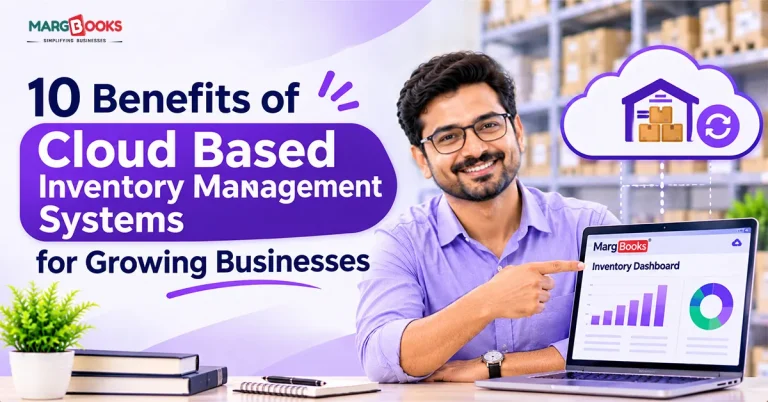
Cloud based inventory management systems refer to online solutions used for inventory management, tracking shipments, and managing suppliers. Companies often don’t intend to outgrow spreadsheets. This usually happens when one day they are casually updating their document with the number of 40 products and then find out they are selling in three different places, and someone messed up the formulas in the table so that nobody has any idea how many products of their best-seller they have in stock.
If you can relate to this description, read this guide. Here you will find a list of ten reasons why you should switch to a cloud based inventory management system.
What Are Cloud Based Inventory Management Systems?
An inventory management software system that runs in the cloud and functions over the internet, so it can keep track of what is on hand, where it is located, and items that are being received or dispatched, all of which can be accessed without the need for an installation on the server.
Because all people using the system are relying on the same set of live information, if an online transaction happens, it alters the stock count for warehouse staff in a few seconds’ time. Most systems have similar features:
- Monitoring stock levels by categories, locations, and batches
- Handling purchase orders and vendors’ information
- Synchronizing orders coming from both physical stores and online platforms
- Sending out data to billing software and cloud accounting solutions

The 10 Benefits of Cloud-Based Inventory Management Systems
In this section, we have explained the 10 major benefits of cloud-based inventory management systems.
1. Real-time inventory visibility
You have complete awareness of the stock available for sale. The same cloud computing system keeps track of the stock available across two warehouses, a retail store, and an online shop. Thanks to it, you won’t be in trouble with selling things that do not exist.
2. Lower upfront and maintenance costs
With traditional software, you have to spend money on servers, purchase licenses all at once, and hire specialists to maintain everything. Things are way easier with cloud service as the provider solves all issues; you will just have to pay monthly or yearly.
3. Easy scalability
For example, if you want to open a second warehouse, or to double the quantity of your products, or to do something else, with the help of the cloud technology you will just need to add a new location or to upgrade the plan (and not to buy hardware and so on).
4. Access from anywhere, on any device
Your staff does not have to be at the location physically for operations to be done. For instance, an operator scans the barcode and a manager approves the order via the phone, while the owner has access to stock levels from anywhere.
5. Automated reordering and fewer stockouts
If you run out of a fast-moving product, you will stop selling. If you keep too much of a slow-moving product, you will run out of cash. Cloud-based solutions allow you to set reorder points and low-stock alerts, and many of these solutions can even create purchase orders automatically for you.
6. Seamless integration with cloud-based accounting software
Many organizations that deal with inventory take advantage of this technology. When the inventory system of an organization is integrated with cloud-based accounting software, inventory movements and stock values are entered automatically into the books.
As a result, your books are cleaner, more error-proof, and close much faster. Your accountant will also be pleased because he will have reliable numbers.
7. Faster, more accurate invoicing with billing software
Inventory and invoicing are interlinked. Indeed, when a person places an order, all the necessary information gets to the invoicing software, which guarantees that the bill matches the products, quantities, and prices. It implies that the number of disagreements because of inaccuracies is lower.
Apart from that, it streamlines the process of payment. For instance, invoices are sent ahead of time, clients are provided with the correct totals, and there is no time wasted trying to correct discrepancies.
8. Fewer manual errors
Errors are possible. ‘1’ can turn into ‘100’, some lines may disappear, and there might be two users editing one document at a time. However, with the introduction of barcode scanners, such problems are avoided. If it turns out that something is amiss, it will be possible to learn who made any modifications to the document and when.
9. Stronger security, backups, and recovery
There are many small businesses that depend on a single hard drive for information storage, but there are now several good cloud solutions available as well. These types of solutions come with data encryption, controlled access, automatic backups, and more, meaning that you will be able to keep your inventory safe, even in the event of a flood or theft of your device.
10. Better reporting and demand forecasting
To make informed decisions, it is important to have good data. You will find many dashboards in the cloud that will tell you your best-selling and slow-moving products, as well as how quickly the stock is turned and what margins your product line has.
Cloud Based vs On-Premise Inventory Management
In the table below, we have compared cloud based and On-premise Inventory Management systems on various factors-
| Factor | Cloud Based | On-Premise |
| Upfront cost | Low, subscription-based | High, with licenses and hardware |
| Setup time | Often days or weeks | Usually longer |
| Scalability | Add users and locations easily | Needs new infrastructure |
| Access | Anywhere with internet | Often limited to the office network |
| Updates | Handled by the provider | Handled by your IT team |
| Integrations | Typically built in for accounting and billing tools | Often custom work |
Most companies in the stage of growth enjoy the benefits of reduced costs and flexibility that come with cloud technology and ease of integration with other systems. In general, it makes sense to use on-premises technology only in some cases requiring a specific residency or unstable internet connection.
How Inventory, Billing, and Accounting Work Together
Like these three applications that exemplify different links of the same chain, this process is carried out in the following steps:
- The customer orders from the company
- The stock system updates the stock quantity
- The billing software generates the bill with all the price and ordering information
- The accounting system ensures that the sale is recorded in the system along with the goods sold and the amount of money due.
- The payment process is implemented when the customer pays.
Once the automation of the above processes is executed correctly, it guarantees stable financial results; otherwise, one would need to carry out the reconciliation manually.
Who Benefits Most from Cloud Based Inventory Software?
In other words, nearly all types of firms could take advantage of an inventory management system, but especially:
- E-commerce merchants managing multiple sales platforms
- Retailers with numerous outlets
- Wholesale and distribution businesses with extensive product portfolios
- Manufacturers following the movement of the raw materials and the finished goods
- Organizations having several warehouses that need a joint overview
Conclusion
Spreadsheets may kickstart your journey; however, they may not suffice for managing a growing volume of work. Cloud-based inventory management solutions, like MargBooks, offer you fresh data and decrease the costs of the invoicing process. In addition, thanks to cloud technology, all data updates are up to date for your inventory accounting software, thus saving you time from searching for mistakes and focusing more on production. One can try several systems by placing real orders.
FAQs
Q1. What is a cloud based inventory management system?
This application runs on the cloud, unlike conventional software that can be installed on your servers. You can use a browser or mobile device to access the application and view orders and inventories from anywhere.
Q2. What are the main benefits of cloud based inventory management systems?
The main advantages of cloud-based software are real-time monitoring, reduced costs, simplified scaling, remote access, lower error rates, and connections with accounting and billing software. Moreover, the platform offers great reporting and stronger security mechanisms.
Q3. Is cloud based inventory management better than on-premises?
In most cases, cloud-based software provides the best solution for any business. The costs and scaling options of this solution are much better. Also, maintenance is very easy.
Q4. Can inventory software integrate with cloud based accounting software?
To an extent. Nowadays, almost all kinds of digital applications are connected to accounting systems, which simplifies the process of bookkeeping and speeds up the process of month-end reporting.
Q5. Do I need separate billing software if I use an inventory system?
It depends. Some inventory systems have basic invoicing features, while more advanced billing software often includes extra features like features for subscription billing, tax accounting and payment processing, which is quite important depending on the stage of the company’s development.
Q6. How much do cloud based inventory management systems cost?
Many companies use subscription pricing. The price varies from one service provider to another, which is why the comparison has to be made based on the needs of your organization.
Q7. Are cloud based inventory systems secure?
A good vendor should have security features like encryption, access management, and regular backups, which guarantee advanced levels of security that small businesses usually don’t have. Still, it is a good idea to check the security procedures of the vendor before purchasing their product.

Aman Kannojia is the Digital Team Lead at MargBooks. He started out as an SEO Specialist and never lost his love for words. With 5 years of experience across banking, SaaS, and finance, both domestic and international, he brings strategy, leadership, and storytelling together. He doesn’t just manage a team, he builds one that creates.