Retail Software
 Distribution Software
 Retail Chain


GSTR-1 vs GSTR-3B vs GSTR-2B: What the April 2027 Changes Mean for Your ITC

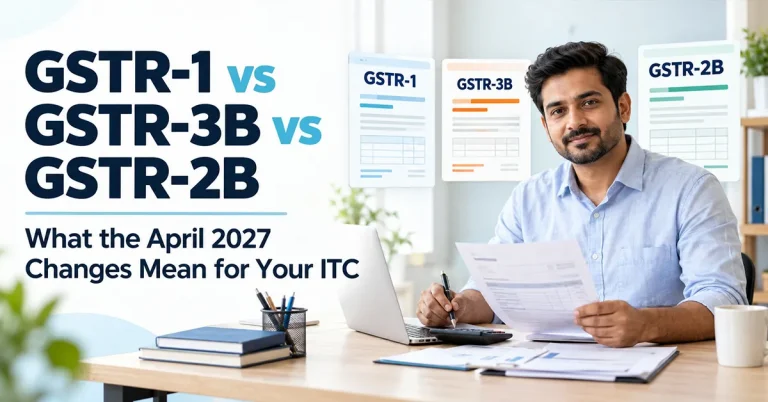
Every GST filer has been there. You file on time, pay the tax, close the books for the month, and a few weeks later a notice arrives because two numbers on two forms don’t agree.
At its 57th meeting on 8 October 2026, the GST Council took up this exact problem. It recommended a way to correct mismatches between GSTR-1, GSTR-3B and GSTR-2B, which could start from the April 2027 return period.
These are recommendations only. They take effect once the rule changes, notifications, or circulars are issued. So read this as an early look, not a final rulebook.
The GST Council has recommended new mechanisms, possibly from the April 2027 return period, to correct differences between GSTR-1, GSTR-3B and GSTR-2B. They aim to align liability and ITC reporting, but the usual ITC eligibility conditions under GST law still apply.
GSTR-1 vs GSTR-3B vs GSTR-2B: what’s the difference?
People mix these three up all the time, so let’s settle it first.
| GSTR-1 | GSTR-3B | GSTR-2B | |
| What it is | Return of outward supplies | Summary return | Auto-generated ITC statement |
| Who prepares it | You | You | The GST portal |
| What it shows | Your sales, invoice by invoice | Total tax liability, ITC claimed, tax paid | ITC available to you, based on your suppliers’ filings |
| Main use | Reporting sales | Paying tax and claiming credit | Checking what ITC you can claim |
The link between them is simple. Your GSTR-1 should back up the liability you show in GSTR-3B. Your GSTR-2B should back up the ITC you claim in GSTR-3B. Break either link, and you get a mismatch.
Why do these returns stop matching?
Most mismatches come from everyday slips, not anything shady.
- A sales invoice is in GSTR-1 but missing from the GSTR-3B figures.
- A supplier files late, so your purchase invoice never shows up in GSTR-2B.
- A credit note is booked in your accounts but never reported on the portal.
- ITC is claimed in GSTR-3B for an invoice that GSTR-2B doesn’t show.
- ITC is reversed in one month and reclaimed months later, with no clear record connecting the two.
Take a simple case. You report taxable sales of ₹5,00,000 in GSTR-1. At 18%, that’s ₹90,000 of tax. But in GSTR-3B you key in ₹4,00,000, so you pay only ₹72,000. The portal now sees an ₹18,000 gap, and today that can turn into an intimation or a notice. The Council’s proposal is intended to provide a mechanism for correcting reporting differences and reducing mismatch-related notices or intimations.

What has the GST Council recommended from April 2027?
Here are the main proposals for the GST return changes April 2027.
Better GSTR-1 to GSTR-3B reconciliation
GSTR-1, GSTR-1A and the Invoice Furnishing Facility (IFF) are to be enhanced so differences with GSTR-3B are easier to spot and sort out.
Liability correction under Rule 61(1A)
A new sub-rule would let you align the liability in GSTR-3B with what you declared in GSTR-1, GSTR-1A or IFF. This is the fix for the ₹18,000 gap above.
ITC correction under Rule 61(1B)
This does the same for credit. It would let you align the ITC you claimed in GSTR-3B with what GSTR-2B makes available.
Electronic Credit Reversal and Reclaim Statement (Rule 86C)
If you reverse ITC and later become eligible to take it back, this statement is meant to keep both entries together in one place. Anyone who has tried to explain an old reversal to an auditor will see the point.
Electronic statement for reverse charge (Rule 86D)
Under RCM, you pay the tax instead of the supplier. The proposed statement would record the RCM tax you paid and the ITC you claimed on it.
Invoice Management System changes (Rule 60)
Subject to conditions, you would be able to accept, reject or keep pending the invoices and credit notes that feed your GSTR-2B. The Council has specifically mentioned conditions on how long a credit note can stay pending.
DRC-03 with invoice details
When you make a voluntary payment through Form DRC-03, you would have to tie it to the invoice it relates to.
What do these changes mean for your ITC?
Start with the good news. If you claimed more or less ITC than GSTR-2B shows because of an honest error, there may soon be a defined way to correct it, instead of waiting for a notice.
Now, the caution. A correction tool is not a green light. An invoice appearing in GSTR-2B does not automatically make the credit yours. You still have to meet the conditions for ITC under GST law, and blocked credits and other restrictions continue to apply. The mechanism fixes reporting differences. It doesn’t turn ineligible credit into eligible credit.
One more practical point. If Invoice management software lets you accept, reject, or hold invoices, then somebody has to actually do that every month. If nobody owns it, invoices will sit untouched, and your GSTR-2B will carry the consequences.
How to prepare before April 2027
You don’t have to wait for the final notification to clean up your process. These habits help under any version of the rules.
- Reconcile before you file, every month. Match your sales register to GSTR-1 and GSTR-3B. Match your purchase register to GSTR-2B.
- Chase suppliers early. If an invoice is missing from GSTR-2B, ask the supplier to fix it before your due date, not after.
- Keep RCM records on their own. Note the supply, the tax paid and the ITC claimed.
- Log every reversal and reclaim. One line per entry, linked to the supporting documents.
- Name one person for IMS. Give them a monthly review date and a rule for handling pending invoices.
- Note the invoice behind every DRC-03 payment. Don’t pay first and work out the details later.
- Watch official sources. Check the GST portal, notifications and circulars before you change how you file.
Doing this by hand across spreadsheets gets tiring fast. If you use accounting software like Margbooks, check that your sales and purchase data can be compared with GSTR-1 and GSTR-2B without copy-pasting between files. Fewer manual steps mean fewer places for an error to slip in.
Will these changes end GST notices?
No. The goal is to cut down notices that arise from reporting mismatches. Real tax shortfalls, ineligible ITC claims, and non-compliance will still get attention from the department.
Conclusion
The direction of these proposals is clear: fewer surprises, better tracking, and a proper way for taxpayers to correct their own mistakes. How smoothly it works will depend on the final rules and how the portal handles them.
Until then, the advice is the same as it has always been. Reconcile early, keep clean records, and never claim credit you can’t support. If your GSTR-1, GSTR-3B and GSTR-2B agree with each other and with your books, the April 2027 changes will be much easier to handle.
This is where the right software makes a real difference. With MargBooks, you can keep your sales, purchases, and ITC records in one place, so your books are already in order when it’s time to file. Instead of matching figures across spreadsheets and portal downloads, you can compare your records against your returns and catch gaps while there is still time to fix them.
FAQs
Q1. What is the difference between GSTR-1, GSTR-2B and GSTR-3B?
GSTR-1 reports your outward supplies. GSTR-2B is an auto-generated statement of the ITC available to you. GSTR-3B is the summary return where you declare liability, claim ITC and pay tax.
Q2. Will the new GST return rules apply from April 2027?
Not yet confirmed. The Council has recommended the mechanism from the April 2027 return period, but it needs legal notification before it takes effect.
Q3. Why does my GSTR-3B not match GSTR-2B?
Usually because you claimed ITC that the portal doesn’t show, or a supplier hasn’t filed, or an amendment or credit note changed the figures. The difference needs to be checked invoice by invoice.
Q4. Can I claim ITC if the invoice appears in GSTR-2B?
Not automatically. You must still meet the conditions and restrictions for ITC under GST law.
Q5. What are Rule 86C and Rule 86D?
Rule 86C is proposed for an Electronic Credit Reversal and Reclaim Statement. Rule 86D is proposed for an electronic statement of tax paid under reverse charge and the ITC claimed on it.
Q6. What is the Invoice Management System (IMS)?
It is a portal facility, proposed to be provided under sub-rule (6A) in Rule 60, that lets you accept, reject, or keep pending the invoices and credit notes that feed your GSTR-2B, subject to conditions.
Q7. How can I correct an ITC mismatch in GSTR-3B?
The Council has recommended a correction mechanism under Rule 61(1B). Until it is notified, reconcile before filing and follow the procedures currently available.
Q8. Will the new mechanism stop GST notices?
No. It aims to reduce notices caused by reporting mismatches, but genuine discrepancies and ineligible claims can still lead to notices.

Aman Kannojia is the Digital Team Lead at MargBooks. He started out as an SEO Specialist and never lost his love for words. With 5 years of experience across banking, SaaS, and finance, both domestic and international, he brings strategy, leadership, and storytelling together. He doesn’t just manage a team, he builds one that creates.