Retail Software
 Distribution Software
 Retail Chain


GST Changes from 1 November 2026: What to Fix in Your Billing Before the Date Hits

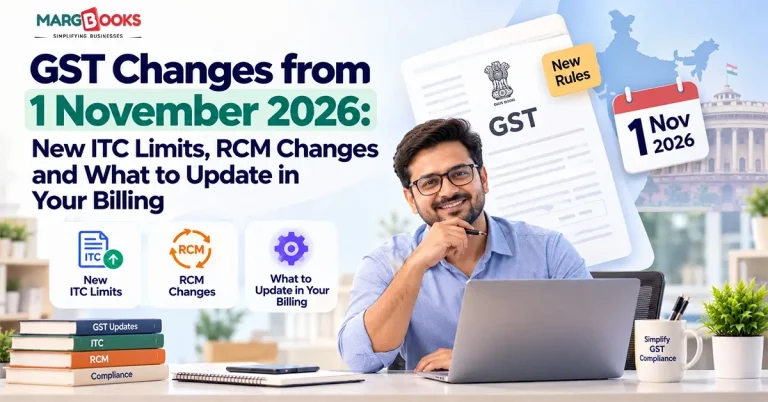
The government issued GST notifications on 27 October 2026, and they take effect on 1 November 2026. That is two days away. If you run a hotel, restaurant, catering business, EV service, or online delivery operation, some of your invoices will be wrong on Monday unless you change something first.
The notifications tighten input tax credit (ITC) for hotels, restaurants, and outdoor caterers who buy services from someone in the same line of business. They also add specific entries for EV transport and rental, revise delivery services sold through e-commerce platforms, and change two reverse charge (RCM) entries.
This post goes through each change in simple terms, shows the numbers, and A quick note before we start: this is a summary based on published news coverage of the notifications. Before you change your tax settings, read the entry that applies to you in the official notification, because each one carries its own conditions.
GST Changes from 1st November 2026
Here is a detailed tabular format of GST Changes from 1st November 2026.
| Area | What changed | Rate (CGST / IGST) | ITC effect |
| Hotel accommodation | New limit on ITC for input services bought from a supplier in the same line of business | As per the entry | Capped |
| Restaurant services | Same idea, with its own conditions | As per the entry | Capped |
| Outdoor catering | ITC limited when the subcontractor charges a higher rate than you do | As per the entry | Capped |
| EV passenger transport and EV rental (battery charging included in the price) | New specific entries | 2.5% / 5% | Capped on same-business inputs |
| Delivery services through an e-commerce operator (supplier not required to register under Section 22(1)) | Entry revised | 2.5% / 5% | No ITC on goods and services used |
| Reverse charge | Serial 15 (CGST and UTGST) changes from 6 to 9. Serial 17 (IGST) changes from 12 to 18 | n/a | Check your RCM ledger |
| Toll-Operate-Transfer concessionaires | UTGST payable on operation and maintenance amounts debited from the escrow account | n/a | Timing of liability changes |
ITC restrictions for hotels, restaurants and outdoor catering
This is the change most likely to hit your margins, so it is worth slowing down on. The condition applies when you buy an input service from another supplier in the same line of business. A hotel that books rooms from another hotel is one example. A caterer that subcontracts part of an event to another caterer is another. If you charge your own customer a lower concessional rate than the tax your supplier charged you, you can no longer claim the full credit. You can claim only up to the rate you charge. The notification gives two worked examples.
Hotel. A hotel buys accommodation for ₹10,000 and pays central tax of ₹900 at 9%. It then charges its own customer central tax at 2.5%. Credit is limited to ₹250, which is 2.5% of ₹10,000. The other ₹650 is a cost you now carry.
Caterer. An outdoor catering service is bought for ₹60,000. The subcontracted caterer charges central tax at 9%, which is ₹5,400. The main caterer charges its customer 2.5%. Credit is limited to ₹1,500.
One detail that is easy to miss: the IGST version of the same illustration uses a 5% limit, not 2.5%. So check which tax applies to the transaction instead of assuming one percentage fits all.
If you do a lot of subcontracting, run last quarter’s purchases through this rule and see what it would have cost you. Then decide whether your pricing still works.

EV transportation and rental services
There are now specific entries for three services, provided the price includes the cost of charging the battery:
- carrying passengers in an electrically operated vehicle
- renting an electrically operated vehicle meant for passengers
- renting an electrically operated vehicle for carrying goods
The rate is 2.5% under CGST and 5% under IGST, subject to the conditions in each entry. The notification defines an electrically operated vehicle as a road vehicle that runs only on electrical energy, either from an outside source or from batteries fitted to it. Electric bicycles are included.
The same ITC cap shows up here. Say you charge a passenger ₹1,000 for a ride and hire an electric vehicle with an operator for ₹800, paying ₹72 central tax at 9%. If you charge your customer 2.5%, your credit on that hire is limited to ₹20, not ₹72.
Fleet operators who bill from the road may find a mobile billing app easier to keep current than a desktop setup in an office.
Delivery services sold through e-commerce platforms
The revised entries cover certain delivery services supplied through an e-commerce operator, where the supplier is not required to register under Section 22(1) of the CGST Act. The rate is 2.5% under CGST and 5% under IGST for the specified category.
The condition that matters most: no input tax credit can be taken on the goods and services used to supply these deliveries. The wording around reverse charge for delivery services and the registration conditions has also been revised, so read the entry against your own setup.
If you sell online, your invoices and platform orders should line up with what you report. A tool built for e-commerce sellers keeps that tidier.
Reverse charge: two numbers changed
Under Notification 08/2026, the figure “6” is replaced by “9” against serial number 15 in the CGST reverse charge table (and the matching UTGST notification). Under the IGST notification, “12” is replaced by “18” against serial number 17.
That is a small edit on paper and a real difference on a GST return. Find out which service category those serial numbers point to, check whether you buy it, and change your RCM entries from 1 November. If you have a standing template for self-invoicing or RCM vouchers, update it now so nobody has to remember on the day.
Concession agreements (a short one)
Notification 10/2026 under the UTGST framework covers concessionaires on the Toll-Operate-Transfer model. They must pay tax on amounts charged or debited from the escrow account for operation and maintenance expenses, in the tax period when the expense is debited. Most of our readers will not be affected. If you are, look at your escrow arrangements and the timing of liability.
Conclusion
The notifications dated 27 October 2026 change how ITC works for hotels, restaurants and caterers, add specific rates for EV services and certain delivery services, and amend two reverse charge entries. All of it applies from 1 November 2026, so the work is simple but time-bound: find your entries, recalculate your credits, and make sure your invoices carry the right rate from the first bill.
That last part is where software earns its keep. MargBooks software lets you keep invoices, purchases, and returns in one place, so a rate or ITC change shows up in your books and your GSTR data without a second round of manual fixes.
FAQs
Q1. When do these GST changes start?
They take effect on 1 November 2026. The notifications were issued on 27 October 2026.
Q2. Which businesses are affected?
Hotel accommodation, restaurants, outdoor catering, EV transport and rental, certain delivery services through e-commerce operators, and some concessionaires. Anyone who pays tax under the two amended RCM entries is also affected.
Q3. How is ITC limited for hotels and caterers?
When you buy a service from another supplier in the same line of business and charge your own customer a lower concessional rate, your credit is limited to that lower rate applied to the value of the input. In the hotel example, ₹10,000 of input gives a credit of ₹250, not ₹900.
Q4. What GST rate applies to EV transport and rental?
2.5% under CGST and 5% under IGST, when battery charging cost is included in the price and the conditions of the entry are met.
Q5. Can I claim ITC on inputs used for e-commerce delivery services?
Not for the specified category. The amended entries say credit on goods and services used to supply these deliveries is not to be taken.
Q6. What changed in reverse charge?
Serial 15 in the CGST and UTGST tables changes from 6 to 9. Serial 17 in the IGST table changes from 12 to 18.
Q7. Do I need to update my billing software?
If you sell or buy any of the affected services, yes. Update tax rates and invoice templates before you raise your first invoice on 1 November.
Q8. Where can I read the official notifications?
On the CBIC website and in the Gazette. Notification numbers to look for are 06/2026 and 08/2026 (Central Tax and Integrated Tax Rate), and 10/2026 (Union Territory Tax Rate).

Aman Kannojia is the Digital Team Lead at MargBooks. He started out as an SEO Specialist and never lost his love for words. With 5 years of experience across banking, SaaS, and finance, both domestic and international, he brings strategy, leadership, and storytelling together. He doesn’t just manage a team, he builds one that creates.