Retail Software
 Distribution Software
 Retail Chain


Composition Scheme under GST: Rules, Benefits & Limits

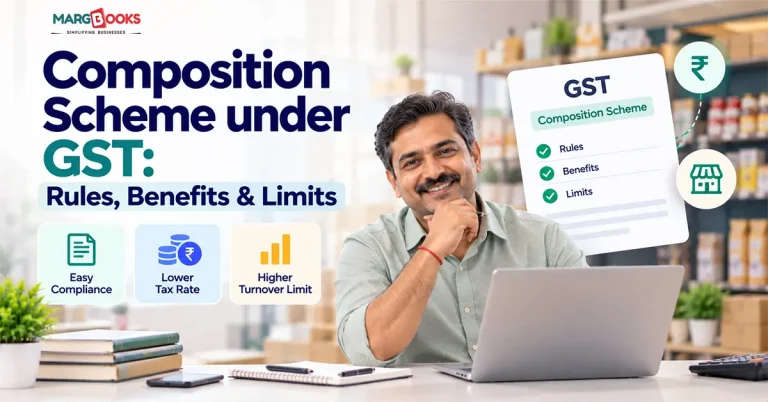
If you’re running a small store, another café, or a small service business, filing your GST can often feel like a bit of a hassle, another job piled on top of your day-to-day work. You have to file GST returns every month, keep invoices in order, track inputs, and keep engaging the services of a chartered accountant or CA. The composition scheme under GST was introduced to reduce that headache. You file returns less frequently compared to the actual GST, pay a lesser amount of tax, and get back to your work.
But all that doesn’t mean that the composition scheme is without its drawbacks. The main drawback is that you lose the ability to claim input tax credit. Whether the scheme is beneficial or not will depend on how the business is actually being run. This article will go through all the various rules, rates, benefits, and drawbacks, so that you can take a decision based on exact numbers.
What Is the Composition Scheme under GST?
The composition scheme is an optional, simplified way of paying GST for small taxpayers. Instead of charging GST on each sale and then adjusting it against the tax you paid on purchases, you pay a flat percentage on your total turnover. It comes from Section 10 of the CGST Act, with the procedures set out in Rules 3 to 7 of the CGST Rules.
Who Is Eligible, and What Is the Turnover Limit?
The limit depends on what you do and where you operate your business.
- Goods suppliers (traders and manufacturers): aggregate turnover up to ₹1.5 crore in the previous financial year.
- Certain special category states, mainly in the North East: the limit is ₹75 lakh.
- Service providers: a separate route under Section 10(2A) lets eligible service providers opt in up to ₹50 lakh.
Turnover here means the combined turnover of all your registrations under one PAN, not just one GSTIN. That catches people out. If you have two shops registered under the same PAN, both are counted together.
Who cannot opt in
You generally can’t use the scheme if you:
- make inter-state outward supplies of goods
- supply goods through an e-commerce operator who collects tax at source
- manufacture certain notified goods such as ice cream, pan masala or tobacco products
- supply goods or services that are not taxable under GST
- are not eligible on any other ground in the notified conditions
If you’re unsure about your own case, check the latest notifications or ask a CA before you opt in. The list of exclusions has been amended over the years.

Composition Scheme Tax Rates
The rates are applied to your turnover, and they are split equally between CGST and SGST.
| Type of business | Rate on turnover |
| Manufacturers and traders | 1% |
| Restaurants not serving alcohol | 5% |
| Service providers (Section 10(2A)) | 6% |
Say you run a general store with a turnover of ₹50 lakh in a year. Under composition, your GST is 1% of that, which is ₹50,000. Under regular GST, you would charge tax at the applicable rate on each product and then subtract the credit on your purchases. For a low-margin retailer who mostly sells to walk-in customers, the composition figure is often lower and certainly easier to calculate. One thing to take care of is that the tax is on your total turnover, not only the taxable part of it.
Key Rules and Conditions
Once you’re in the scheme, the rules are applied to you:
- No input tax credit: You can’t claim ITC on anything you buy.
- No tax collected from customers: You pay the tax out of your own pocket. It can’t be shown separately on your bills.
- Bill of Supply, not tax invoice: You issue a Bill of Supply for your sales.
- Display requirements: The words “composition taxable person, not eligible to collect tax on supplies” must appear on your bills and on a signboard at your place of business.
- All or nothing under one PAN: If you opt in, every registration under that PAN has to be in the scheme.
- Reverse charge still applies: If you buy something that attracts reverse charge, you pay that tax separately.
Benefits of the Composition Scheme
Here are the benefits of the composition scheme
Lower compliance.
Regular taxpayers file monthly or quarterly returns plus an annual return. Composition taxpayers file a quarterly payment statement and one annual return. That means fewer deadlines and, usually, a smaller accountant bill.
Simple tax calculation.
You don’t track credit, match purchase invoices, or worry about supplier defaults. You apply a percentage to turnover and pay.
Better cash flow.
A low flat rate and less paperwork leave more money, and more time, in the business.
A good fit for small B2C sellers.
If most of your customers are individuals who don’t need tax credit, the scheme lines up well with how you sell.
Limits and Drawbacks of Composition Scheme under GST
Limits and Drawbacks of the composition scheme under GST.
You lose input tax credit
If your purchases carry a lot of GST, say you buy costly raw material or equipment, the credit you’d have claimed under regular GST can be worth more than the saving from the lower rate.
No inter-state sales
Selling goods to another state rules you out. That is a real problem if you want to grow beyond your own state.
B2B customers may walk away
Your buyers can’t claim credit on what they purchase from you, because you don’t issue a tax invoice. Business customers who care about ITC may prefer a regular supplier.
Tax on all turnover
Because the rate applies to everything you sell, including exempt supplies, the effective burden can be higher than expected in some cases.
Limited online selling
Supplying goods through an e-commerce operator who collects tax is not allowed under the scheme.
Composition Scheme vs Regular GST
Here is a difference between the composition scheme and regular GST.
| Composition scheme | Regular GST | |
| Tax rate | Fixed 1%, 5% or 6% of turnover | Standard rates by product or service |
| Input tax credit | Not allowed | Allowed |
| Document issued | Bill of Supply | Tax invoice |
| Inter-state supply of goods | Not allowed | Allowed |
| Returns | CMP-08 quarterly and GSTR-4 yearly | GSTR-1 and GSTR-3B, plus annual return |
| Best for | Small B2C businesses with low input credit | B2B sellers, high input credit, inter-state trade |
If your input credit is small and your buyers are mostly consumers, composition is worth a serious look. If you buy heavily from registered suppliers and sell to other businesses, regular GST usually works out better.
How to Opt In, Exit or Switch from Composition Scheme
Opting in. You can choose the scheme when you first register for GST. If you’re already registered under the regular scheme, file Form CMP-02 before the start of the financial year in which you want to join. You’ll also need to file Form ITC-03 to reverse the credit on stock you hold at the time of switching.
Leaving voluntarily. File Form CMP-04 if you want to move back to regular GST.
Crossing the limit. If your turnover goes over the permitted limit, or you start doing something that disqualifies you, such as an inter-state sale, you’re out of the scheme from that point. Move to regular GST and file the required forms on time.
Return Filing and Due Dates
Composition taxpayers deal with two return filings.
- Form CMP-08 is a quarterly statement-cum-challan used to pay your tax. It is due by the 18th of the month after each quarter: 18 July, 18 October, 18 January and 18 April.
- Form GSTR-4 is the annual return. For recent years, it is due on 30 June after the financial year ends. It used to be 30 April, and plenty of older pages still show that date, so check the GST portal for the current one.
A useful rule: you can’t file GSTR-4 until every CMP-08 for that year is filed.
If you pay late, interest at 18% a year applies on the unpaid tax. Late filing of GSTR-4 also attracts a late fee, which has a daily rate and a cap.
Is the Composition Scheme Right for You?
It probably suits you if:
- your annual turnover is under the limit and likely to stay there
- you sell mainly within your own state
- most customers are individuals, not businesses claiming credit
- your purchases carry little GST, or your margins are thin
- you want fewer filings and a simpler routine
It probably doesn’t suit you if:
- you sell to other states or plan to soon
- your business customers insist on tax invoices
- you buy a lot from registered suppliers and rely on input credit
- you sell mainly through e-commerce platforms
When in doubt, run the numbers both ways for one year of your actual sales and purchases. The better option is usually clear on paper.
Conclusion
The Composition Scheme under GST is a trade-off between ease of use and flexibility. You have low rates and do less paperwork, but at the same time lose input tax credit and do not sell across states. It works well for a small local business. However, if you are heavily purchasing from registered dealers or making sales to businesses, normal GST might be cheaper overall.
Make sure to do your own calculations first before the decision and speak to a CA in case your situation is complex. Rules and deadlines keep changing, so check the official GST portal for the latest updates.
If you opt for the Composition Scheme, you will find the process easier by using software like MargBooks. This tool allows you to produce Bills of Supply and maintain the required records in a handy way.
FAQs
Q1. What is the turnover limit for the composition scheme?
It is ₹1.5 crore for most goods suppliers, ₹75 lakh in certain special category states, and ₹50 lakh for eligible service providers.
Q2. Can a composition dealer claim input tax credit?
No. Giving up ITC is the price of the lower rate and simpler compliance.
Q3. Can composition dealers sell inter-state or online?
Inter-state supply of goods is not allowed. Supplying goods through an e-commerce operator that collects tax is also barred.
Q4. What is the difference between CMP-08 and GSTR-4?
CMP-08 is the quarterly statement used to pay tax. GSTR-4 is the yearly return that sums up the year. You need both.
Q5. How do I leave the composition scheme?
File Form CMP-04 to withdraw voluntarily. If you cross the turnover limit or break a condition, you move to regular GST and must follow the exit procedure.

Aman Kannojia is the Digital Team Lead at MargBooks. He started out as an SEO Specialist and never lost his love for words. With 5 years of experience across banking, SaaS, and finance, both domestic and international, he brings strategy, leadership, and storytelling together. He doesn’t just manage a team, he builds one that creates.