Retail Software
 Distribution Software
 Retail Chain

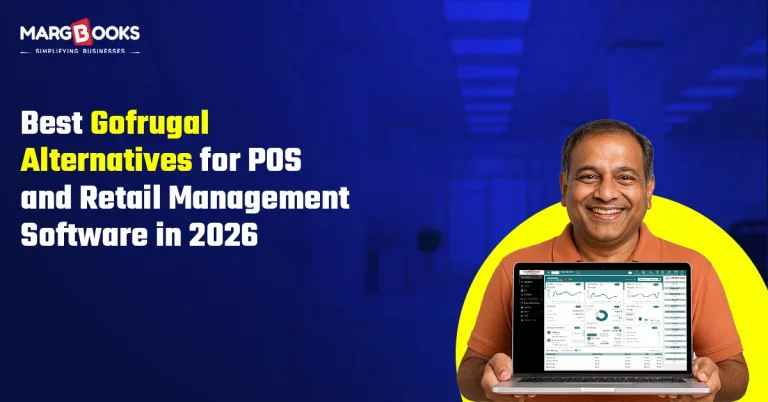
Best Gofrugal Alternatives for POS and Retail Management Software in 2026

Switching billing software is nobody’s idea of a good time. You have years of invoice data sitting in the system, your staff knows the shortcuts, and the last thing you want is three weeks of downtime while some consultant migrates your database. So when retailers start actively searching for a Gofrugal alternative, something has usually gone wrong — and gone wrong enough that the pain of switching sounds better than the pain of staying.
For some businesses, it is the pricing. Gofrugal’s base plan looks fine until you start adding what you actually need — multi-store support, proper e-invoicing, inventory tracking by batch — and suddenly the bill looks very different from the initial quote. For others, it is the cloud access. Or the support ticket that sat unanswered for two days while a GST deadline loomed. Or the third failed attempt to get a new branch set up on the system.
The reasons vary. The outcome is the same: retailers looking for something better.
This guide covers five platforms that Indian businesses are moving to in 2026. Not five random software options that showed up in a keyword search — five platforms with real track records in Indian retail, each suited for a different type of operation.
Top Gofrugal Alternatives
- MargBooks — Best Overall for Cloud POS, Billing, Inventory and Retail Management
- Vyapar — Best for Offline POS Billing for Small Retailers and Solo Traders
- Unicommerce — Best for Omnichannel Retail and E-commerce Order Management
- TallyPrime — Best for Advanced GST Compliance, Accounting and Retail Finance Management
- Petpooja — Best for Restaurant POS, Billing and Food Service Operations
What Is Actually Pushing Businesses Away from Gofrugal
Nobody leaves a system they have been on for years over one bad experience. It builds up. The implementation complaint is the most common. Getting Gofrugal configured properly takes time — not days, often weeks. Counter staff need training that goes beyond a one-hour walkthrough. For a retail business trying to open a second or third location, that kind of setup lag is not just inconvenient; it is expensive.
Then there is the module pricing. The base subscription covers the basics. But retail businesses need the basics plus GST compliance, plus inventory management, plus multi-location support, plus decent reporting. Each of those is an add-on. By the time a mid-sized retailer has ticked all the boxes, the monthly cost is significantly higher than the number they saw on the pricing page.
Cloud access comes up repeatedly in user reviews. Gofrugal has a cloud offering, but retailers who have used genuinely cloud-native platforms describe the experience as sluggish by comparison. Real-time stock visibility from a phone, pulling sales reports from outside the store, giving an accountant remote access without setting up a VPN — these are standard expectations now, and Gofrugal does not always meet them smoothly.
Support quality is inconsistent. Some users report good experiences. Others describe long waits during critical moments, a billing software down during peak hours, a GSTR deadline the next morning, a new staff member stuck on a configuration issue. Inconsistent support is worse than slow support, because you cannot plan around it.
None of that makes Gofrugal a write-off. Even with a strong IT department and predictable requirements, you can use this; however, if your company is moving rapidly and has multiple locations, or if it is moving into e-commerce, the problems start immediately.
Comparison Between Top Gofrugal Alternatives for POS and Retail Management
| Software | Best For | Cloud POS | GST Billing | Inventory Management | Multi-Store | Mobile App |
| MargBooks | Cloud POS, Billing and Distribution | Yes | Yes | Yes | Yes | Yes |
| Vyapar | Offline POS for Small Retailers | Basic | Yes | Basic | No | Yes |
| Unicommerce | Omnichannel and E-commerce Retail | Yes | Yes | Yes | Yes | Yes |
| TallyPrime | GST Compliance and Retail Accounting | Partial | Yes | Yes | Yes | Companion App |
| Petpooja | Restaurant POS and Food Service | Yes | Yes | Basic | Yes | Yes |
Top 5 Gofrugal Alternatives for POS and Retail Management in 2026
1. MargBooks
The MargBooks group has developed retail & distribution applications for Indian companies since 1992. They are not new to the area of GST compliance — they have been addressing ongoing compliance cycles, inventory management flows, and other edge cases for Indian retail businesses regularly since 1992.
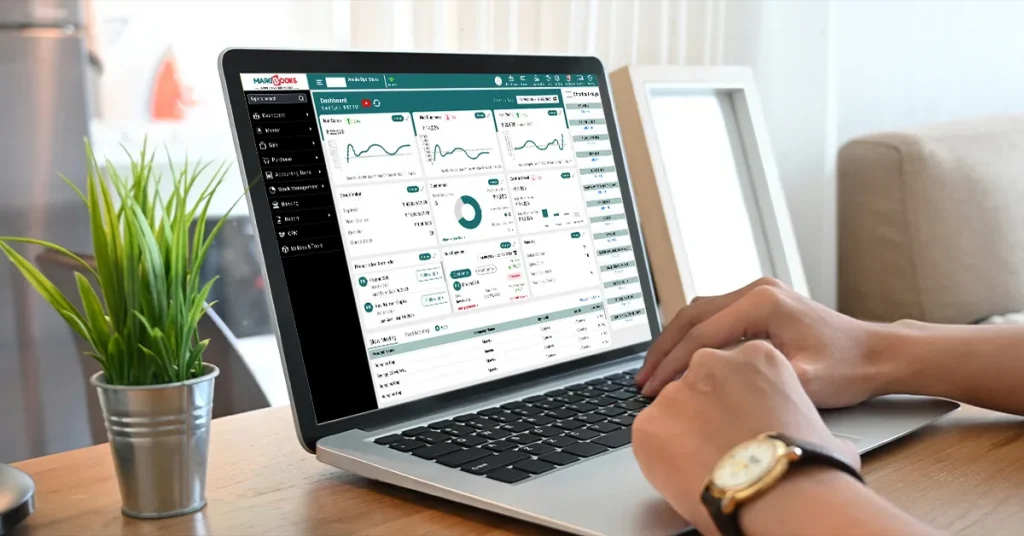
The billing flow is genuinely fast. When an item is scanned with a barcode scanner, the item appears, the HSN/SAC is automatically filled, the invoice is created, and the customer receives the invoice via WhatsApp before they complete payment for the item. For a counter handling hundreds of transactions a day, that speed matters. The e-invoicing (i.e., generating IRNs and embedding QR codes) is done in the background and doesn’t require the accounting staff to think about it. The e-Way bills are automatically created from the invoices; the user doesn’t have to log into the government portal to do that.
GST return filing does not require a separate process. GSTR-1, GSTR-3B, and GSTR-2A reconciliation are automated. The data is already there from the billing entries — the POS Billing software does the reconciliation and flags mismatches before filing. For businesses that have spent years manually cross-checking purchase registers against supplier GSTR-2A data, this alone is worth the switch.
Multi-branch management is not a premium add-on. Stock levels across all locations update in real time. Inter-branch transfers have proper documentation built in. Consolidated reports, sales, GST, and inventory pull data from every location into a single view. A retailer managing stores in Delhi, Pune, and Bengaluru sees all three from one dashboard, from any device.
The accounting module that includes the balance sheet, P&L, ledger management, and bank reconciliation connects directly to the billing and inventory data. No re-entering numbers. No end-of-month scramble to reconcile what the billing system shows against what the books show.
MargBooks also offers free data migration from Gofrugal. Invoice history, customer ledgers, inventory masters, everything comes across. For businesses that have been dreading a clean-break switch, that migration support removes the biggest obstacle.
Pros: Cloud-native with real device flexibility, full GST compliance stack built in, multi-branch management included, strong inventory capabilities, free Gofrugal migration
Cons: For smaller businesses, they could be overwhelmed with all of the available features and see no need to utilize so many of them at their stage of development.
Best For: Retailers, wholesalers, medical wholesalers, & pharmacy chains have a variety of values when on this platform since it encompasses all of their requirements (billing, GST compliance, inventory management, accounting) irrespective of which of their multiple locations utilize the resource through an internet device or tablet.
2. Vyapar
Some businesses do not need multi-branch dashboards or automated GSTR reconciliation. They need to bill a customer, track who owes them money, and know roughly what stock they have left. Vyapar, an accounting software, is built around that reality.
The offline capability is the thing that actually matters here. Rural locations, or smaller populated cities where few customers may visit your company, often have inconsistent internet connectivity. For instance, if your broadband fails unexpectedly, you may find it very difficult to run your shop’s cash register if you have no present means of transmission (i.e., you can’t simply tell a customer to wait for the internet to come back). Vyapar works fully offline — invoices are generated, printed, and recorded locally. When the connection comes back, everything syncs.
Setup takes an afternoon. Training a new staff member takes a day. The interface does not require explanation; the billing screen does what a billing screen should do without making the user navigate five menus to get there.
What Vyapar does not do is equally important to know upfront. There is no automated GSTR filing; you get summary reports that help with manual filing, but the actual return submission is your job or your accountant’s. There is no multi-store management. Advanced inventory features like batch tracking or expiry management are not there. For a business that has grown beyond a single location or needs serious compliance automation, Vyapar will hit its ceiling quickly.
For the business, it is designed for a single-location shop, trading business, or small service provider, as it covers the daily workflow without unnecessary complexity.
Pros: Easy to learn, reliable – even if offline; affordable – provides good coverage for day-to-day invoicing and simple tracking of receivables
Cons: Does not have any multi-store capabilities; does not support automated GSTR filing; very little opportunity to expand business.
Best For: Single-location shops, small traders, and kirana stores where reliable offline GST billing and basic receivables tracking are the core requirements
3. Unicommerce
Gofrugal was built when a retailer meant someone with a physical store. Unicommerce was built for what retail looks like now — the same business selling on Amazon, Flipkart, Meesho, its own website, and a physical store simultaneously, trying to manage one inventory pool across all of it without losing their mind.
The operational problem Unicommerce solves is real and specific. When an item sells on your website, the Flipkart listing needs to update immediately, or you will oversell. When an Amazon return comes into your warehouse, the staff must know where to send it back. It is also necessary that someone can pick and pack and generate a shipping label by 2 am for a Meesho order so that it will be dispatched before their cut-off time. Most emerging e-commerce companies manage returns and shipping through multiple marketplaces via separate portals; consequently, this type of manual handling creates errors and unhappy customers.
Unicommerce centralizes all of it. Orders from every channel flow into one screen. Inventory updates across all platforms when a sale happens anywhere. Returns follow automated workflows. Shipping label generation integrates with all major logistics partners — Delhivery, Blue Dart, Ecom Express, and others, so the fulfilment process runs faster with fewer manual steps.
For a business that is primarily physical retail without e-commerce ambitions, Unicommerce is overkill. It is not a counter POS Billing Software; it is not built for the restaurant trade, and its pricing reflects the complexity it manages. But for a brand doing serious volumes across online and offline channels, it handles what Gofrugal structurally cannot.
Pros: Managing the complexities of various channels that a traditional POS could not do; having strong integrations with all major marketplaces in India; providing real-time inventory updates; automating many aspects of the return process.
Cons: Cannot be used as a stand-alone point-of-sale system for brick-and-mortar stores; not applicable to the food service industry or restaurants.
Best For: Direct-to-consumer companies, marketplace sellers, and any omni-channel retailer managing the inventory and fulfilment of product orders through Amazon, Flipkart, Meesho, Myntra, their website, and in a brick-and-mortar location.
4. TallyPrime
When you ask CAs throughout India about which accounting software you should use for managing your retail customers’ accounts, TallyPrime is sure to be among the first two responses received. This is because Tally has been the heart of compliance for Indian SMMEs (small and medium-sized enterprises) for many years, and TallyPrime continues this tradition by providing e-invoicing (including automated generation of form IRN and embedding of QR code), automated reconciliation of GSTR – 1, 3B, and 2A, as well as audit-proofing financial statements. Tally also offers integration with the direct electronic filing of GSTRs to facilitate reconciling the three GSTR reporting bases and to help business owners operate under the GST regime efficiently. E-way bills are generated directly from transactions. The audit trail is detailed. The financial reporting depth balance sheets, P&L, multi-currency management, and godown-wise inventory are not matched by most of the other platforms on this list.
Where TallyPrime struggles as a Gofrugal replacement is on the operational side. It is a desktop-first product. The mobile companion app extends some functionality, but it is not a full POS, a busy counter running 300 transactions a day will find the billing workflow slower than purpose-built billing platforms. The interface has improved, but it still reflects a product designed around an accountant’s workflows more than a store manager’s. Non-finance staff take longer to get comfortable with it.
For a retail business where the finance team or an external CA firm is the primary operator, where GSTR accuracy and audit readiness matter more than billing speed, TallyPrime is hard to argue against. For a business that needs a fast counter POS first and compliance second, it may not be the best fit.
Pros: The best compliance product for small to medium-sized businesses in India for SMBs is Gainbook – Gainbook has the greatest number of GSTR automated under integration and has thorough overall financial reporting, excellent documentation of historical transactions, and good stock control.
Cons: Gainbook is primarily a desktop-based (traditional) software platform with limited cloud capabilities; it is not designed for high-volume (quick checkout) Point of Sale transactions; non-financial staff may find using Gainbook to be more time-consuming than expected.
Best For: Businesses that are mid-sized, chartered accountants who have customers who are in retail and all finance-based operations, with a requirement for audits and GST calculation for submission, must also have the ability to show as quickly as possible for billable hours and the ability to charge those hours out.
5. Petpooja
Gofrugal sells a restaurant module. Petpooja is a restaurant platform. That distinction matters more than it sounds.
A retail POS adapted for restaurants can handle billing and basic inventory. What it cannot do is manage the actual operational rhythm of a food business — tables turning over, kitchen tickets printing before a verbal order gets lost, Zomato orders landing alongside dine-in orders in the same queue, a staff member seeing in real time which tables have been waiting too long.
Petpooja is built around those workflows. KOT generation sends the order to the kitchen the moment it is placed, no handwritten tickets, no miscommunication between the floor and the kitchen. Table management is a way to monitor how many occupied tables there are and for each table, the time they have been seated, and what orders they are currently waiting on to be filled. When a Swiggy order is placed, it appears directly in the same point-of-sale program that the table next to the window is in, instead of being placed in a separate aggregator portal that needs to be refreshed by someone every few minutes for new orders. Inventory tracking at the ingredient level, not just the dish level, lets you see food costs and wastage in a way that changes how you manage purchasing. If your butter chicken is 12% over cost this week, the system can show you whether it is the chicken supplier, the portion size, or the wastage in the kitchen. That is a different kind of insight than knowing your total grocery spend went up.
Multi-outlet management handles menu changes across locations, consolidated sales reporting, and central monitoring without needing a separate visit to each location’s terminal. GST billing with GSTIN capture is included, along with basic CRM and loyalty tools.
If you have been managing a restaurant on Gofrugal’s module and making do, Petpooja will feel like a different product category entirely.
Pros: Designed specifically for food service operators; designed with tight integration to Zomato and Swiggy; good KOT (Kitchen Order Ticket) management/restaurant table management; managed and accounted for ingredient-level inventory; Very robust multi-outlet capability.
Cons: Not applicable to non-food retail, general merchandise, or distribution companies.
Best For: Restaurants, cafes, QSRs, cloud kitchens, and multi-outlet food chains that need a proper food service POS, but not for a retail platform with a restaurant tab added on.
How to Choose the Right Gofrugal Alternative
| Choose | If You Need |
| MargBooks | One cloud-based platform for managing the Point of Sale (POS) billing, GST compliance, inventory management, accounting, and multi-branched business management. |
| Vyapar | Simple offline GST billing for a single-location shop without ERP complexity or cost |
| Unicommerce | Centralized orders and inventory across all marketplace and brick-and-mortar business locations worldwide. |
| TallyPrime | Finance team, CA can manage both deep automated GST compliance and Audit Ready Financials |
| Petpooja | A food-service-native POS with KOT workflows, aggregator integration, and ingredient-level inventory |
Conclusion
The right answer depends entirely on your business type — there is no single best option for every retailer reading this.
A pharmaceutical distributor running four branches across two cities has nothing in common with a cloud kitchen managing 80 Zomato orders a day. A kirana store owner in a tier-2 town has different priorities than a fashion brand selling across six online marketplaces. Forcing the same platform onto all of them is how businesses end up paying for features they do not use while missing the ones they actually need.
That said, for the broadest category — growing Indian retail businesses that need billing, compliance, inventory, and accounting to work together without maintaining multiple systems — MargBooks software covers more ground with fewer trade-offs than anything else on this list. The 32-year institutional knowledge of Indian retail operations shows in the product. The compliance automation is genuine, not a checkbox feature. And the free Gofrugal migration removes the biggest reason businesses stay on a system longer than they should.
If that sounds like your situation, a demo is the logical next step. See it run on your type of inventory, your GST structure, your number of locations — then decide.
FAQs
What is the best Gofrugal alternative for POS and retail management?
For most growing Indian retail and distribution businesses, MargBooks covers the same ground as Gofrugal — billing, GST compliance, inventory, multi-store management, accounting — on a genuinely cloud-native platform with free migration support from Gofrugal included.
Which Gofrugal alternatives support e-invoicing in India?
TallyPrime, MargBooks, and Unicommerce all support native IRN (Invoice Reference Number) creation, QR code embedding, and e-invoice compliance. If you cross the e-invoicing threshold for your business, any of these three will manage your e-invoicing seamlessly without having to do another e-invoicing portal workflow.
Is there a proper cloud-based Gofrugal alternative?
MargBooks and Unicommerce are both cloud-native, not desktop software with remote access added. By utilizing either of these systems, you’ll have secure instant access to information across any available device (there’s no requirement to have a physical server present in your office or a virtual private network connect).
Which Gofrugal alternative works for restaurants?
Petpooja. A retail POS with a restaurant module and a restaurant-native platform are two different things. If food service is your business, Petpooja is the platform built for it.
Can Gofrugal data be migrated to MargBooks?
Yes. MargBooks runs a structured migration process that brings invoice history, customer ledgers, inventory masters, and financial data across from Gofrugal. Businesses do not have to start from a blank system.

Aman Kannojia is the Digital Team Lead at MargBooks. He started out as an SEO Specialist and never lost his love for words. With 5 years of experience across banking, SaaS, and finance, both domestic and international, he brings strategy, leadership, and storytelling together. He doesn’t just manage a team, he builds one that creates.