Retail Software
 Distribution Software
 Retail Chain

QuickBooks Alternatives for Every Business Type in 2026

Let’s be honest, QuickBooks is not a bad product. For businesses in the US and Europe, it does the job reasonably well. But if you are running a business in India, you have probably noticed that QuickBooks was never really built for you.
The GST filing does not go deep enough. The inventory features stop short of what a trader or distributor actually needs. The Subscription Fee Continues to Increase Every Year. The Moment You Require an Additional User Your Monthly Fee Increases Again.
So businesses start looking around. A retailer wants accounting software that handles GST billing and stock together. A trader needs something that manages godowns and batch tracking without a separate tool. Freelancers Only Want to Quickly Send Invoices and Get Paid – Every Freelancer Wants Something Different, Therefore, There Is No One Transmit Of “What Is The Best QuickBooks Alternative To Use”. This guide breaks it down by business type. We have compared MargBooks, Vyapar, Busy Accounting, FreshBooks, and TallyPrime across pricing, GST compliance, inventory, and ease of use — so you can pick what actually fits your business, not just what ranks well on a list.
Best QuickBooks Alternatives in 2026
- MargBooks — Best Overall for Cloud Accounting, GST Billing and Inventory Management
- Vyapar — Best for Offline GST Billing and Basic Accounting for Small Retailers
- Busy Accounting — Best for GST Compliance, Trading and Manufacturing Accounting
- FreshBooks — Best for Freelancers and Service-Based Businesses
- TallyPrime — Best for Advanced GST Compliance and Financial Reporting in India
Why Are So Many Businesses Moving Away from QuickBooks?
The Many Problems Indian Businesses Have with QuickBooks appear to be a Few Common Problems.
The price does not match the value anymore
QuickBooks has raised its subscription costs multiple times in recent years. For an Indian SMB that is not using half the features, paying that monthly fee starts to feel like a bad deal — especially when local accounting software options offer more relevant functionality at a lower price.
GST compliance needs constant workarounds
Complete Understanding of India’s GST System – This is very complicated with multiple reconciliations of GSTR1, GSTR3B and GSTR2A, Electronic Invoicing and E-Way Bill Requirements. QuickBooks was not built around this. Most Indian businesses using QuickBooks end up managing GST filing through a separate tool, which defeats the purpose of having integrated accounting software in the first place. What they actually need is cloud-based GST billing software where compliance is baked into the billing workflow from day one.
Adding users gets expensive quickly
Whether you are bringing on an accountant, a billing executive, or a store manager, each additional user on most QuickBooks plans means a higher monthly bill. That adds up fast for growing teams.
Inventory management runs out of road
As a retailer/wholesaler/distributor, you undoubtedly know what I’m talking about. QuickBooks does a decent job of keeping track of your basic inventory levels; but as soon as you need to keep track of items by batch/expiry date, utilize multiple warehouses, or transfer goods between branches, QuickBooks won’t be able to handle it.
It was built for a different market
This is the root of most of the issues. QuickBooks is a genuinely capable product for the market it was designed for. That market is not India. Indian businesses have specific statutory requirements, specific workflows, and specific compliance needs that local accounting software handles far better.
Comparison between Top QuickBooks Alternatives
| Software | Cloud-Based | GST Filing | Invoicing | Inventory | Free Plan | Mobile App |
| MargBooks | Yes | Yes | Yes | Yes | No | Yes |
| Vyapar | Basic | Yes | Yes | Basic | Yes | Yes |
| Busy Accounting | Partial | Yes | Yes | Yes | No | Companion App |
| FreshBooks | Yes | Basic | Yes | No | No | Yes |
| TallyPrime | Partial | Yes | Yes | Yes | No | Companion App |
1. MargBooks
If you would prefer a single solution for billing, GST compliance, inventory management, and accounting – without having to connect multiple different software programs – MargBooks is typically where many Indian companies end up after migrating from QuickBooks.
The platform is built on three decades of experience, re-engineered from the ground up as a true cloud product. That background matters because it means the software understands Indian business workflows — the way a pharmacy tracks batch numbers and expiry dates, the way a distributor manages inter-branch stock transfers, the way a retailer needs GST invoices generated and shared on WhatsApp in under ten seconds. These are not features that were added later. They are built into how the product works.
The difference from QuickBooks becomes obvious within the first week. There are no add-ons needed for e-invoicing. There is no third-party integration required for e-way bills. GSTR reconciliation happens inside the same platform where you raised the invoice. For Indian businesses, that kind of native compliance is not a nice-to-have — it is the whole point of using accounting software.
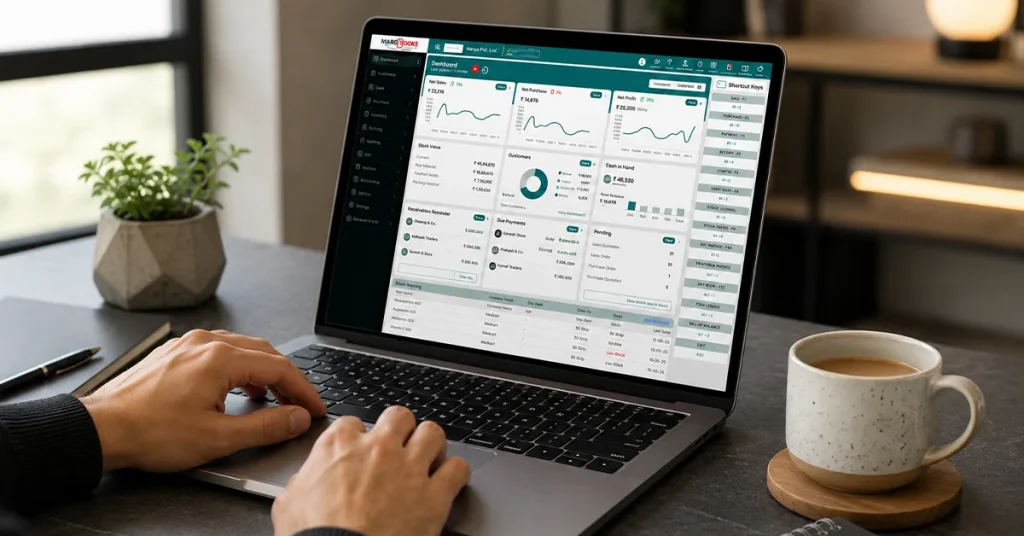
Key Features
- GST billing with barcode scanning, HSN/SAC auto-fill, and fully customizable invoice formats
- Automated e-invoicing with IRN generation and QR code embedding, compliant with current GSTN requirements
- One-click e-way bill generation without leaving the billing screen
- GSTR-1, GSTR-3B, and GSTR-2A reconciliation with direct filing automation
- Invoice sharing via WhatsApp and email directly from the billing interface
- Multi-branch stock management with centralised visibility, inter-branch transfers, and location-wise reporting
- Complete Accounting – Full Feature Set; Balance Sheet, Profit-and-Loss Statement, Ledger Controls, and Reconcile Bank to Billing
- Inventory tracking for Pharmacies, FMCG Distributors and Retailers – by Batch & Expiry / Multi Warehouse
Pros
- Genuine cloud access from any device — browser, tablet, or phone
- GST compliance built natively, not through workarounds or integrations
- Handles single-location billing and multi-branch operations on the same platform
- Free data migration from QuickBooks with full history, ledgers, and inventory records carried over
Cons
- No free plan — it is a paid product from the first month
- First-time cloud accounting users may need a short onboarding period to get comfortable
Best For:
Retailers, wholesalers, medical distributors, and Indian SMBs who want complete cloud accounting software with native GST compliance, inventory management, and multi-branch operations without switching platforms as they grow
2. Vyapar
Not every business needs a full accounting suite. A kirana store owner, a local hardware shop, or a regional trader running a one-person operation has a very different set of daily needs. Send an invoice, track who paid and who did not, keep a rough eye on stock levels, and have something to show the CA at the end of the quarter. Vyapar handles all of that without overcomplicating things.
The offline capability is what genuinely sets Vyapar apart in this segment. It works without internet, which matters more than people outside smaller towns might realise. You can create and print GST invoices, record payments, and check stock levels, whether or not the connection is stable that day.
Key Features
- Complete offline GST billing — invoices created and printed without any internet connection
- Basic inventory tracking and purchase order management for day-to-day stock control
- GSTR summary reports to share with a CA for manual filing
- Payment reminders and outstanding dues tracking across customers
- Profit and loss summary for a basic picture of business performance
- UPI and QR code payment collection built into the invoicing workflow
- Quotation and estimate creation with one-tap conversion to invoices
Pros
- Fully functional offline — no dependency on internet connectivity for daily billing
- Free plan covers the core features most small retailers actually use
- Straightforward enough that most users are billing on day one with no training
- UPI integration makes collections simple for cash-light operations
Cons
- Not designed for businesses with multiple branches or locations
- GST reporting is summary-level — not a substitute for proper cloud based GST billing software
- Financial reporting is basic and will not satisfy businesses that need detailed accounts
Best For:
Kirana stores, neighborhood retailers, regional traders, and solo merchants who need reliable offline GST billing with basic inventory tracking and simple bookkeeping
3. Busy Accounting
Trading and manufacturing businesses have always had a complicated relationship with accounting software. The stock movements are complex. The pricing structures involve schemes, discounts, and multi-level rates. The GST compliance touches every transaction. And the statutory reporting requirements leave no room for error.
Busy Accounting was built specifically for this kind of business. It has been a fixture in Indian trader and manufacturer accounting for years, and for good reason — it goes deeper on the things that actually matter for this segment than almost any other platform in the market.
Key Features
- Compliance with all facets of Goods and Services Tax (GST), such as GSTR-1, GSTR-3B, GSTR-2A/2B reconciliation, e-invoices, and e-way bills, can be fulfilled in one program.
- Multi-location inventory management by godown, batch, and serial number is also available.
- Manufacturing module covering bill of materials, production orders, and finished goods management
- Sales and purchase order management with multi-level pricing and trade scheme handling
- Payroll with PF, ESI, and TDS built in for Indian statutory requirements
- Multi-currency support for businesses with import or export transactions
- Branch and cost centre accounting for tracking profitability across divisions and locations
Pros
- Deeper Indian GST compliance than almost any other accounting software at this price point
- Inventory management built for the real complexity of trading and distribution businesses
- Decades of trust among Indian CA firms and finance teams
- Manufacturing accounting is handled without needing a separate production tool
Cons
- Primarily desktop-based — cloud access exists but is not as seamless as true SaaS platforms
- The interface is functional rather than modern — new users take some time to get oriented
- Mobile access is limited to a companion app rather than a full mobile experience
Best For:
Indian traders, manufacturers, distributors, and SMBs who need serious GST compliance, multi-location inventory management, and manufacturing accounting without paying enterprise software prices
4. FreshBooks
Freelancers and service businesses have a specific problem with QuickBooks — it was built for companies that have accountants. Most freelancers are not accountants. They are designers, consultants, writers, developers, and agency owners who need to get an invoice out quickly, track whether a client has paid, and have enough financial visibility to file their taxes at the end of the year. That is it.
FreshBooks keeps the accounting side simple enough that you can handle it yourself while making the invoicing side genuinely fast and professional.
Key Features
- Clean invoice creation with automated payment reminders and optional late fee enforcement
- Time tracking built directly into the platform and connected to project billing
- Expense logging with receipt capture through the mobile app
- Project profitability view showing hours spent and costs against what was billed per client
- Recurring invoices and retainer billing automation for ongoing client work
- Proposals and estimates that clients can approve online and convert to invoices with one click
- Multi-currency invoicing for working with international clients
Pros
- The fastest invoicing workflow of any tool in this comparison
- Time tracking and billing connected in a way that actually saves time each week
- Clean enough that non-accountants can manage their own books without a steep learning curve
- Mobile app is genuinely useful for capturing expenses and sending invoices on the go
Cons
- No inventory management — not suitable for product businesses
- GST compliance is too basic for Indian businesses with serious filing requirements
- Lower-tier plans restrict how many clients you can actively bill
Best For:
Freelancers and independent consultants require rapid, professional invoicing, timekeeping, and easy-to-use project billing.
5. TallyPrime
The reason that TallyPrime appears on nearly all accounting software lists for Indian companies is because of its superior functionality. Chartered accountants trust it. Finance teams rely on it. And for compliance-heavy businesses where GSTR reconciliation, e-invoicing, and audit-ready books are non-negotiable daily requirements, it remains the most thorough option available.
TallyPrime combines decades of trusted experience with a new, more user-friendly interface; more seamless connectivity; and greater automation. It also maintains the level of compliance that has made Tally the top choice for serious Indian accountants. TallyPrime does all of this while protecting the investment and depth of compliance that have established it as a long-time trusted brand in Indian accounting.
Key Features
- Automatically reconcile GSTR-1, GSTR-3B, & GSTR-2A with complete integration into the marketplace and accounting applications
- Generate e-invoices with the IRN generation process, include the QR Code for reference purposes, & create a simple process for cancelling an invoice.
- Generate e-way bills for shipping goods & monitor them until they arrive at their destination from the original invoice.
- An audit trail, balance sheet, profit/loss (P&L) statement, and multi-currency management are all critical components of total financial reporting.
- Godown-wise, batch-wise, and multi-location inventory tracking
- TDL-based customisation for businesses that need specific invoice formats or workflows
- Manufacturing and distribution accounting with bill of materials support
Pros
- The deepest GST compliance capability of any accounting software in the Indian market
- Trusted and understood by CA firms and finance teams across the country
- Highly customizable through TDL for businesses with specific reporting or workflow requirements
- Handles trading, manufacturing, and distribution accounting in the same platform
Cons
- Cloud functionality is partial — it is not a true cloud-first platform the way MargBooks is
- Takes time to learn properly — not the right choice for someone who wants to be up and running in a day
- Mobile access is through a companion app rather than a full mobile interface
Best For:
Businesses in India – including small & mid sized companies, Certified Public Accountants (CPA), retailers, & compliance-based entities – require the most thorough GST compliance, statutory financial reports, & audit-compliant financial statements.
How to Pick the Right QuickBooks Alternative for Your Business
| Choose | If You Need |
| MargBooks | Complete cloud accounting with native GST billing, inventory, and multi-branch management in one platform |
| Vyapar | Simple offline GST billing and basic bookkeeping for a small shop or solo trading operation |
| Busy Accounting | GST compliance & accounting for small businesses |
| FreshBooks | Quick facilitation of invoicing & billing for service providers & freelancers |
| TallyPrime | The most thorough GST compliance and statutory financial reporting available for Indian businesses |
Conclusion
QuickBooks works well for the market it was designed for. For Indian businesses dealing with GST compliance, multi-location inventory, and industry-specific accounting needs, the alternatives on this list do the job significantly better.
The right choice depends entirely on your business type. MargBooks for retailers and SMBs wanting complete cloud accounting in one place. Vyapar for small traders who need simple offline billing. Busy for manufacturers and distributors with complex inventory. FreshBooks for freelancers who just want to get paid faster. TallyPrime for businesses where compliance depth is the priority above everything else.
Start with what your business actually needs today — and make sure the platform can handle where you are headed next year.
FAQs
Q1. What is the best QuickBooks alternative for small businesses in India?
MargBooks covers the most ground for Indian small businesses — GST billing, e-invoicing, inventory management, and multi-branch accounting in one true cloud platform built specifically for Indian compliance requirements.
Q2. Which QuickBooks alternative works without internet for small retailers?
Vyapar works fully offline. You can create GST invoices, track payments, and manage basic stock without any internet connection — which makes it practical for smaller towns and areas with unreliable connectivity.
Q3. Which QuickBooks alternative suits trading and manufacturing businesses?
Busy Accounting handles the complexity that traders and manufacturers deal with daily — godown-wise inventory, scheme-based pricing, bill of materials, and deep GST compliance — better than any other option at its price point.
Q4. Which QuickBooks alternative is best for freelancers?
FreshBooks. It is faster to use, simpler to learn, and built around the invoicing and time tracking workflows that freelancers and consultants actually need — without the complexity that makes QuickBooks frustrating for non-accountants.
Q5. Which QuickBooks alternative has the best GST compliance for India?
TallyPrime and MargBooks are the two strongest options. TallyPrime for statutory depth and CA-level reporting. MargBooks for cloud-native GST billing, e-invoicing, and compliance built into the daily billing workflow.
Q6. Can you migrate data from QuickBooks to MargBooks?
Yes. MargBooks handles the full migration — accounting history, customer ledgers, inventory records, and financial data — with dedicated support included so the transition does not disrupt your operations.

Aman Kannojia is the Digital Team Lead at MargBooks. He started out as an SEO Specialist and never lost his love for words. With 5 years of experience across banking, SaaS, and finance, both domestic and international, he brings strategy, leadership, and storytelling together. He doesn’t just manage a team, he builds one that creates.