Retail Software
 Distribution Software
 Retail Chain

Best Khatabilling Alternatives for GST Billing and Invoicing in 2026

Khatabilling works fine when your biggest problem is remembering who owes you money. The khata feature is genuinely useful, the interface loads fast, and for a shopkeeper handling 20–30 transactions a day, it covers the basics without getting in the way.
The problem starts around the time your accountant first says the words “e-invoicing threshold.”
Once you cross ₹5 crore in turnover (and this limit has been coming down steadily), every B2B invoice needs an IRN number and a QR code generated through the government’s IRP portal. Khatabilling doesn’t do that. So either you’re logging into a separate portal for every invoice, or you’re hoping your CA catches it before a notice does.
That’s just one thing. Add GSTR reconciliation that you’re doing by hand, no e-way bill support when you’re dispatching goods, and zero ability to manage two shop locations under one GST number, and you start to see why businesses that started on Khatabilling eventually go looking for khatabilling alternatives. This guide covers the five tools most worth considering.
Top Khatabilling Alternatives in 2026
- MargBooks — Best Overall for Cloud GST Billing, Invoicing, Compliance & Inventory Management
- Vyapar — Best Offline GST Billing software for Small Retailers & Solo Traders
- myBillBook — Best for Mobile-First GST Invoicing for Micro Businesses
- TallyPrime — Best for Advanced GST Compliance, GSTR Filing & Financial Accounting
- Busy Accounting — Best for GST-Compliant Trading, Manufacturing & Multi-Warehouse Operations
Where Khatabilling Actually Falls Short
People are searching for Khatabilling alternatives not because they dislike using it, but rather when specific issues arise that cannot be resolved within the app itself.
The e-invoicing gap. IRN generation, QR code embedding, cancellation handling — none of this is built into Khatabilling. For businesses above the e-invoicing threshold, this means a parallel workflow on the government portal. Every single invoice.
GSTR filing is a manual job. Filing GSTRs is a chore as the app only records GST against invoices. To file the GSTRs, you’ll need to manually extract, clean, and reconcile your data with GSTR-2A through numerous spreadsheets either yourself or with the help of a CA. It does become exponentially more time-consuming if you’re processing many transactions.
Generating e-way bills – If your business sells goods worth more than ₹50,000 in value and you need to generate an e-way bill, you’ll have to revisit the website, as Khatabilling does not include this feature.
Multiple locations– If you own two retail stores or a small distribution company, Khatabilling does not allow you to manage consolidated GST billing, nor does it allow you to manage consolidated compliance across multiple locations.
Invoice templates are what they are. You get limited options for customisation. For some businesses, that’s fine; for others, sending a generic-looking invoice to a corporate buyer feels off.
None of this is a criticism of what Khatabilling set out to be. The application was created for easy use. However, GST compliance is becoming increasingly complex, while the app has not kept pace with the changes.
Comparison between Khata Billing Alternatives
Here is a detailed comparison between KhataBilling alternatives for proper understanding-
| Software | Best For | GST E-Invoicing | E-Way Bill | GSTR Filing | Mobile App |
| MargBooks | Cloud GST Billing, Invoicing & Distribution | Yes | Yes | Yes | Yes |
| Vyapar | Offline GST Billing for Small Retailers | Basic | Basic | Basic | Yes |
| myBillBook | Mobile-First GST Invoicing | Yes | No | Basic | Yes |
| TallyPrime | Advanced GST Compliance & Accounting | Yes | Yes | Yes | Companion App |
| Busy Accounting | GST Trading, Manufacturing & Multi-Warehouse | Yes | Yes | Yes | Companion App |
The Top 5 Khatabilling Alternatives for GST Billing in 2026
In this section, we are explaining the invoicing software that is Khatabilling alternatives in terms of features and other benefits-
1. MargBooks
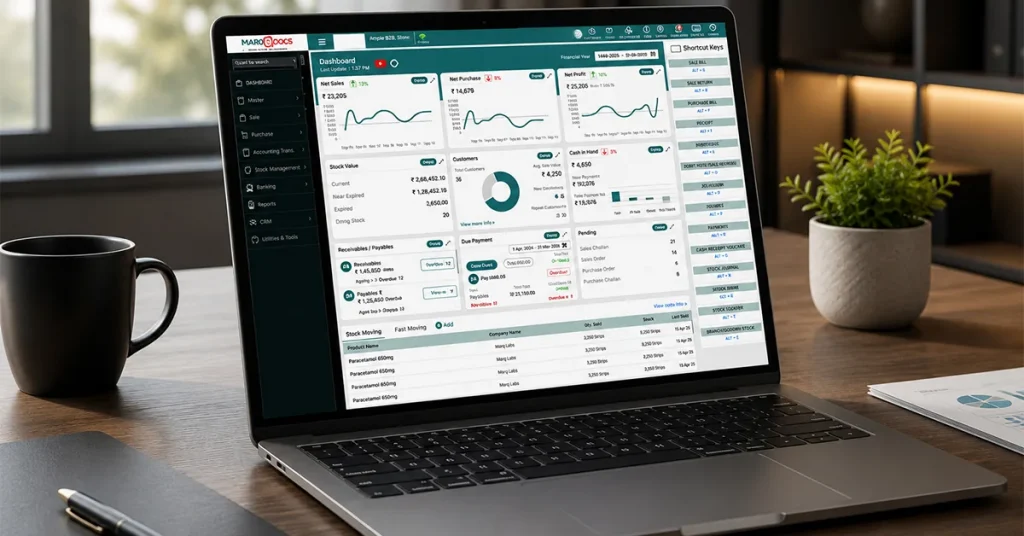
Marg has been building accounting and billing software for Indian businesses since 1992. MargBooks is their GST Billing software in cloud version — rebuilt from the ground up for browser and mobile access, rather than just taking desktop software and putting it online.
What this means practically: the GST compliance features aren’t afterthoughts. IRN generation, e-way bills, GSTR reconciliation — these are core to how the billing workflow is designed, not add-ons you activate separately.
When you raise an invoice in MargBooks, the system can generate the IRN and embed the QR code before you even share it with the customer. E-way bills get created from the same screen. The invoice goes out on WhatsApp or email directly. Your GSTR-1 data is already captured. That entire chain — which takes multiple tools and portal visits in Khatabilling — happens in one place.
For businesses with multiple locations, MargBooks handles centralised GST billing with consolidated compliance reporting. Stock transfers between branches are tracked with GST implications. All of it flows into a single set of financial books.
The inventory side is also notably deep. The app offers batch and expiration date tracking as well as multi-warehouse inventory tracking. This will be of interest if you’re a pharmaceutical company, in the FMCG distribution business, or any other industry that uses lot numbers as part of its compliance process.
Key features:
- Barcode scanning, HSN/SAC auto-fill, customizable invoice templates
- Automated IRN generation and QR code embedding for e-invoicing
- E-way bill generation from the invoice screen
- The application is set up to handle all GSTR-1, GSTR-3B, and GSTR-2A reconciliations and file them directly from the application.
- WhatsApp and email invoice sharing
- Multi-branch billing with consolidated compliance reporting
- The application also covers all areas of accounting, including month-to-month balance sheets, profit and loss statements, ledger management, and bank reconciliation for inventory that can be tracked through batch, expiry, and multiple warehouses.
- Free data migration from Khatabilling
Pros:
- Full GST compliance stack without needing separate portal visits
- Accessed from any device, whether it’s a smartphone, tablet or laptop.
- Grows as your business grows – from 1 branch to multiple branches all on the same software.
- Inventory depth is well above what most billing-focused tools offer
Cons:
- More than you need if your operation is very small and compliance-light
- The app is funded with a monthly subscription and not a one-time fee.
Best for: Retailers, wholesalers, distributors, and pharmaceutical businesses that are looking to have complete GST compliance as part of their billing solution rather than adding it to their billing solution after the fact.
2. Vyapar
Vyapar is popular for one reason most review articles undersell: it works without internet. Not “works with limited features offline”, actually works. If you don’t have an internet connection, you can create and print invoices, record your payments, and manage your entire set of books offline, and then once you’re on the internet, you can sync the data together.
For a shop in a market area with patchy connectivity, or a trader who moves between locations, this matters more than any compliance feature.
The GST coverage is solid for the use case. HSN/SAC codes, GSTIN on invoices, GST summary reports for reference when your CA files return. It won’t generate your IRN automatically or file GSTR for you, but it gives you the data you need to do it through other means.
Payment reminders and receivables tracking work well. The purchase order workflow is basic but functional.
Key features:
- Complete offline GST billing
- HSN/SAC code support and GSTIN on every invoice
- GST summary reports for CA handoff
- Payment reminders and receivables management
- Basic purchase order handling
Pros:
- Genuinely reliable offline functionality
- Familiar enough for Khatabilling users to get up to speed quickly
- Useful for managing what customers owe you alongside invoicing
Cons:
- No automated IRN generation for e-invoicing
- GSTR filing requires manual work outside the app
- Not ideal for multi-location management or complex inventory tasks.
Best for: Retailers and small trading businesses where offline billing and reliability are more important than total compliance automation.
3. myBillBook
myBillBook is designed for people who run their business from a phone and aren’t interested in learning desktop software. The invoicing software is built around the idea that creating a GST invoice should take under a minute and land in your customer’s WhatsApp before they walk out the door.
It handles that specific job well. GSTIN verification, HSN/SAC codes, invoice sharing via WhatsApp or SMS, smooth and fast. There’s a basic stock management feature and a payment tracking dashboard that works for simple operations.
The gaps are real, though. No e-way bill generation, which rules it out for any business that dispatches goods. GSTR filing is manual. Accounting depth is limited.
Key features:
- Fast GST invoice creation and WhatsApp/SMS sharing from mobile
- GSTIN verification and HSN/SAC support
- Basic GST summary reports
- Digital catalogue and stock alerts
- Payment tracking dashboard
Pros:
- Best mobile billing experience in this category
- Invoice-to-WhatsApp flow is genuinely quick
- Low learning curve for micro-business owners
Cons:
- No e-way bill support
- Not suitable once GST compliance gets complex
- Limited accounting and inventory capability
Best for: Retail owners, kirana stores and independent vendors needing fast invoicing on a mobile device and WhatsApp for delivery.
4. TallyPrime
Tally has been the standard for Indian business accounting for decades. TallyPrime is the current version, and if your primary concern is GSTR filing accuracy and audit-ready financial books, nothing touches it.
The compliance features go deep. GSTR-1, GSTR-3B, GSTR-2A reconciliation, direct filing integration, e-invoicing with full IRN and cancellation management, e-way bill generation. The audit trail is comprehensive. The statutory reporting covers every scenario a CA would need.
The tradeoff is that Tally is desktop-first. There’s a companion app for mobile access, but it’s not the same as a cloud-native platform. Takes more effort to implement than plug-and-play invoicing with billing systems that are strictly clean and simple.
Key features:
- GSTR-1 , GSTR-3B, GSTR-2A reconciliation with Electronic Filing
- Electronic Invoices with IRN, QR Code, Cancellation Management.
- E-way bill generation from transactions
- Complete record-keeping, Balance Sheet, P/L, Multi-Currency
- Requires significant implementation effort
- More expensive than invoicing systems as additional costs may apply
Pros:
- Deepest GST compliance in the market
- Trusted by CAs across India
- Comprehensive statutory and audit reporting
- Large partner ecosystem
Cons:
- Desktop-first; mobile access through a companion app only
- Requires meaningful implementation effort
- Higher cost, especially with add-ons
Best for: Medium sized businesses, CPA firms, and financial Departments for GSTR filing accuracy and financial reporting detail.
5. Busy Accounting
Busy is built for businesses where billing connects directly to warehouse operations and production. A sales invoice creates a stock movement, which has GST implications, which ties back into a production order. The software handles that entire chain.
For a trading business managing multiple godowns, or a manufacturer tracking raw material consumption against finished goods, Busy’s structure makes sense in a way that pure billing tools don’t.
GST compliance is solid — e-invoicing, e-way bills, GSTR filing all built in. The multi-location warehouse management and inter-branch transfer tracking with GST implications is particularly well thought through.
Like Tally, it’s desktop-based. Not a mobile-first or cloud-native product.
Key features:
- GST invoicing purpose, manufacturing and services
- E-invoicing, e-way bill, and GSTR filing in the billing workflow
- Multi-warehouse and inter-branch stock transfer with GST tracking
- Manufacturing BOM and production order management
Pros:
- Strong for businesses where billing and operations are tightly linked
- Good multi-warehouse and distribution management
- Full GST compliance coverage
Cons:
- Desktop-based
- More than needed for straightforward retail billing
- Requires setup and training investment
Best for: Manufacturers, material processers and mid-size wholesale merchant trades that utilize integrated billing which is compliant with GST to manage production and warehouse activities.
How to Choose the Right Khatabilling Alternative
| Choose… | If you need… |
| MargBooks | Complete cloud-based GST billing system that includes, e-invoicing, e-way bill, GSTR filing, Inventory management and multi-branch management, all in a single scalable solution. |
| Vyapar | Reliable Offline GST Invoicing Solution with basic compliance summary functionality specifically for Micro-Shops & Sole Retailers. |
| myBillBook | Fast mobile GST invoice creation and WhatsApp sharing for micro-businesses |
| TallyPrime | Advanced GSTR filing automation, e-invoicing compliance & deep financial accounting |
| Busy Accounting | GST-compliant billing tied to multi-warehouse trading, manufacturing & production workflows |
Conclusion
Khatabilling does what it was designed to do. The question isn’t whether it’s bad — it’s whether it still fits where your business is headed.
If e-invoicing is now mandatory for you, or you’re spending meaningful time on GSTR reconciliation every month, or you’ve opened a second location and the billing situation has become messy, staying on Khatabilling is costing you more than you think. Just not in a way that shows up as a line item.
For most businesses in that position, MargBooks software is worth looking at first. The compliance features cover everything from IRN generation to GSTR filing, the inventory side is deep enough for distributors and pharma businesses, and it scales to multiple branches without needing to switch software later. They also migrate your data from Khatabilling for free, so the switching cost is lower than it sounds.
If you’re smaller and primarily need offline reliability, Vyapar. If everything happens on your phone and the transactions are simple, myBillBook. If your CA is driving the decision and compliance depth is everything, TallyPrime. The gap is going to be finding out which solution matches how you actually do your billing.
FAQs
What is the best Khatabilling alternative for GST billing and invoicing?
MargBooks, the best khatabilling alternative covers the entire GST billing process (E-Invoicing with IRN generation, E-Way Bill Creation, GSTR-1/3B & 2A Reconciliation and Filing, Multi-Branch Billing and Inventory Management) all within a single cloud-based solution.
Which Khatabilling alternatives support e-invoicing in India?
MargBooks, TallyPrime, and Busy Accounting all handle automated IRN generation and QR code embedding. Out of the three solutions, MargBooks has the most direct integration with your daily billing workflows as opposed to treating compliance as a separate function from your day-to-day operations.
Is there a cloud-based Khatabilling alternative for GST billing?
MargBooks and myBillBook are both cloud-native. MargBooks is the more complete option if you need compliance and inventory alongside invoicing. myBillBook is better suited if mobile-first invoice creation and sharing is the main requirement.
Which Khatabilling alternative is best for GSTR filing automation?
MargBooks handles GSTR-1, GSTR-3B, and GSTR-2A reconciliation with filing integration. TallyPrime goes deeper on statutory compliance and audit trails — better suited for CA firms or businesses where the finance team drives the process.
Which Khatabilling alternative works offline for GST billing?
Vyapar. It’s the most reliable offline-first option, built for full GST invoice creation and basic compliance reporting without requiring internet access.
Does MargBooks support data migration from Khatabilling?
Yes. MargBooks migrates GST invoice history, customer ledgers, inventory masters, and financial records from Khatabilling as part of onboarding.

Aman Kannojia is the Digital Team Lead at MargBooks. He started out as an SEO Specialist and never lost his love for words. With 5 years of experience across banking, SaaS, and finance, both domestic and international, he brings strategy, leadership, and storytelling together. He doesn’t just manage a team, he builds one that creates.