Retail Software
 Distribution Software
 Retail Chain

12 Retail Pricing Strategies Every Business Should Use to Price Products Right


If you ask ten shopkeepers how they price their goods, five of them will probably shrug their shoulders and say they are charging a price that is similar to other shopkeepers. The other half will tell you they added their usual margin and moved on. Neither answer is entirely wrong, but neither is a particularly effective strategy; it’s just a habit.
And habits work fine until they don’t. A supplier raises rates, a new competitor opens two shops down, footfall dips for no obvious reason, and suddenly the price that “always worked” is quietly eating into profit nobody noticed was gone.
Pricing deserves more thought than that. Not endless spreadsheets and A/B tests (unless you’re running a large e-commerce operation, in which case, sure), but a basic understanding of the different ways prices can be set, and when each one actually makes sense.
Here are 12 of them, the ones that show up again and again across retail, along with where they help and where they can quietly backfire.
What is a Retail pricing strategy?
Simply saying that the retail pricing strategy is the rationale behind a proposed price. One has to ask: What is wrong with offering ₹499 instead of ₹450? What makes prices different among the competitors in the market? Is it relevant at all? There are three components to each pricing decision: the cost of producing the item, consumer perception, and where you want to position yourself compared to other market participants.
A mistake in one of the above may lead to a debacle that will only be discovered when the financial report is released.
The 12 Retail Pricing Strategies
1. Cost-plus pricing: is where almost everyone starts, and there’s no shame in that. Work out what the product costs you, add a markup that feels fair, and that’s your price. A shirt sourced at ₹400 with a 50% markup sells for ₹600, simple math, no guesswork. This works well for small shops and stores that do not find a reason to change their prices frequently. However, the moment we pause and begin thinking in terms of the point made, we see the problem: it does not indicate whether the customers feel that ₹600 is reasonable at all, or if the fur shop nearby sells the same fur coat for ₹500.
2. Competitive pricing: It shifts the focus. This means that instead of focusing on your own cost base, you should rather be concentrating on the prices charged by other stores for similar products, and setting your price keeping that in mind, either by matching it, slightly underselling it, or just going above if your service or location allows. For instance, if three stores in the vicinity sell phone covers for ₹299, pricing yours at ₹279 might just be enough for you to make the sale without starting a price war that none can win. Used carelessly, though, this is exactly how price wars start, everyone chasing everyone else downward until margins disappear for the whole street.

3. Value-based pricing: focuses on a different question altogether: instead of asking, what has it cost me, it concentrates on what its value is to those purchasing it. A cosmetic company sells a lotion for ₹1,200 while actually producing it at a small fraction of the selling price; customers trust the lotion’s effectiveness for their skin. This concept is perfectly functional provided that product branding and trust exist. Should it be absent, the price may be perceived as a rip-off.
4. Psychological pricing: Psychological pricing is used with great success, as in the case of just ₹999 instead of ₹1,000. People read the number from left to right, giving more significance to the first digit. For example, when the product is sold for ₹500 instead of ₹499, it seems like a completely different price, though the price difference is only one rupee. Use it everywhere, and it stops working, though customers do eventually notice when every single tag ends the same way.
5. Penetration pricing: means launching cheap on purpose, to get people in the door and build a customer base fast, with the plan to raise prices gradually once you’re established. New grocery delivery apps do this constantly, half-price first month, standard pricing after. It’s a solid way to steal market share quickly. The risk shows up later: raise prices too fast or without warning, and the same customers you worked to attract feel tricked into leaving.
6. Price skimming: runs the opposite direction, launch high, while the product is new and desirable, then bring the price down as competition catches up. New phones do this every release cycle. It generates maximum profit from early users who are ready to pay for the privilege of being the first consumers. Don’t be surprised, though, if people who care about prices refrain from purchasing products until the price drops.
7. Bundle pricing: markets different products at a lower price compared to purchasing them separately. It’s a good way to move slower stock alongside bestsellers and nudge up the average basket size. The problem is that when you don’t do it carefully, you might accidentally encourage the discounting of the product you shouldn’t have discounted.
8. Discount pricing: When you have sales, celebrations, clearance offers, and other seasonal discounts. Used now and then, it clears stock and creates urgency. Used constantly, it trains your own customers to simply wait for the next sale instead of ever paying full price, which is a slower kind of damage but real damage nonetheless.
9. Dynamic pricing: adjusts in real time based on demand, surge pricing on a cab app during rush hour, or an online listing that quietly climbs when stock is running low, and interest is high. Done well, it captures value that fixed pricing leaves on the table. Done without proper data behind it, it’s just guessing with extra steps, and customers notice the inconsistency fast.
10. Premium pricing: The premium pricing strategy means you deliberately charge more for the product, as part of the appeal of the product is in the price. If your handbag costs ₹15,000, while another practically the same handbag costs ₹3,000, it means that you have sold a story about exclusiveness rather than leather.
11. Loss leader pricing: sells one product near cost, or even at a small loss, purely to get people through the door. Supermarkets do this constantly with milk or eggs, betting customers will fill the rest of their basket at normal margins. It works, but only if people actually buy other things once they’re there. If people take the milk away without paying for anything else, they will only have left something for donation, not a sale.
12. Anchor pricing: It presents an inflated ‘original’ price that has been crossed out next to the real price of ₹2,000, ₹1,299, to create the perception that the current price is a significant deal. It works well because individuals refer to relative judgment of prices. It only works honestly, though, if that original price was ever actually real. Inflate it just to inflate the “discount,” and customers who catch on stop trusting your prices altogether.
How to Choose the Right Pricing Strategy for Your Business
Nobody runs on a single strategy for long. Most retailers end up mixing two or three depending on what they’re selling and what season it is, and honestly, that’s fine, you’re not being inconsistent, you’re just being realistic. Before settling on anything, I’d sit with a few questions first. How predictable are your costs month to month? In case the margins are thin, using only a cost-plus pricing strategy may not be enough; the pricing strategy may require combining it with either a value-based or a competitive pricing strategy. How can customers simply figure out how your prices compare with those of the shop next to yours? Commodity goods leave you almost no room to move; something genuinely different gives you a lot more. And what are you actually trying to do this quarter, win new customers, protect the margin you’ve got, or just get old stock off the shelf before it goes stale? Each of those points is somewhere different. Data matters more than people give it credit for, too. Dynamic pricing sounds great in a pitch deck, but it falls apart fast without real numbers behind it. A spreadsheet someone half-updates every couple of weeks isn’t going to cut it.
Common Pricing Mistakes Retailers Make
I personally observed the same few pricing problems occurring repeatedly. One of the problems is pricing out of fear, cutting prices without questioning whether the price would still be profitable. It usually doesn’t. Then there’s ignoring perceived value entirely, treating every single product like a commodity, even when customers would gladly pay more for better service or packaging, or just trusting the brand more. There’s also the price that gets set once, at launch, and then never looked at again, while costs and competitors and whole seasons shift around it untouched. And under most of these sits the same root problem: pricing by feel because nobody’s actually tracking the real numbers behind the decision in the first place.
Why does this really come down to visibility?
Almost all of the mistakes above trace back to one thing: not knowing, with any real precision, what a product costs you once wastage and overheads, and purchase price are all added up. It’s hard to price something with any confidence when that number is fuzzy in your head.
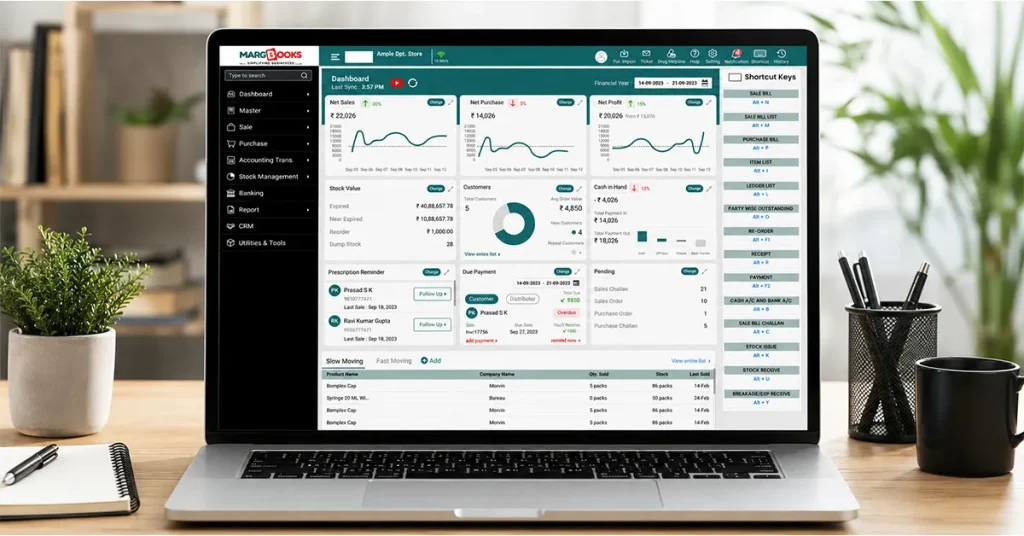
This is honestly where decent billing and inventory software earns its keep. MargBooks gives retailers a live view of purchase costs, stock movement, and margins per product, so the pricing call rests on actual numbers instead of a vague sense of things. Supplier changes their rate on you? You see the hit to your margin right away, instead of finding out three months later when you’re staring at a P&L wondering where the money went.
Conclusion
There’s genuinely no single retail pricing strategy that’s right for every product or every business; that’s just not how pricing works, no matter how many “ultimate guides” claim otherwise. What actually matters is knowing your own costs cold, paying real attention to your customers, and being willing to change course when the market shifts under you. Try to pick two or three things mentioned above that fit your business today, use them, and monitor the margins you achieve. Apart from this, use MargBooks Software, which will help you to manage the inventory, and hence you can strategize better for your business.
FAQs
Q1. What’s the most common retail pricing strategy?
Cost-plus, easily, mostly because it’s the least effort to calculate, and it guarantees some margin on every single sale without needing much data behind it.
Q2. How do small businesses usually land on their pricing in the first place?
Most companies start with the cost-plus pricing strategy, later adjusting their prices based on the prices of competitors.
Q3. Cost-plus versus value-based, what’s the actual difference?
Cost-plus starts from what the thing costs you to source or make. Value-based starts from what the customer thinks it’s worth, and doesn’t really care what it costs you. Same product, completely different starting point.
Q4. Which strategy works best for a brand-new product launch?
Depends on what you’re optimising for, honestly. Go with penetration pricing if you want market share fast. Go with price skimming if the product’s unique enough that early buyers will happily pay a premium for being first.
Q5. How often should prices actually get revisited?
Every few months at the very least, or the second supplier costs, or competitor pricing, or demand shifts in any noticeable way. A price that only gets looked at once a year is usually already out of step with reality by the time anyone bothers checking.

Aman Kannojia is the Digital Team Lead at MargBooks. He started out as an SEO Specialist and never lost his love for words. With 5 years of experience across banking, SaaS, and finance, both domestic and international, he brings strategy, leadership, and storytelling together. He doesn’t just manage a team, he builds one that creates.