Retail Software
 Distribution Software
 Retail Chain

7 Problems a Distributor and Consumer Management System Can Solve for Modern Businesses

Most businesses running distributor networks know the frustration well: your sales team is on calls chasing order updates, your regional manager is working off a spreadsheet that’s already three days old, and somewhere in the chain, a shipment went to the wrong location because someone missed an email. And yet, this is how thousands of FMCG and pharma companies still operate.
The complexity only deepens when you factor in what these industries actually deal with : multiple distributor tiers, hundreds of active SKUs, strict regulatory requirements, pricing schemes that change by region, and a consumer base you can barely see through the distribution fog. A general CRM won’t cut it. Neither will a legacy ERP that was never designed for the ground reality of secondary and tertiary sales.
That’s where a Distributor and Consumer Management System comes in, purpose-built to handle the full complexity of modern distribution. Whether you’re looking for reliable FMCG Distribution Software or a robust Pharma Distribution Billing Software, the right inventory management system addresses challenges that no spreadsheet ever could.
Here are 7 critical DCMS problems it solves.
Problem 1: You Have No Real Visibility Into What’s Happening Across Your Network
Your distributor sent a weekly report. It’s Tuesday. The report is from last Friday. A lot can go wrong in four days and often does.
Sales managers and regional heads operating without real-time data are essentially flying blind. You don’t know which distributors are holding excess stock, which regions are showing weak sell-through, or where a stockout is quietly forming until a complaint lands on your desk.
For FMCG companies, this is particularly costly. Fast-moving SKUs have narrow windows. A two-day visibility gap between a distributor’s warehouse and your dashboard can mean missed restocking, pile-up of slow movers, or complete stockouts during a peak period, all without early warning.
For pharma, the stakes are different but no less serious. Batch-wise inventory tracking and expiry visibility aren’t just operationally useful; they’re compliance requirements. Knowing where a specific batch is sitting and when it expires is non-negotiable.
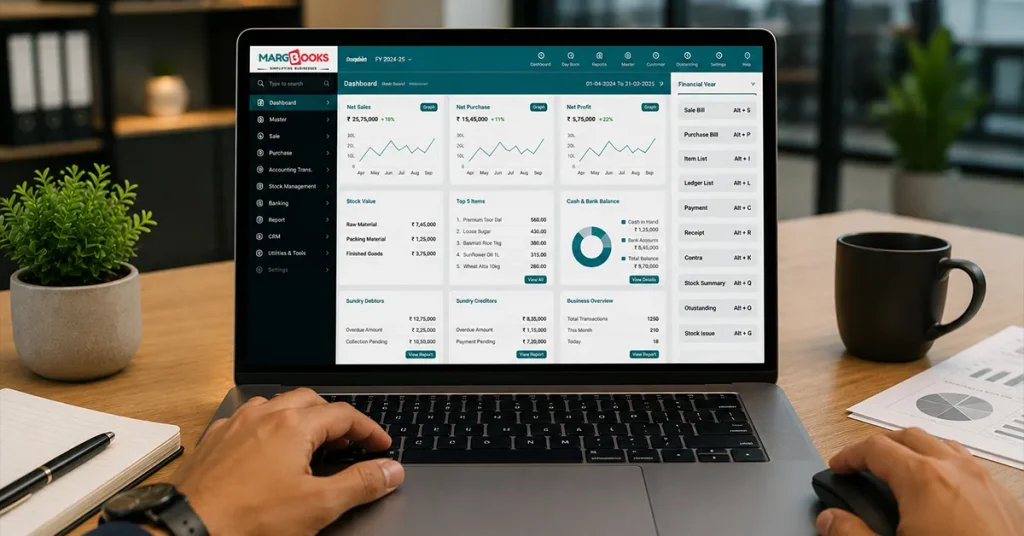
A Distributor Management System solves this with a unified dashboard that gives you live stock levels, order status by distributor, and regional performance at a glance. With the right FMCG Distribution Software, your team stops reacting to problems and starts getting ahead of them.
Problem 2: Order Management Is Still Running on Calls, Emails, and Guesswork
Every missed order, every duplicate entry, every delayed dispatch that happens because someone didn’t see an email in time, that’s not just an operational inconvenience. It’s a revenue and relationship problem.
Order management teams in high-volume distribution environments face a relentless flow of incoming requests. When those requests arrive through WhatsApp, phone calls, emails, and occasionally a fax (yes, still), the chances of something going wrong multiply fast. Distributors get frustrated. Deliveries slip. Billing gets tangled.
FMCG businesses run particularly high order frequencies. With hundreds of SKUs moving across dozens of distributors simultaneously, manual processing simply doesn’t scale. Errors become inevitable, and the cost of fixing them, in time, credits, and distributor trust adds up.
In pharma, a wrong order is more than a logistical nuisance. Incorrect products or quantities for regulated medicines can trigger compliance issues and, more importantly, can affect patient safety downstream.
A Distributor and Consumer Management System automates the full order lifecycle from placement and approval through dispatch and invoicing inside a single platform. This is also where Pharma Distribution Billing Software integration pays off: every order flows directly into billing, eliminating manual reconciliation and reducing errors at the invoicing stage.
Problem 3: Inventory Is Either Piling Up or Running Out — Rarely Just Right
Overstocking ties up capital. Understocking loses sales. Both damage your relationship with distributors who are trying to run their own businesses profitably.
The root cause is usually the same: inventory decisions are being made on incomplete, outdated, or disconnected data. Finance doesn’t know what the supply chain knows. The supply chain doesn’t know what sales just promised. And the distributor on the ground is managing their own stock with little visibility into what’s coming their way.
For FMCG businesses, this becomes particularly acute around promotional periods and seasonal demand spikes. If your system can’t anticipate a surge in demand for a product two weeks before a major festival, you’ll either be scrambling to replenish or sitting on dead stock once the window closes.
For pharma, the inventory challenge has an additional dimension: near-expiry stock management. Products approaching their expiry date need to be flagged, prioritized for dispatch, and in the worst case efficiently recalled by batch. Spreadsheets are unable to provide the level of accuracy that is needed in this instance.
A quality Distributor and Consumer Management System provides centralised inventory tracking, automated low-stock alerts, and demand forecasting tools. These resources take into account historical movement, seasonal trends, and distributor performance data.
An added benefit of using a dedicated FMGC Distribution Software solution is that they not only provide the tools mentioned above, but will also allow you to implement demand-driven replenishment, allowing you to maintain a lean supply chain as well as preventing out-of-stock items within your distribution network.
Problem 4: Your Consumers Are a Blind Spot
Here’s a problem that doesn’t always get framed as a distribution problem, but it is: you’re selling millions of units through a network of distributors and retailers, and you have almost no direct insight into who’s buying, how often, what they prefer, or whether they’re loyal to your brand or just buying what’s available.
This matters because the distributor is not your customer in the truest sense — they’re a channel. The consumer at the end of that chain is where brand equity is built or lost. Yet most distribution software leaves this relationship entirely unaddressed.
For FMCG companies, consumer loyalty programs and direct-to-trade engagement have become genuine brand differentiators. Knowing which retailers are your strongest performers, which outlets drive repeat purchases, and which regions show declining brand affinity gives your marketing team something to actually work with.
For pharma, tracking chemist and retailer buying behavior is how you measure real market penetration. It tells you whether your MR’s territory is converting prescriptions into actual pharmacy purchases, or whether a competitor is capturing that demand.
A Distributor and Consumer Management System closes this gap with consumer data capture, loyalty program management, and engagement tracking built into the same platform handling your distributor operations. This is also why a standalone Pharma Distribution Billing Software falls short: billing data without consumer-side intelligence leaves half the picture dark.
Problem 5: Claims, Returns, and Disputes Are a Slow, Painful Process
Ask any distributor relationship manager what keeps them busy, and claims will be near the top of the list. Damage claims, shortage claims, scheme payout disputes, expiry returns, they pile up fast and take forever to resolve when the process is manual.
The typical flow looks something like this: a distributor raises a claim via email, your team asks for supporting documents, those documents arrive in a different email thread three days later, someone manually calculates the credit note amount, finance takes another week to process it, and the distributor who has been following up every other day, finally gets a resolution three weeks after the original claim. That’s not a process. That’s organized friction.
For FMCG companies running high volumes of trade promotions and schemes, the volume of claims this generates is enormous. Manual reconciliation becomes a bottleneck that strains both internal teams and distributor relationships.
For pharma, claims carry additional complexity. Batch returns, expiry-based adjustments, and compliance-linked documentation requirements make pharma claims uniquely demanding. This is precisely the use case where Pharma Distribution Billing Software with integrated claims management stops being a nice-to-have and becomes essential — the billing record, the batch data, and the claim should all live in the same system.
A Distributor and Consumer Management System replaces this chaos with a structured claims workflow: digital submission, document attachment, real-time status tracking, and automated credit note generation. Claims stop being a source of friction and become a managed, auditable process.
Problem 6: Trade Schemes Are Leaking Value Somewhere and You Can’t See Where
Trade schemes are one of the most powerful tools in a distributor network and one of the most commonly mismanaged. Schemes get miscommunicated. Eligibility criteria are applied inconsistently. Some distributors find loopholes; others don’t claim benefits they’ve earned. And when it’s all running on spreadsheets and manual tracking, you often don’t know what’s happening until the quarter closes.
FMCG companies are particularly exposed here. Running dozens of concurrent schemes, primary, secondary, and tertiary across multiple regions and distributor tiers is inherently complex. A regional scheme meant for certain distributors in one geography gets accidentally applied elsewhere. A time-bound promotional scheme keeps running past its window because someone forgot to update the tracker. These aren’t edge cases; they’re common occurrences in manually managed environments.
Pharma has its own version of this problem. MR-driven schemes and chemist incentive programs need careful tracking to ensure the right people are getting the right benefits and that the investment is actually translating into sales performance.
A Distributor and Consumer Management System brings digital scheme configuration with eligibility rules built in, automated application at the point of order, and real-time performance tracking so you can see which schemes are working and which are draining budget without impact. For companies managing complex, multi-tier promotions, this is where well-designed FMCG Distribution Software pays for itself.
Problem 7: Your Reporting Is Too Late, Too Inconsistent, and Too Shallow
Leadership shouldn’t have to wait until Friday to know how the week went. But in most distribution-driven organisations, that’s exactly the situation: reports compiled manually from multiple sources, formatted differently by different regions, and arriving just in time to be mostly irrelevant.
The problem isn’t a lack of data. It’s that the data lives in silos. Sales data is in one system. Inventory is tracked separately. Distributor performance lives in a regional manager’s spreadsheet. When these don’t talk to each other, you can’t get a single, reliable view of the business.
For FMCG companies, the reporting needs are specific and demanding: secondary sales tracking, beat-wise coverage data, outlet-level performance, and scheme redemption rates, all of which require a system that captures the right data at the right point in the distribution chain.
For pharma, the reporting requirements include MR performance by territory, product-wise prescription trend data, and distributor billing analytics. These are the reports that drive field force decisions and marketing spend, and they’re core to what Pharma Distribution Billing Software should be providing as a matter of course, not as an afterthought.
A Distributor and Consumer Management System integrates these data streams into a single analytics layer: real-time dashboards, KPI tracking, and a custom report builder that gives every level of the organization from the regional manager to the CXO, the view they actually need. When this is done right, it connects the dots between FMCG Distribution Software capabilities and pharma billing intelligence in one coherent picture.
Why Generic Software Falls Short
Many decision-makers will ask the following question at this stage: can’t we simply re-configure an existing ERP/CRM system to do this? The answer to that question is not really.
Generic enterprise tools are built for horizontal use cases. They don’t have distributor onboarding workflows, secondary sales capture, or consumer loyalty modules out of the box. Configuring them to approximate these capabilities is expensive, slow, and usually results in a system that works for the general case but fails on the industry-specific edge cases that matter most.
FMCG Distribution Software and Pharma Distribution Billing Software need to be purpose-built for the realities of distribution-led businesses, the SKU complexity, the multi-tier network structure, the compliance requirements, and the speed at which things need to move. A purpose-built Distributor and Consumer Management System addresses all of this without requiring years of customisation to get there.
Conclusion
Distribution networks are complex by nature. But the problems that slow them down, poor visibility, manual order chaos, inventory imbalances, disconnected consumers, claim bottlenecks, scheme leakage, and shallow reporting, are not inevitable. They’re solvable.
Whether you operate in FMCG or pharma, these challenges show up in some form across every distribution-led business. And the businesses that address them systematically, rather than patching them one spreadsheet at a time, are the ones that scale distribution as a genuine growth engine rather than an operational drag.
A Distribution Management System isn’t just a software upgrade. It’s the infrastructure that lets your distribution network work the way it was designed to.
If you’re evaluating options or want to see how this works for your specific network, whether you need FMCG Distribution Software, a Pharma Distribution Billing Software, or both, we at MargBooks Software would be happy to walk you through a tailored demo. Talk to our team and see what your distribution operations could look like with the right system behind them.
FAQs
Q1. We already use an ERP. Do we need a separate Distributor and Consumer Management System on top of it?
Most ERPs handle internal operations well, such as finance, procurement, and manufacturing. What they don’t handle is the external distribution layer: secondary sales capture, distributor-level scheme tracking, consumer loyalty, and field-level reporting. MargBooks is designed to fill exactly that gap. It works alongside your existing ERP, pulling billing data from one side while capturing distribution intelligence on the other. You don’t replace your ERP; you extend its reach into the channel with a system that actually understands how distribution works on the ground.
Q2. How long does it typically take to onboard distributors onto a system like MargBooks?
This depends on your network size and how digitally ready your distributors are, but MargBooks is built for relatively fast onboarding. The distributor-facing interface requires minimal training — most tasks like order placement, stock checking, and scheme tracking are designed for field use, not office use. The bigger effort is usually upfront data preparation: cleaning your SKU master, pricing structures, and scheme configurations before go-live. Companies that invest in that groundwork typically have their networks live and operational within 6 to 12 weeks.
Q3. Our distributors aren’t very tech-savvy. Will they actually adopt this?
This is one of the most common concerns and a fair one. With MargBooks, adoption tends to happen faster than expected because the value is immediately visible to distributors themselves. When a distributor can check their outstanding claims, see their scheme earnings in real time, and place orders without calling your sales team, they have a direct reason to use it. The interface is built for simplicity, with a few taps for the most common workflows. The companies that see the strongest adoption are usually the ones that show distributors what’s in it for them, not just what’s in it for head office.
Q4. How does MargBooks handle compliance requirements specific to pharma distribution?
Pharma distribution has requirements that generic software simply wasn’t built for batch-wise inventory tracking, expiry management, and audit-ready documentation for claims and returns. MargBooks addresses these as core features, not afterthoughts. Batch traceability, near-expiry alerts, and recall readiness are built into the inventory layer, while the Pharma Distribution Billing Software functionality ensures every transaction is documented and auditable. For pharma companies managing regulatory scrutiny at the distribution level, this isn’t optional infrastructure; it’s the foundation.
Q5. What’s the difference between primary and secondary sales tracking, and why does it matter for my business?
Primary sales are what you invoice to the distributor. Secondary sales are what the distributor sells onward to retailers or chemists. Most companies have reasonable visibility into primary sales because it runs through their own billing. Secondary sales is where the real market intelligence lives; it tells you what’s actually moving at the outlet level, which regions are absorbing demand, and whether your end-market is responding to your schemes and promotions. Without it, you’re measuring how full the pipeline is, not whether anything is coming out the other end. MargBooks captures both layers within a single Distributor and Consumer Management System, which is what makes the reporting genuinely useful for decisions, not just for records.

Aman Kannojia is the Digital Team Lead at MargBooks. He started out as an SEO Specialist and never lost his love for words. With 5 years of experience across banking, SaaS, and finance, both domestic and international, he brings strategy, leadership, and storytelling together. He doesn’t just manage a team, he builds one that creates.