Retail Software
 Distribution Software
 Retail Chain

How the Right Garment Barcode Label Saves Time and Boosts Sales

Let me ask you something, honestly. How many times has your billing counter slowed down because a tag was missing from a garment?. Your staff typed the wrong price for a garment because they were in a rush?. You lost track of how many pieces of a particular size of garment were left in your stock?
If you own a garment store, it does not matter if it is big or small; you already know these problems with your garment store. These things happen at your garment store every week.
Most store owners I talk to are still trying to fix these problems. They add staff. They do manual checks. They spend Sunday evenings sorting out stock. This work is exhausting. It still does not fully solve the problem. The real fix is simpler than you think. It starts with something as basic as the label on your garment.
What Exactly Is a Garment Barcode Label
A garment barcode label is the tag on a piece of clothing that stores all the information about the product in a way that can be scanned. When the person who handles the bills scans it the system will know away what the product is called, what size it is, what colour it is, how much it costs and what the tax is. No typing needed.
Most people look at a barcode label and think it is just a price tag with some lines on it. But it is actually doing a lot more work behind the scenes. Every time it is scanned, it is updating your stock count, recording a sale, and feeding data into your reports. It is quietly running your back office while your staff focuses on the customer in front of them.
The difference between a garment business that runs smoothly and one that is always firefighting often comes down to whether they have the right labelling system in place.
Not all Barcode Labels for clothes are the same
This is where a lot of people who own stores make a mistake. They choose the label without thinking about where the label will be used and what it needs to do.
Here is a quick look at the types of barcode labels for clothes and when each one is a good choice
Hang tags are used the most. You can see them on every piece of clothing in a store that sells things to people who will use them. The hang tag contains the company name, the price shown on the product, the size, and the bar code, all of which can be found on the tag.
Woven labels are affixed to a garment via sewing (generally at the neck or waistband). They typically last through several hundred washes or more, depending on how well they are sewn in place. They are more expensive but are the right choice for premium garments or anything where the label needs to last the life of the product.
Printed Labels are the go-to for high-volume businesses. If you are moving hundreds or thousands of pieces every month, printed labels let you produce what you need quickly and cheaply without sacrificing scan quality.
Adhesive Sticker Labels are for temporary use. When you think about it, people use these labels for things like sorting in a warehouse, processing returns or tagging items that come in without any labels. These labels do the job. They are not meant to stay on the clothes for a time.
One type of label is the QR Code Label. A customer can use their phone to scan the QR Code Label and check if a product is real, read how to take care of the product or get help after they buy the product. This is great for brands that want to give their customers an experience.
Care and Size Combo Labels pack the compliance information and the barcode into one label. Practical and cost-saving for businesses that want to reduce the number of labels per garment.
| Label Type | Best For | How Long It Last |
| Hang Tag | Retail billing, display | Short term |
| Woven Label | Premium garments, brand quality | Very long term |
| Printed Label | High volume, fast fashion | Medium term |
| Adhesive Sticker | Returns, warehouse use | Short term |
| QR Code Label | Customer engagement, authentication | Medium term |
| Care and Size Combo | Compliance and billing combined | Long term |
What Happens When You Have the Wrong Label
A bad garment barcode label does not just look unprofessional. It actively costs you money and wastes your team’s time, often in ways you do not even notice day to day.
Here is what I see in stores that are using poor-quality labels or no labels at all.
The barcode fades or smudges after a few weeks. Your billing staff cannot scan it. So they type the product code manually. They mistype it once every ten transactions. That one error causes a billing dispute, a return, or an angry customer who got charged the wrong amount.
Labels fall off during transit or while the garment is on the rack. Now you have stock that nobody knows how to bill. Your team has to stop, search for the product in the system, and figure out the price. During a busy Saturday, this brings the whole counter to a crawl.
The label data does not match what is in the billing software. Maybe the MRP was updated but the labels were not reprinted. Now some garments are scanning at the old price. Your staff may not catch it every time. You lose margin without realising it.
None of these are dramatic incident. They are small, daily frictions. But they compound fast, and over a month, they add up to real time wasted and real money lost.
How the Right Garment Barcode Label Saves You Time
When your labels are done right, everything at the store gets faster. Not a little faster. Noticeably, meaningfully faster.
Imagine you are at the counter paying for something. Your staff scans the clothes. Away the billing software fills in the name of the product the size, the colour, the price and the tax. The customer does not even have time to get their wallet out before the bill is ready. What used to take a couple of minutes now takes than thirty seconds.
During hours this difference is really big. A counter that used to handle fifteen customers an hour can now handle thirty. Your queue moves. Customers do not get frustrated and leave. You capture sales you were previously losing just because the wait felt too long.
In the stockroom, getting a shipment used to mean counting pieces by hand, writing down codes and spending an hour typing everything into a register. With barcode labels, your team scans each piece as it arrives. The inventory updates right away. The whole process is faster and more accurate.
Exchanges and returns, which are painful in any garment business, become simple. Scan the returned item, and the system tells you exactly what it is, when it was sold and at what price. The exchange is processed in under a minute.
Even your end-of-day stock check becomes easier. Instead of physically counting and cross-referencing, you scan, and the system confirms.
How the Right Garment Barcode Label Boosts Your Sales
Time saving is only half the story. The bigger win is what good labelling does for your actual sales numbers.
When every item in your store is labelled and your billing software is tracking every scan, you always know your exact stock position. You know which styles have ten pieces left and which ones are already sold out. That means you can reorder at the right time, before you run out, and never lose a sale to a customer who wanted something you technically had but could not find or account for.
Your garment billing software starts building a picture of your business every single day. Which size is selling fastest in a particular style? Which colour is sitting untouched for three weeks? Which price point is your customers’ sweet spot this season? All of that comes from the scan data your labels generate.
With that information, you can plan your next buying round better. You do not have to guess based on gut feeling. You have actual numbers. You buy more of what moves and less of what sits. That directly improves your cash flow and your margins.
Fewer mistakes with bills also mean fewer arguments and fewer returns because of pricing issues. Every time a customer trusts that your bill is right, you are building a relationship with them that makes them want to come. Customers who come back are always more valuable than customers who only buy something once.
Because your staff does not have to spend time doing things by hand at the counter they have more time to talk to customers suggest things they might like and sell more things on the floor.
What Makes a Garment Barcode Label Actually Work
Choosing the right type of label is one part of it. But the label also has to be designed and produced correctly, otherwise even the right type can fail you.
The barcode format matters.
For most garment retailers in India, EAN-13 is the standard choice for retail billing. These labels work with billing software and scanners. Code 128 is better for things like labelling in a warehouse because it can hold information in a space. Make sure the type of label you choose works, with your billing software. QR Code Labels are a choice because they can do a lot of things like help customers check if a QR Code Label is real or get help after they buy the product.
The material has to match the garment.
A paper label on a garment that goes through twenty washes will not survive. Choose polyester or synthetic material for anything that needs to last. For hang tags that come off before the customer wears the garment, standard quality paper works fine.
Print quality is non-negotiable.
The bars on your barcode need to be high contrast against the background. Low-quality printing is a reason barcodes do not scan well. If your labels are blurry or the ink spreads it’s worth getting a printer. You need labels for the barcode to work.
Encode the right information.
At minimum, your label should carry the SKU, MRP, size and colour. If your business deals with seasons or suppliers, adding a batch number and season code helps enormously when you are reviewing old stock or handling returns months later. Batch numbers and season codes help you track stock.
Decide whether to print in-house or outsource.
If you get styles every season making your own labels is a good idea. You can make them when you need them. This way you do not have to wait for someone to make them for you. For businesses with a more stable catalogue, outsourcing to a label printer can save costs on the setup.
How Garment Barcode Labels Work with Your Retail Billing Software
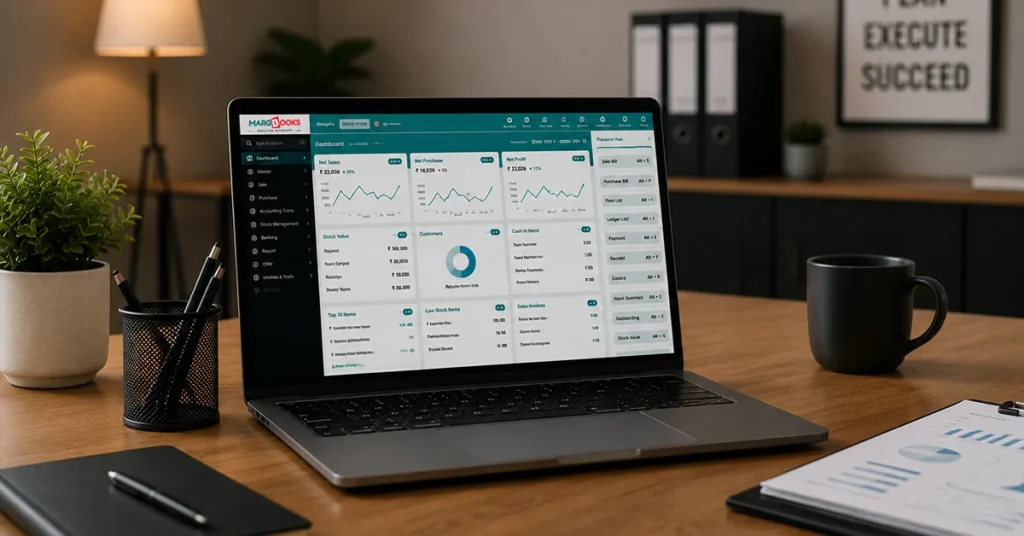
The retail billing software is really important. When your staff scan a garment at the checkout counter the scanner reads the barcode on the label. Sends that information to your retail billing software in real time. The software matches it to the product in your catalogue. Pulls up everything automatically. Your billing software does all the work. Name, size, colour, price, GST category. It all appears on the screen in under a second.
The bill is calculated, the payment is recorded, and the stock count is reduced by one. No separate step. No manual update. It all happens in the background while your staff is already moving to the next customer.
If you run more than one store, the same label works the same way at every location. Your retail billing software keeps inventory in sync across branches so you always have an accurate picture of your total stock, wherever you are.
And every transaction builds your data. Over weeks and months, your retail billing software gives you reports that tell you about your selling styles, busiest billing hours, highest-margin products and slowest-moving stock. All of it comes from those label scans.
How Garment Billing Software Handles Your Labels End to End
Good garment billing software does not just process bills. It manages the entire label lifecycle from the moment a new product is created in your system to the day that the last piece is sold.
You can create new products directly in the software, assign sizes and colours, set prices and the system generates a unique barcode for each variant automatically. No separate tool needed. You print directly from the software onto your label printer, and the labels are ready to apply.
When stock arrives, your team scans the incoming pieces against the purchase order. The system checks the quantities, flags any discrepancies and updates your inventory automatically. What used to take a couple of hours now takes thirty minutes.
The size and colour matrix in garment billing software is something that makes a big difference for apparel, specifically. One kurta style might come in sizes XS to XXL in four colours. That is ten or more SKUs under one product. The software handles all of these reports cleanly. It lets you track each variant independently without things getting messy.
When a style drops below a quantity, the software flags it. This way, you know to reorder before you run out. And the reports you get are built for garment businesses specifically. Sales by style, by size, by colour, by season, by supplier. Not generic retail reports but actual garment retail reports.
How to Get Started Without Overcomplicating It
Many store owners know they need labelling. They put it off because they think it will be complicated to set up. It does not have to be complicated.
Start by looking at where things are breaking down today. Look at your process. Is billing taking too long? Are you constantly finding stock discrepancies? Are returns taking more time than they should? Pick your biggest problem and focus there first.
Then talk to your garment billing software provider about barcode label support. Most modern systems have this built in. You should not need a separate tool just to generate and print labels.
Build out your product catalogue in the software, assign barcodes, and start printing labels for your current stock. Test the labels on your scanner before you apply them to everything. Make sure every scan is pulling the right data.
You should teach your billing staff how to use the process. It is easier than what they’re doing now but people need a little time to get used to it. Give your staff a day to practice and feel comfortable with the process.
Once everything is running, check your reports at the end of the first week. You will already see a difference in how clean your stock data looks.
Conclusion
A garment barcode label is not an expensive upgrade. Changing to a system might take some getting used to. It’s simpler than what you’re doing. Give your team a day to get comfortable with it. This is not a technology project. It is a tool. Thousands of clothing businesses use it to run smarter operations every day.
The stores that struggle with slow billing, frequent stock errors and poor sales visibility are usually the ones still doing things manually. The stores that have got their labelling right, and connected it to good garment billing software such as MargBooks Software, are the ones that spend less time on admin and more time growing. If you have been putting off sorting out your labels, now is the time to do it. Making your labels is worth doing, and it will make things easier for you and your staff. You will see results. These results will add up over time.
Want to see how it works for your business? Book a free demo with us today. We will walk you through the whole setup and show you exactly how garment barcode labels and our billing software can work for your store.
FAQs
Q1. What information should be on a garment barcode label?
The basics are SKU, MRP, size and colour. If you want better reporting and return handling, also add batch number, season and supplier code. The more structured your label data, the more useful your reports will be.
Q2. Which barcode format works best for garment retail in India?
EAN-13 is the most widely used format for retail billing in India. It works with almost all scanners and billing software. For internal warehouse use, Code 128 gives you more flexibility. Check with your software provider before you commit to a format.
Q3. Can I print my own garment barcode labels in-house?
Yes, and for most businesses it makes sense to do so. A thermal label printer is a one-time investment that pays for itself quickly. If your garment billing software supports label generation, you can print exactly what you need, when you need it, without depending on an external vendor.
Q4. How does the barcode label connect to my retail billing software?
The barcode on the label encodes a product code. When your scanner reads that code, it sends it to your retail billing software, which looks up the product and brings up all the details instantly. The connection is automatic once your products are set up correctly in the system.
Q5. What is the difference between retail billing software and garment billing software?
Retail billing software handles billing and invoicing for any type of retail business. Garment billing software is built specifically for clothing businesses and includes things like size and colour matrix management, style-wise reporting, season tracking and label generation. If you are in garment retail, garment billing software will serve you much better.

Aman Kannojia is the Digital Team Lead at MargBooks. He started out as an SEO Specialist and never lost his love for words. With 5 years of experience across banking, SaaS, and finance, both domestic and international, he brings strategy, leadership, and storytelling together. He doesn’t just manage a team, he builds one that creates.