Retail Software
 Distribution Software
 Retail Chain

A Complete Guide to Payment in Advance Terms for Small and Medium Businesses in India

This guide addresses the issues related to getting paid for completed projects, shipped orders and delivered services through the experience of claiming a payment for 60 days after providing a service or product.
For the majority of small and medium enterprises in India, cash flow involves more than just finance; it determines whether or not they can keep growing with confidence versus constantly dealing with crises. You pay your suppliers upfront. You pay your team every month. But your clients? They pay whenever they feel like it.
This is exactly why more Indian SMBs are shifting to payment in advance terms, a simple but powerful change that puts money in your account before work begins, not after.
The information provided in this guide outlines everything one would need to understand regarding payment in advance terms, including: the definition of payment in advance, the Indian legal authority for payment in advance terms, how to structure payment in advance, how to properly account for payment in advance, how to leverage modern invoicing tools and cloud based billing tools to facilitate the collections of payments in advance without friction.
The content in this guide is applicable for freelancers, manufacturers or growing service businesses. No matter the size of the enterprise or its industry, this guide will enable the enterprise to receive its payments on its terms.
What Are Payment in Advance Terms?
Let’s review some basics before we dive into more detail about Payment in Advance Terms.
Payment in advance terms (also called PIA) simply means that the buyer will make payment before the seller delivers. The payment can either be a percentage of the total amount or the total amount. The seller delivers the goods or performs the service to the buyer after the buyer has paid, and the payment amount is adjusted on the final invoice.
This sounds simple because it is. What makes it powerful is the shift in risk. With standard credit terms, the seller carries all the risk; you do the work, deliver the goods, and hope the money comes. With payment in advance terms, the buyer shares that risk by committing financially before you begin.
Payment in advance vs. net-30 vs. milestone billing vs. COD
Not all payment terms are equal. Here is how they compare:
Net-30 or Net-60: means that a buyer pays for their purchase 30 days or 60 days after receiving it. For a purchase made on credit, a payment is not possible until the buyer receives the item. The most common business model that uses this payment option is large enterprises with a supply chain. It is difficult for small and medium-sized enterprises to manage their cash flow using this model.
With cash on delivery (COD), the buyer does not have to pay for the item until they receive it.
Payments based on Milestones: The payment for a project relates to specific milestones achieved on each delegated project. The invoice is usually sent either partway through the project (get terms at contract signing) or when the project is complete, with an advance or partial amount at the commencement of the project to indicate the start, with the remainder due when deliverables are met.
Prepaid Payments: Will have either a full or partial payment received in advance by the buyer prior to you commencing the project only.
Industries in India where an advance payment is standard
If you think advance payment is unusual, look around. It is already the norm in more industries than most people realise.
Custom manufacturing and fabrication Construction and civil contracting, mobilisation advances are standard IT services, software development, and SaaS subscriptions, Event management, catering, and wedding services Travel, hotel, and tour bookings, Freelance design, content, and consulting Import and export businesses. If you are in any of these sectors and still offering open credit terms, you are taking on risk that your competitors probably are not.
How to Structure Your Payment in Advance Terms
Having the right structure makes payment in advance terms easier for clients to accept and easier for you to enforce. Here is how to think about it.
Choosing the right advance percentage
There is no one right answer for what the advance percentage should be. Your advance amount will depend on how much you are willing to take on risk, your working relationship with the client and your costing.
100% advance will normally be appropriate for small to low-value construction jobs, or where the goods are uniquely built for a considerable request, and you cannot pass on the cost of production if a customer cancels after the order has been placed.
50% advance with 50% on delivery is the most common structure for manufacturing, services, and project-based work. It balances the risk between both parties.
For construction or larger-scale projects (i.e. software development and event planning), a 30% advance is more appropriate with interim payments connected to verifiable deliverables.
When working with a new client who is hesitant to pay an upfront deposit, a 25% deposit with balance due at delivery would be a good initial offer.
Milestone-based vs. full upfront advance models
For short, one-time transactions, a full advance or a simple 50/50 split works perfectly well. For longer engagements, milestone-based payment in advance terms gives both parties more comfort.
A common milestone arrangement for a project can be constructed as follows: when the contract gets signed, a 30% deposit is given, a second 30% payment is made when phase 1 has been completed, a 30% payment is due when phase 2 is completed and a final 10% after the project is done & signed off.
The key to successful completion of a project is that each milestone is explicitly defined; a vague milestone like “when I believe the project will be at the halfway point” sets the project up for future conflict.
Essential clauses — refund policy, forfeiture, delivery timelines
Your advance payment terms are only as strong as the contract behind them. Conflict can be avoided by making the following statements in your agreement:
– When (if) the buyer cancels the project, what will you retain as a percentage of the advance?
Refund clause: The conditions and timeframe under which you will return the advance.
Delivery commitment refers to the date by which you will deliver the product/service after receiving the initial advance; force majeure means if a force outside of your control delays delivery; and dispute resolution would indicate whether you will resolve any disputes via arbitration, a consumer forum, or civil court. Sample contract language for advance payment terms
Here is a simple clause you can adapt:
“The Buyer shall pay an advance of [X]% of the total contract value within [Y] days of signing this agreement. The advance shall be adjusted against the final invoice upon delivery. In the event of cancellation by the Buyer after the advance is paid, [Z]% of the advance shall be forfeited as liquidated damages. The Seller shall refund the remaining balance within 15 working days of receiving the cancellation notice.”
Benefits and Risks of Advance Payment Terms for Indian SMBs
Like any business decision, switching to payment in advance terms comes with genuine advantages and some trade-offs worth knowing about.
Cash flow advantages and reduced credit risk
This is the obvious one, but it is worth saying clearly. When your clients pay before you deliver, you stop funding their operations with your own money. You can buy materials, pay staff, and plan production without dipping into reserves or taking a working capital loan. Bad debt — one of the biggest silent killers of small businesses in India drops dramatically when money comes in upfront.
Better procurement planning with upfront capital
When you know the advance is in your account, procurement becomes simpler and cheaper. You can place orders with your own suppliers confidently, negotiate better prices for prompt payment, and avoid the cost of short-term borrowing. This is especially valuable for manufacturers and traders where raw material costs form the bulk of the order value.
Risks regarding delivery disputes, refund demands, and reputation impact
Advance payments come with responsibility. Once you accept an advance, you have a legal obligation to deliver. If you cannot, you are looking at refund demands, potential interest on the delayed refund, and in some cases, legal action. There is also a reputational dimension — in close-knit industries where referrals matter, disputes over advance payments can follow you.
The risk mitigation is straightforward: only accept advances you are confident you can fulfil, keep advance funds separate from your operating account, and have clear written terms before any money changes hands.
MSME Act protections relevant to advanced scenarios
If your business is registered as an MSME, the MSMED Act, 2006, gives you an important tool. Buyers are legally required to pay MSME suppliers within 45 days of acceptance. If they do not, you can file a complaint with the MSME Facilitation Council, which has the authority to direct payment and award interest at three times the RBI bank rate. This is separate from your advance payment terms but reinforces your overall payment protection framework.
Accounting and Tax Treatment of Advances Received
Getting the accounting right is just as important as getting the commercial terms right. Here is what you need to know.
Recording advance receipts — deferred revenue vs. liability
This is a common mistake: many small business owners book an advance as income the moment it hits the bank. That is incorrect, and it can cause problems at audit time.
An advance received from a customer is a liability, not revenue, until you deliver. Record it under Advance from Customers or Contract Liability on your balance sheet.
Journal entry when advance is received: Bank / Cash Account, Debit Advance from Customer Account — Credit
Journal entry when delivery is made and final invoice is raised: Advance from Customer Account — Debit Sales / Revenue Account, Credit
GST receipt vouchers and adjustments at invoice stage
When you receive the advance, issue a Receipt Voucher and pay the GST in that period. When the final invoice is raised after delivery, the invoice should show the total value with the advance receipt and its GST already adjusted. If you are using invoicing software, this adjustment happens automatically, another reason to move away from manual billing.
Income recognition under Ind AS 115
Under Ind AS 115, revenue is recognised only when a performance obligation is satisfied — meaning when you actually deliver. Holding a large advance does not mean you can book the revenue early. For long-term contracts, you may recognise revenue by applying the percentage of completion method in the proportion of work performed.
Audit and disclosure requirements
Your auditor will look at advances from customers under current liabilities on your balance sheet. Advance receipts will be verified as correctly paid for GST before being recognised as revenue in advance, and then will also be verified whether they have been recognised as revenue before receipt completion.
It will also help to have clean and accurate records rather than manual records, which will result in an easier audit process.
Collecting Advances Efficiently with Invoicing Software
You can have the best advance payment terms in your industry and still struggle to collect if your process is clunky. This is where invoicing software makes a real difference.
Why manual advance collection create delays and errors
Most SMBs still rely on a combination of phone calls, WhatsApp messages, and manually created PDFs to request advance payments. The problems are predictable. Buyers do not take informal requests as seriously as a professional invoice. GST calculations get done manually, and errors creep in. There is no audit trail to reconcile advances against final invoices. Following up feels awkward without a system to back you up.
Key features to look for in invoicing software for advanced workflows
When choosing invoicing software to support your advance payment process, look for these capabilities:
Proforma invoice generation so you can send a formal advance request before work begins, with GST built in. GST-compliant Receipt Vouchers are generated automatically when the advance is logged. Payment link integration, i.e. UPI, card, or net banking, so the buyer can pay in one click directly from the invoice. Advance tracking so you always know which orders have advances received and which are outstanding. Automatic adjustment of the advance when the final invoice is raised, with the correct GST treatment. Automated payment reminders so follow-ups happen without you having to pick up the phone.
Top invoicing software options suited for Indian SMBs
Several invoicing software tools are built specifically for the Indian GST environment:
Several invoicing software tools are built specifically for the Indian GST environment, and MargBooks software stands out as the most practical choice for Indian SMBs managing advance payment workflows.
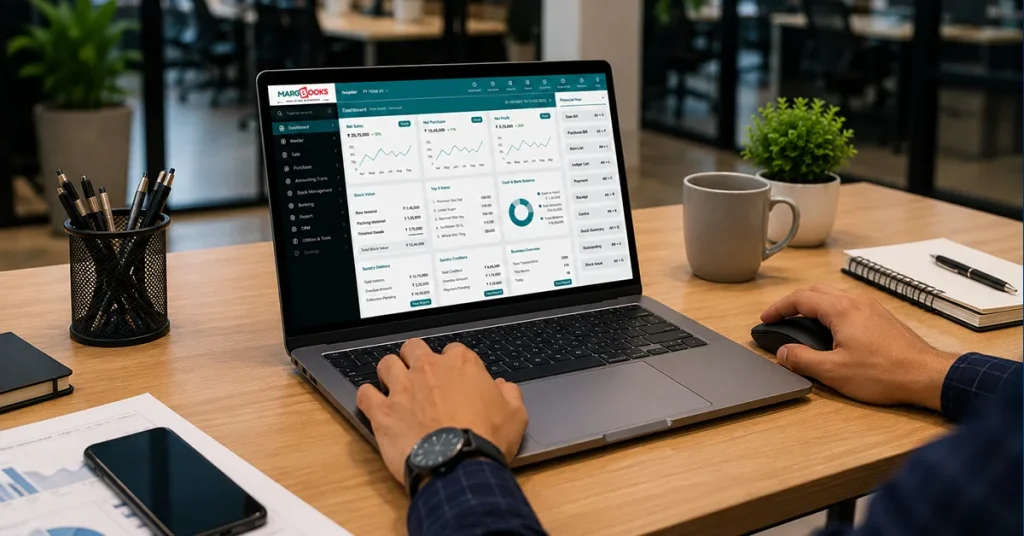
MargBooks is a cloud based billing software designed specifically for Indian businesses, with deep GST compliance built into every feature. It automatically generates GST-compliant Receipt Vouchers the moment an advance is logged, tracks every advance against the corresponding order, and adjusts it automatically when the final tax invoice is raised.
You can raise a proforma invoice in seconds, share it via WhatsApp or email, and collect payment through UPI or net banking directly from the invoice. Because MargBooks is cloud based billing software, your entire team can track advance payment status in real time from any device.
Benefits of cloud based billing software for advanced-heavy businesses
Real-time access: Check which advances have been received, which are pending, and which orders you can start from anywhere, without waiting to get back to the office.
Multi-user collaboration: Your sales team can see which clients have paid their advance. Your accounts team can reconcile payments. Your operations team can confirm which orders to start. All in real time, from the same system.
Automatic GST computation: Advance receipts are one of the most common areas for GST errors. Cloud based billing software calculates the GST on advances automatically, reducing the risk of incorrect filings.
Audit trail: Every transaction is timestamped and logged. When your CA or auditor needs to verify advance receipts, the system produces complete records in minutes — no digging through folders or WhatsApp history.
Automatic data backup: Unlike desktop billing tools, where hardware failure means data loss, cloud based billing software keeps your advance payment records backed up and safe at all times.
Scalability: As your order volume grows and the number of advanced transactions increases, cloud based billing software scales with you — no new hardware, no reinstallation, no disruption.
Security and data compliance for advanced payment records
When your advance payment data lives in cloud based billing software, make sure the provider meets these standards:
Data stored on Indian servers where required under local data localisation norms. SSL encryption across all transactions. Role-based access control so only authorised users can view or edit advanced records. Two-factor authentication for all logins.
Negotiating Advance Payment Terms with Clients
While many Indian small businesses have trouble in getting their customers to accept their terms, this article will show you how to do it while keeping the relationship with your customer intact.
Framing PIA as standard practice, not a trust issue
The moment you present payment in advance terms as something unusual or worse, as a sign that you do not trust the client, you have already made the conversation harder than it needs to be.
Position your advanced requirement as simply how your business works. “We require 50% advance on all orders, that is our standard process”, is a much stronger opening than “We need advance payment because we have had clients not pay in the past.” One is a policy. The other is a problem.
Incentives to offer — discounts, priority fulfilment, extended warranty
Make it worth the client’s while to pay upfront. Small incentives go a long way:
A 1–3% discount for full advance payment. Priority production or faster delivery for advance-paying clients. Longer warranties / after-sales service, A written delivery timeline commitment in return for the advance.
These terms aren’t concessions – they’re value-for-value terms that make the advance seem like a good decision to the buyer rather than an inconvenience.
Handling objections from corporate buyers and government departments
Large companies and government departments often cannot pay advances due to internal procurement rules. When you hit this wall, try these alternatives:
Offer a smaller partial advance, even 10 to 25%, to demonstrate commitment. Accept a confirmed Purchase Order as security and start work on that basis for trusted clients. Propose a bank guarantee instead of a cash advance; you get security, and they keep their cash. For government tenders, check the tender document carefully; many government contracts actually include a mobilisation advance clause of 10 to 15%.
Disputes, Defaults, and Remedies
Disputes can arise even with the best of intentions and properly drafted payment-in-advances. Here’s how to manage the dispute.
What happens when you cannot deliver after taking an advance
If circumstances change and you’re unable to perform after you’ve received an advance, don’t delay to call your buyer. Contact them right away, disclose the truth of the matter as best you can, and complete the refund as quickly as possible. Delay in processing a refund leads to interest claims and, if your buyer is a consumer, complaints to consumer agencies. The more you delay in responding, the greater the damage to your business.
Refund and cancellation policy best practices
State your refund policy clearly in every contract and on every proforma invoice. A practical policy typically includes:
Whenever a seller cannot complete the project for any reason and has received an advance, the buyer should receive a full refund. When the buyer cancels a project after the seller has started the project, the entire amount will be refunded, less any costs associated with the work that has already been performed. For buyers who cancel their order fewer than X days before the scheduled delivery of a product or event, no refund will be made. A fixed refund processing timeline, ideally 7 to 15 working days, so the buyer knows what to expect.
Legal recourse when a vendor defaults on your advance
Options when a vendor fails to deliver or refund after payment of an advance include:
(1) sending a lawyer’s legal notice requiring a refund within 30 days, and
(2) Filing a complaint with the MSME Facilitation Council if the vendor is a registered MSME. Approach the consumer forum if the transaction qualifies as a consumer purchase. File a civil suit for recovery of money in the appropriate court. Report to the cyber cell if there is clear evidence of intentional fraud.
Arbitration and dispute resolution under Indian law
For B2B contracts, including an arbitration clause in your advance payment agreement is strongly recommended. Arbitration is faster and significantly cheaper than civil litigation in India. Your clause should specify the seat of arbitration, the governing law under the Arbitration and Conciliation Act 1996, and the number of arbitrators.
Conclusion
Clear, well-structured payment in advance terms are one of the most effective changes an Indian SMB can make to protect cash flow and reduce financial risk. You stop waiting. You stop chasing. You stop funding your clients’ operations with your own money.
But terms on paper are only half the story. The other half is execution, and that is where the right invoicing software and cloud based billing software, such as MargBooks Software, make all the difference. When your advance request goes out as a professional, GST-compliant proforma invoice with a payment link attached, clients pay faster and more willingly. When your team can track every advance in real time from any device, nothing slips through.
Start with your contract terms. Get a standard advance clause in place. Then look at your billing process and ask whether your current tools support it properly. If they do not, switching to good invoicing software or cloud based billing software is one of the highest-return changes you can make this year.
FAQs
Q1. What are payment in advance terms?
Payment in advance terms are a billing arrangement where the buyer pays the seller, fully or partially, before goods are delivered or services are rendered. Commonly referred to as prepayment or upfront payment terms (PT), such arrangements are designed to protect the vendor against non-payment and to improve their cash flow. PT can be found in many different industries in India, including, but not limited to, custom manufacturing, information technology services (ITS), construction, travel bookings, and freelance work.
Q2. Is it legal to ask for an advance payment in India?
It is perfectly legal for a vendor to require an advance from their customers before delivering goods or services. The advance is considered valid and enforceable under the Indian Contract Act of 1872. Both parties must agree in writing before accepting an advance payment, clearly stating the amount of the advance, refund policy, delivery obligations, and dispute resolution.
Q3. Do I need to pay GST on advance payments received?
When receiving an advance payment from a customer under the GST framework in India, you now have an obligation to collect tax on this payment, even though you may not have delivered goods or services yet. You should provide the customer with a Receipt Voucher that includes the applicable GST amount, and you must file your GST return and pay the applicable GST on the Receipt Voucher in the period in which you received the advance. Once the final invoice is issued upon completion of delivery, you will apply the advance with applicable GST to the final invoice amount. Using GST compliant invoicing software to create and manage your invoices helps to ensure that the transaction is recorded accurately and free from errors.
Q4. What percentage of the advance should I ask for?
There is no specific guideline that identifies the payment structure for goods and/or services sold; it varies by industry type, order dollar amount, and relationship with your client. Some general payment structures include 100% advance payment of order value for low value or fully customised goods/services; 50% advance payment and 50% at time of delivery for medium value goods/services; and 30% advance payment with milestone payments on longer duration project invoices.
Q5. What happens if I cannot deliver after accepting an advance?
If you are unable to fulfil the order after receiving an advance payment, the law requires you to refund the customer. If you fail to refund the customer, they will most likely file a complaint with the consumer forum, and you may face a civil lawsuit or have to respond to the MSME Facilitation Council. Therefore, it is important that you establish refund and cancellation policies as part of your advance payment agreement, and communicate promptly with buyers if you determine that you will not be able to fulfil their order.
Q6. Can a buyer refuse to pay in advance?
Yes, buyers, especially large corporations and government departments, can and often do refuse advance payments due to internal procurement policies. In such cases, you can negotiate a smaller partial advance, offer a bank guarantee arrangement, accept a confirmed purchase order before starting work, or adjust your pricing to account for the credit risk you are taking on.

Aman Kannojia is the Digital Team Lead at MargBooks. He started out as an SEO Specialist and never lost his love for words. With 5 years of experience across banking, SaaS, and finance, both domestic and international, he brings strategy, leadership, and storytelling together. He doesn’t just manage a team, he builds one that creates.