Retail Software
 Distribution Software
 Retail Chain

How RFID in Inventory Management Reduces Errors and Saves Time

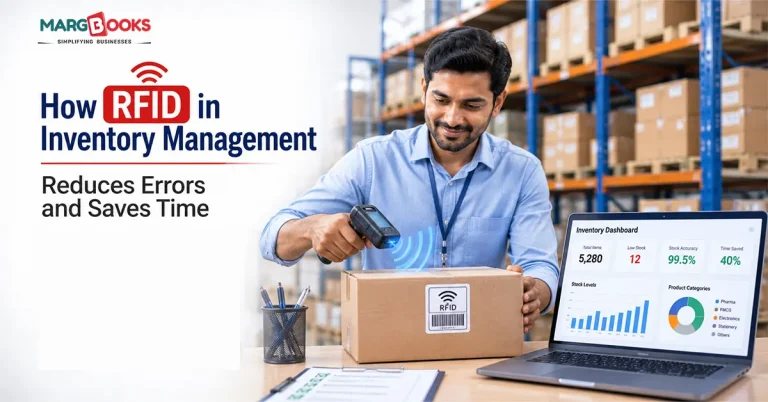
If you’ve ever done a full stock count by hand, you already know how it goes. Two people end up with two different totals, someone forgot to log a return, and half the afternoon is gone before you’ve even started fixing the mismatch. It’s not that the staff isn’t careful; counting hundreds or thousands of items one by one is just a setup for mistakes. This is exactly the gap RFID in inventory management is built to close.
Even though RFID technology is an old phenomenon that came into existence with tried and tested applications in industries such as logistics and retail, it is only now that various small businesses are using it. This is mainly attributed to the fact that the investment necessary to implement this technology has significantly decreased. What happens in a business if it opts for the implementation of RFID technology in its warehousing processes?
What does RFID mean?
RFID refers to Radio Frequency Identification. This technology makes it possible for the company to dispense with scanning each item since the items with the RFID tags on them communicate with RFID receivers wirelessly. This goes against the barcode approach, which involves scanning every object with the finger in order to take the information off it.
Depending on the specific purposes of the company, such a tag may show the batch number or the expiry date of a product or the location where the product was scanned before. In the case of the company using an RFID tag, the information received by the reader is sent directly to the inventory system.
There are two categories of RFID tags worth mentioning:
Passive RFID tags don’t have their own power source. They “wake up” when a reader’s signal reaches them, which makes them cheap enough to slap on individual products in bulk. Active tags, on the other hand, have a battery and can broadcast over much longer distances; these are usually reserved for tracking expensive equipment or containers rather than everyday stock.
In retail and warehousing, passive RFID tags are used successfully. In this instance, the price of the tag makes the application possible on the inventory level rather than only for the most valuable items.

Why More Businesses Are Making the Switch
The honest answer is that manual counting doesn’t scale. A shop with fifty products can get by with a notebook and a barcode scanner. A warehouse moving thousands of units a day cannot, at least not without errors piling up somewhere in the chain.
When a company implements RFID technology, there is no longer a need for the time-consuming back-and-forth actions. A reader can collect readings from numerous tags at the same time. Rather than having to scan every single box on a truck, you can simply move around the entire pallet that is being unloaded with a portable reader and complete your inventory in a matter of seconds.
Consequently, hours of conducting physical counts are saved in the inventory process, and human errors that may happen when people are either tired or rushing are eliminated.
Thus, the inventory information presented on the computer is closer to reality. That gap between “what the system says” and “what’s really there” is where most stock problems start, overselling something that’s technically out of stock, or ordering more of something you already have plenty of.
Where RFID Actually Improves Accuracy
Inventory accuracy isn’t a one-time thing you fix and forget. Every time stock moves — from a supplier, into a warehouse, onto a shelf, out the door to a customer — there’s a chance for the numbers to drift from reality. Even a well-run business slips up here occasionally.
What an RFID system does differently is update records the moment tagged stock passes a reader, rather than waiting for someone to log it later. There’s no gap between the item moving and the system knowing about it. Over weeks and months, that adds up to a much cleaner set of inventory data, instead of numbers that only get corrected during the next scheduled count.
If you’re already running a stock control software to keep tabs on daily sales and purchases, RFID basically feeds it better, faster information, so the reports you’re pulling actually reflect what’s on the ground.
RFID Inside a Warehouse
Warehouses are where RFID tends to pay off the most, mostly because the volume of stock movement is so much higher than in a single retail counter.
Picture a truck arriving with pallets of goods. Instead of someone standing there scanning box after box, an RFID reader mounted near the dock can log the entire shipment as it rolls through. The same happens when goods are picked for an order — readers positioned near packing stations confirm what’s leaving without a manual double-check.
A few things change once RFID is part of daily warehouse management:
Receiving and put-away get faster because bulk scanning replaces item-by-item checks. In addition, the time taken for order picking has reduced by a lot, as opposed to scanning each item one by one. Unlike conventional inventory systems, lost or misplaced goods are now rare due to RFID technology, which makes it possible to trace items more easily.
If a business already runs warehouse management software, RFID doesn’t replace it — it just makes the data going into that system more reliable, since it’s coming from automatic scans rather than manual entries.
Beyond Stock: Asset Tracking and the Supply Chain
RFID isn’t only useful for counting boxes. A lot of businesses use it for asset management too, keeping tabs on equipment, machinery, or fixtures that would otherwise be tracked on a spreadsheet somewhere and forgotten about until something goes missing. When the asset is tagged for the first time, locating it in the future or ensuring that it is still around requires scanning it instead of involving a team of searchers. The same concept can be noted about the entire supply chain. If RFID tags are used at the beginning, for example, at the moment of manufacturing, every step, starting from the warehouse and continuing to the delivery truck and the store, will be automatically recorded in the system. Consequently, the company will understand better where all the things are instead of waiting for information from their colleagues from other departments.
Points to be Considered Before Using RFID
However, just because RFID technology is available does not mean it can be incorporated into warehouses immediately. There are a number of major things to keep in mind before rolling out RFID technology in storage facilities.
The upfront cost is the obvious one; readers, tags, and the infrastructure to support them aren’t free, though prices have dropped a fair bit as more suppliers enter the market. Integration matters just as much: RFID data is only useful if it connects properly with whatever inventory management system you’re already running, instead of sitting in its own separate spreadsheet. And staff will need at least a basic understanding of how tags and readers work, even if using them day-to-day is fairly straightforward once it’s set up.
None of these is a reason to avoid RFID altogether. They’re just things worth planning for instead of running into halfway through a rollout.
Bringing It Together with the Right Software
RFID collects the data, but it still needs somewhere to go. Without a solid inventory management software behind it, all that real-time scanning doesn’t really translate into better decisions; it just becomes more data sitting unused.
MargBooks handles that side of things: real-time stock updates, batch and expiry tracking, and low-stock alerts sent straight to WhatsApp or email so nothing gets missed. Whether you’re managing one store or several locations, having accurate inventory data pulled together in one place makes the everyday decisions, what to reorder, what’s about to expire, what’s actually selling- a lot less guesswork. If you’re currently relying on barcode-based billing, moving toward RFID later on is a natural next step rather than a complete overhaul.
Conclusion
RFID in inventory management isn’t about chasing new technology for its own sake. It solves two problems businesses deal with constantly, inaccurate counts and wasted hours, by replacing manual scanning with something that just works in the background. Whether it’s a single warehouse or a chain of stores, the benefits of RFID show up pretty quickly once it’s running: fewer mismatched numbers, faster stock checks, and a clearer view of what’s actually in your inventory at any given moment. If you want to see how automated inventory tracking fits into your own operations, book a free demo with MargBooks and take a look at what it can do for your stock management.
FAQs
1. What is RFID in inventory management?
It’s a way of tracking stock using radio waves instead of manual barcode scans. RFID means using those tags that are placed onto the goods to share information with a reader and update the inventory system.
2. In what way does RFID differ from barcodes?
Barcodes can be scanned only when there is a clear view, but in the case of RFID, many tags can be read at once, regardless of wrapping.
3. Do passive RFID tags have an application in everyday life?
Yes, since they are inexpensive and still allow for satisfactory tracking of goods.
4. Does MargBooks work with RFID?
MargBooks is built around real-time inventory tracking, barcode billing, and automated alerts. It gives businesses a strong system to plug RFID hardware into as their operations grow.

Aman Kannojia is the Digital Team Lead at MargBooks. He started out as an SEO Specialist and never lost his love for words. With 5 years of experience across banking, SaaS, and finance, both domestic and international, he brings strategy, leadership, and storytelling together. He doesn’t just manage a team, he builds one that creates.