Retail Software
 Distribution Software
 Retail Chain

Digital Inventory Management: A Complete Guide for Modern Businesses

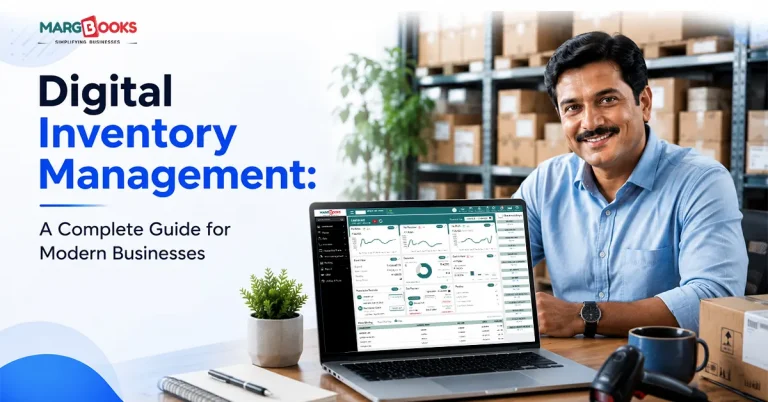
Go into almost any small store or warehouse that’s still running things on registers and Excel sheets, and you’ll see the same scene play out. In the background of our operations, there is a person counting the boxes and, at the same time, another person is arguing with a vendor about a delivery that “should have come last week.” Meanwhile, a supervisor looks at two spreadsheets with different figures for one item.
This isn’t because anyone’s bad at their job. It’s because manual inventory tracking was never built for how fast businesses have to move now. Customers want instant answers. Suppliers want tighter turnaround. And GST filing doesn’t care that your stock register is three weeks out of date.
Digital inventory management is basically the fix for all of this. Instead of stock numbers living in someone’s memory or a notebook, everything gets updated the second a sale happens, or a delivery comes in. You always know what you actually have, not what you think you have.
In this post, we will look at what digital inventory management entails, why businesses cannot afford to disregard it, what functionality to look for in software, and how various industries are utilizing digital inventory management.
What Digital Inventory Management Actually Means
Put simply, it’s tracking your stock through software instead of paper or spreadsheets, from the moment something’s ordered, all the way to the moment it’s sold. Every unit that comes in or goes out gets logged automatically.
The real difference from manual tracking isn’t just that it’s faster. A spreadsheet only knows what a person typed into it, and people forget, mistype, or just don’t update it in time. A proper system, on the other hand, knows the second your last unit of something sells, and can warn you before you’re actually out.
The majority of good systems share some common elements, including immediate stock updates, QR scanning or barcode scanning to eliminate manual entry, cloud capabilities which guarantee uniform information across all devices and locations, and business insights that actually provide meaningful information as opposed to providing statistics without explanation. One of the solutions that combines all of these features would be Inventory Management Software.
Why This Isn’t Optional Anymore
Ten years ago, a customer calling to check stock might’ve waited a day for a callback. Now they expect the answer before they’ve even finished asking. That alone has turned real-time inventory visibility from a nice extra into something businesses simply have to have.
Then there’s GST. Every sale and every stock movement eventually has to line up with what gets reported at filing time, and businesses relying on manual tracking often only discover the mismatches when it’s already too late to fix them quietly. Software that connects billing directly to inventory, something like GST Billing Software, keeps that reconciliation happening automatically in the background instead of becoming a once-a-quarter fire drill.
Scale matters too. A single shop can limp along with manual counts, more or less. But the moment you open a second location, or start selling online alongside your physical counter, manual tracking stops being annoying and starts being genuinely dangerous; you end up double-selling stock you don’t have, missing reorders, or just not knowing what’s actually sitting where.
And honestly, a lot of it comes down to decision-making. Owners who can see which products are moving and which are just sitting there gathering dust can act on it. Without that, you’re basically running the business on gut feeling and whatever you remember from last month.

What to Actually Look for in Inventory Software
Not all inventory management tools do their job effectively. Check the following functions of software:
- Up-to-date stock control, every sale or purchase modifies stock count immediately.
- Scan QR codes and barcodes – allows a speedy checkout procedure and fewer mistakes.
- Batch, serial number and expiration date monitoring is a must for pharmaceutical products, for food products and everything that has a warranty.
- Multi-location or godown management – see and move stock between branches without fifteen phone calls.
- Low-stock alerts – get warned before something runs out, not after a customer asks for it.
- POS and e-commerce syncing – so your counter sales and online orders don’t fight each other over the same stock.
- Reporting dashboards – turn transaction history into something you can actually plan around.
Tools like POS Software and E-Invoicing Software build on this by tying your everyday billing straight into inventory and compliance, so it’s one workflow instead of three disconnected ones.
The Different Types of Systems Out There
Companies finally have to pick one of a small number of systems they can use; each of the systems has trade-offs that one needs to be aware of.
Cloud-based systems store data on distant storage devices; the only requirement for them is internet connectivity. The emergence of a new connection is actually necessary for this kind of system.
Offline or desktop systems can work only on one computer and network locally. It is definitely useful for areas with poor internet connection, but when using more than one station at once, one needs to do manual operations.
Open-source tools are flexible and cheap upfront, but they usually need someone technical in-house to set up and keep running, not always realistic for a small retail team juggling a dozen other things.
Enterprise systems are meant for businesses running several branches or complicated supply chains, with the deeper reporting and access controls that come with operating at that size.
For most growing businesses, something cloud-based as Inventory Management Software lands in a decent middle ground, scalable enough for multiple locations, simple enough that you don’t need a dedicated IT person just to run it.
What Actually Changes When You Go Digital
The benefits tend to show up faster than people expect, honestly.
Fewer mistakes, for one. Manual entry is where mismatched counts and duplicate records usually come from, and removing the manual step removes most of that risk automatically.
You get time back. Staff who used to spend hours doing physical counts can spend that time actually helping customers instead.
You can see everything, everywhere. Owners running more than one store can check stock at every branch from a single screen instead of calling each manager individually to ask.
Reordering happens before you’re empty, not after. Good systems flag, or even trigger, reorders early enough that you’re not scrambling.
You lose less product. Expiry and batch tracking catch problems (spoiled stock, expired medicine, forgotten inventory in a corner somewhere) before they turn into straight losses.
And when inventory, billing, and accounting are actually connected, through something like Accounting Software and Billing Software, a single sale updates your stock, your invoice, and your books all at once. You’re not typing the same number into three different places.
How This Looks Different Across Industries
Pharmacies and medical stores live and die by batch and expiry tracking; selling expired stock isn’t just bad practice, it’s a legal problem.Pharmacy Software focuses on the same, as it tracks batches, expiry dates, and the schedule for drug items, all while requiring no extra work from employees.
Grocery stores and supermarkets have a lot of SKUs to deal with at checkout, which means speed at the counter is just as important as the accuracy of back-end processes. Supermarket Software is designed for exactly that pace.
Garment and footwear stores have to deal with variants, size, color, brand, season, where one “product” quietly becomes dozens of trackable line items. Garment Software and Footwear Software handle that variant mess so staff doesn’t have to track it by hand.
Electronics and home appliance stores usually need serial number tracking for warranty and service purposes, something a generic inventory tool tends to handle badly. Electronics Store Software and Home Appliances Software are built specifically for that.
Computer hardware retailers face similar serial-tracking needs, on top of specs and pricing that change constantly, which is what Computer Hardware Store Software is built around.
Mobile phone and accessories stores juggle two very different inventory profiles under one roof: high-value phones needing IMEI tracking, and lower-margin accessories that move fast. Mobile Phone & Accessories Software is designed with both in mind.
Distributors, whether FMCG or pharma, work at a completely different scale: bulk orders, multiple buyers, tight margins that punish any inaccuracy hard. FMCG Distribution Software and Pharma Distribution Software are built for that volume.
Multi-store chains need one view across every branch and a way to move stock between locations without losing track of it, which is essentially what Retail Chain Management Software exists to do.
Picking the Right System for Your Business
With this many options floating around, it usually comes down to a few honest questions.
Does it actually fit your industry? A generic tool might technically work, but industry-specific features- batch tracking for a pharmacy, size and color variants for a garment shop- save real time once you’re actually using it day to day.
Is it worth what it costs? The software shouldn’t cost more to run than the problems it’s solving. Weigh it against what manual errors and wasted time are already costing you.
Does it talk to your GST and accounting setup? If not, you’re back to entering the same data twice and reconciling everything by hand every filing period.
Can you actually customize it? Every business has its quirks, and rigid software rarely bends to fit them.
Will your staff actually use it? Powerful software nobody wants to touch isn’t really powerful; it’s just expensive shelfware.
And what about backups and security? Cloud systems should have real backup policies and access controls, since this is data your business genuinely can’t afford to lose.
Something like Inventory Management Software checks most of these boxes out of the box, but it’s worth comparing directly against your own pricing needs before deciding anything.
How to Switch from Manual to Digital Inventory
Moving from manual to digital doesn’t have to be chaotic if you do it in order.
First, audit what you’ve got. Know your actual current stock and process before you touch anything.
Then pick the software, weighing it against the stuff mentioned above, industry fit, cost, integrations, and ease of use.
Transfer your old records rather than starting afresh. You want to retain your records. Train your staff properly. Even great software fails if the people using it every day are confused by it.
Go live and actually watch the reports for the first few weeks. That is the time when you can discover the gaps that need correcting.
Most of the systems offer an opportunity to take advantage of a free trial; in fact, it is much easier to identify the difficulties with the new system if you begin using it beforehand.
Mistakes Businesses Make Even After They Go Digital
After switching to a new system, there are still a few mistakes that one may make. Reorder points that never get set properly, so the software can’t actually warn you in time. Skipping batch or expiry tracking on perishables, which kind of defeats the whole point. Keeping billing and inventory as two separate systems, which just brings back the manual reconciliation you were trying to escape. Rushing past staff training, so half the team never really learns the tool. And no mobile access; owners who can’t check stock from their phone end up back on the phone calling the store manager anyway, which a mobile app solves pretty easily.
Where This Is All Heading
Inventory software is moving past simple stock counts pretty quickly. AI-based demand forecasting is starting to predict what you’ll need to reorder before stock even gets low, based on actual sales history instead of a hunch. Omnichannel selling is blurring the line between online and offline stock completely, so a sale on one channel updates availability everywhere else instantly.
Now, even more people are managing the entire stock activity from their mobile phones instead of using a computer in the back office. API integration has made it possible to specify the needs of your company without any need to change or reprogram everything from scratch.
Why Businesses Choose MargBooks
MargBooks pulls together most of what’s covered above- cloud access, GST-ready billing, barcode scanning, batch and expiry tracking, multi-location management- into one platform instead of a patchwork of separate tools. Having founded our company in 1986, we have always been at the forefront of technology and have combined extensive experience in working with Indian businesses. We have more than 10 million clients representing different industries from the retail sector to distribution and service companies. Inventory Management Software allows real-time monitoring of your stock activity or expiration notifications in pharmacies and other products.
Conclusion
Before, while businesses were small and slow, it made sense to track inventory manually, but now this method no longer works. Embracing digitization has become a matter of not convenience anymore; it is about knowing the truth about the operations of your company, not relying on guessing.
If you’re still counting stock by hand or juggling spreadsheets that never quite agree, it’s probably worth considering what a real system would change. MargBooks is one place to start; book a free demo or check pricing to see what fits your business.
FAQs
Q1. What is inventory management software?
Software that tracks your stock, purchases, and sales as they happen, instead of relying on manual registers or spreadsheets that are always a little out of date.
Q2. Is cloud-based inventory data actually safe?
Decent cloud platforms use encryption, regular backups, and access controls, generally a lot safer than a spreadsheet sitting on one laptop that could crash tomorrow.
Q3. What does inventory software cost in India?
Cost of inventory software in India varies based on the size of the business and technology functionality. While a small seller may find cheap packages, a multi-national company has to invest more money for its supply chain management system. It is good to check various pricing options available based on requirements.
Q4. Can small businesses realistically afford this?
Yes, most cloud platforms scale their pricing for smaller businesses, so you’re not stuck paying for enterprise features you’ll never use.
Q5. Does it work with GST billing?
Effective systems directly connect inventory and GST invoicing together, ensuring that movements of goods and tax records are always in order without any extra manual activity.

Aman Kannojia is the Digital Team Lead at MargBooks. He started out as an SEO Specialist and never lost his love for words. With 5 years of experience across banking, SaaS, and finance, both domestic and international, he brings strategy, leadership, and storytelling together. He doesn’t just manage a team, he builds one that creates.