Retail Software
 Distribution Software
 Retail Chain

25 Inventory Management Mistakes Every Business Should Avoid


A seller based in Delhi informed me that she received a complaint via WhatsApp from a client concerning her top-selling product three days after it had sold out. She had no idea until the complaint came through. That’s the thing about inventory management mistakes: they rarely announce themselves. They just quietly cost you money until something breaks loudly enough to notice.
Bad stock control eats into efficiency and profitability in ways that don’t always show up on a P&L statement directly. Late deliveries because of a supplier you didn’t chase up. Cash is stuck in excess stock that isn’t moving. A customer who wanted something you didn’t have went to a competitor instead. None of it looks dramatic in the moment. All of it adds up.
Here are 25 mistakes worth checking your own business against, organized loosely by where they tend to show up: planning, buying, the warehouse floor, your systems, and your books.
Planning & Forecasting Mistakes
1. Ordering by gut feeling.
A lot of businesses still decide what to buy based on what “feels right” rather than looking at actual historical sales data. The fix isn’t complicated; even a basic spreadsheet tracking last year’s numbers beats guessing. Without some kind of forecast, you’re either short during a rush or drowning in stock nobody wants.
2. Treating every month the same.
Diwali sells differently than a random Tuesday in July. Seasonality changes what people buy and how much, yet plenty of businesses order flat quantities year-round and wonder why December always feels chaotic.
3. No safety cushion.
If your stock levels hit zero the moment a supplier is a day late, you don’t have a buffer; you have a gamble. A small safety margin absorbs the delays that inevitably happen.
4. Not knowing what actually sells fast.
Some products fly off the shelf. Others sit for months. Without separating the two, businesses end up putting money and shelf space into things nobody’s buying while their actual bestsellers run thin.
5. No sense of what’s high-value vs. low-value.
A ₹50,000 item and a ₹200 item shouldn’t get the same level of tracking attention. Businesses that skip this classification waste effort watching things that don’t matter much while the expensive stuff slips through unchecked.

Purchasing & Reordering Mistakes
6. Reordering by memory.
If “when do we reorder this” lives in someone’s head instead of a system, you’re one sick day or one busy week away from missing it entirely, which is exactly how overstock and shortages both happen, often for the same product in the same year.
7. Buying extra “just in case.”
It feels responsible. It isn’t, financially. Having too much stock ties up money that is frozen instead of being used for rent, salaries, and advertising; instead, it is spending time with dust and storage.
8. Weak supplier coordination.
Unclear lead times, no backup vendor lined up, no heads-up when a shipment’s delayed, this is how businesses get blindsided by stockouts they could’ve seen coming with one phone call.
9. No low-stock alerts.
Somebody has to notice stock is running low before it’s actually gone. Without an automated way to flag it, that “somebody” is usually a customer, and by then it’s too late.
10. Purchase orders scattered everywhere.
Half in a notebook, half in WhatsApp, half remembered. Nobody has a clean picture of what’s ordered, what’s arrived, and what’s still pending until reconciliation day turns into a headache.
Warehouse & Stock-Handling Mistakes
11. No batch or expiry tracking.
If you’re in food, pharma, or anything with a shelf life, this isn’t just an inventory oversight; it’s a legal and safety risk waiting to happen.
12. A warehouse nobody organized properly.
People work to find products they should find in two minutes, but waste twenty minutes explaining that there are layout issues, not problems with productivity, and problems with warehouse management affect all the work downstream.
13. Still writing things down by hand.
Manual counting invites errors, a “47” that should’ve been “74,” a unit counted twice. Barcode scanning fixes most of this almost overnight.
14. Never check how long stock has sat.
Nobody flags the product that’s been sitting untouched for six months. It just becomes part of the furniture, quietly worth less every month it doesn’t sell.
15. Letting dead stock become permanent. Related to the point above, but worth its own mention, unsold inventory that nobody’s actively trying to clear or discount is money frozen in place, not an asset.
Manual System Mistakes
16. Running the whole operation on a spreadsheet.
Fine for ten products. A mess for five hundred across three locations. Manual entry is where a small discrepancy turns into a real accounting problem later.
17. No real-time visibility.
Decisions made on yesterday’s numbers are decisions made partly blind. Real-time inventory data is what lets you actually react instead of finding out after the fact. Using Inventory management software can be considered as one of the best solutions to this problem.
18. Inventory and accounting live in separate worlds.
Every sale is entered twice, in two systems that don’t talk to each other; it’s only a matter of time before the two stop matching, and nobody can say why.
19. No link between inventory and order processing.
If a sale doesn’t instantly update your stock count, you risk selling something that, technically, isn’t there anymore.
20. Sticking with old habits out of comfort.
Switching systems feels disruptive, so a lot of businesses just… don’t. Understandable, but it’s also how you miss out on automation that would’ve saved hours every single week.
Accounting, GST & Compliance Mistakes
21. Stock counts that don’t match the ledger.
When physical inventory and financial records disagree, something got missed: a return, a damaged unit, a billing slip that never got logged.
22. GST errors from manual billing.
Small mistakes in tax calculation on individual invoices don’t feel like much at the time. They pile up fast, and filing season is when you find out how much.
23. Counting stock once a month instead of continuously.
Between counts, you’re always working with numbers that are at least a little wrong.
24. Inventory not properly reflected on the balance sheet.
Stock is an asset. If it’s recorded inaccurately, your financials quietly stop telling the truth about the business.
25. No clean digital trail for an audit.
Come tax time, businesses without organized digital records spend days pulling together what should’ve taken an hour.
Conclusion
Look back through that list, and a pattern shows up fast: manual processes, disconnected tools, and nobody having one clear picture of what’s actually happening with the stock. That’s really what most inventory management mistakes come down to.
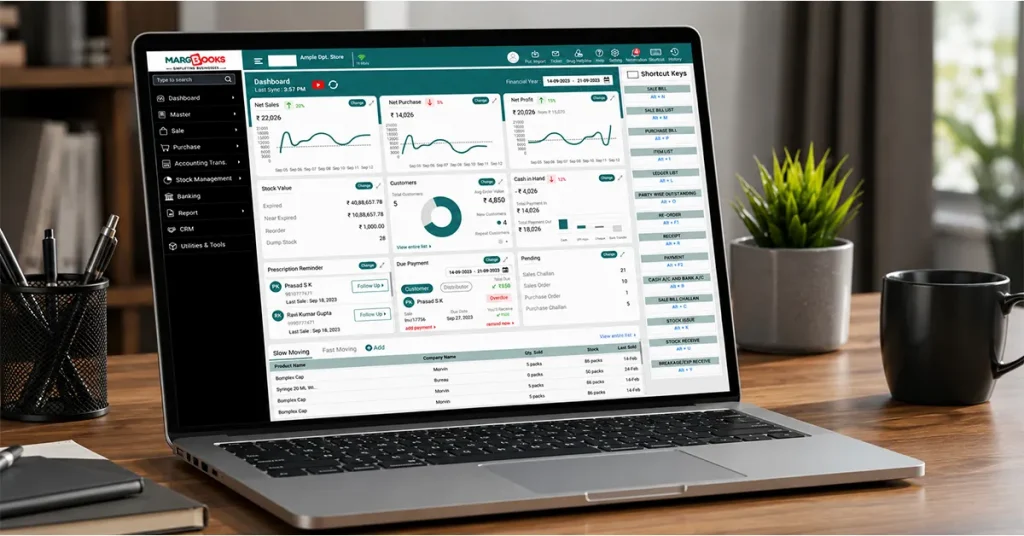
An integrated ERP, such as MargBooks Software, one that connects inventory, billing, and accounting instead of keeping them in separate silos, closes most of these gaps without anyone having to remember to do anything extra. That’s the gap MargBooks is built to fill: real-time stock tracking, automated reorder alerts, batch and expiry management, GST-ready billing, and financial reporting, all pulling from the same data instead of three different spreadsheets that never quite agree with each other.
FAQs
Q1. What’s the most common inventory management mistake small businesses make?
Honestly, it’s guessing instead of tracking. A lot of businesses order stock based on what “feels right” rather than looking at what actually sold last month or last year. Once you start using real sales numbers instead of gut feeling, most of the other mistakes on this list get a lot easier to avoid.
Q2. How do inventory mistakes actually affect cash flow?
Every rupee sitting in stock that isn’t moving is a rupee that can’t pay rent, staff, or anything else the business needs. Overstocking ties up capital for months at a time, while stockouts mean lost sales you never get back. Both hit cash flow, just from opposite directions.
Q3. Can spreadsheets handle inventory management for a growing business?
Spreadsheets might be sufficient for a little catalog, but as soon as you have to handle numerous products, locations, or fast-moving stock, those spreadsheets begin to fail.
Q4. What’s the fastest way to fix recurring stockouts?
Start with safety stock and low-stock alerts. If you’re not tracking a buffer against delays, and nobody’s getting notified when stock runs low, you’re relying on someone noticing manually, which usually means a customer notices first.
Q5. Does inventory management software really help with GST compliance?
Yes, more than people expect. When billing and inventory are connected, tax gets calculated correctly at the point of sale instead of manually per invoice, and your records stay audit-ready without extra work at filing time.

Aman Kannojia is the Digital Team Lead at MargBooks. He started out as an SEO Specialist and never lost his love for words. With 5 years of experience across banking, SaaS, and finance, both domestic and international, he brings strategy, leadership, and storytelling together. He doesn’t just manage a team, he builds one that creates.