Retail Software
 Distribution Software
 Retail Chain

Out of Stock vs Stockout – Key Differences and How to Avoid It

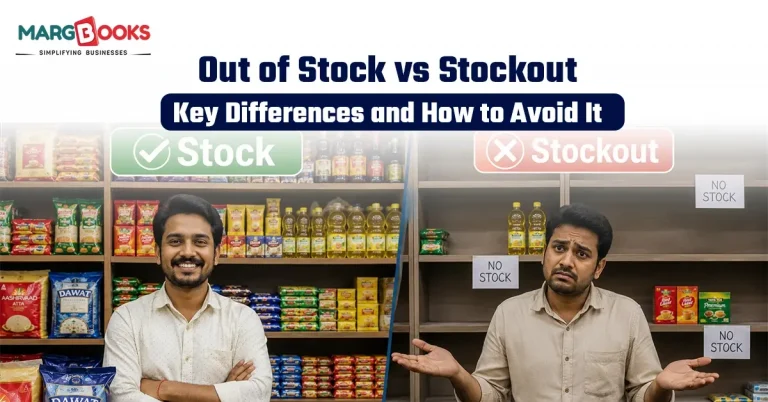
Imagine someone going into an online/offline store, finding something they want to purchase, and putting that item into their shopping cart. But when they’re at the checkout counter, the cashier tells them that the item they want has just become unavailable before the purchase. They close the tab. They buy from your competitor. And there is a good chance they never come back.
This is the real cost of poor inventory management, or you can say not using a cloud-based inventory software is the cost. Still, some Indian business owners confuse the two words that create most issues concerning stock: stock out and out of stock. They are similar, and it is easy to confuse them; however, the consequence of confusion is that you will be addressing the wrong issue. Let us know the key differences between out of stock and stock out, and show you exactly how to prevent both.
What is a stockout?
A stockout is an internal inventory event. When a product in your inventory has no units left in stock (0), there is no more available supply to meet the current amount of demand. This is a problem in either your supply chain or operations; this is also a hidden problem for your customers, who typically wouldn’t know about this until they exhausted their supplies and had an unmet need for that item.
Some of the causes that result in products being “out of stock” include demand forecasting errors, supplier shipment delays, incorrect manual entry (typos) into the inventory management software, or simply forgetting to set a reorder alert for a high-demand product.
What does out of stock mean?
Out of stock is what the customer sees. It is the empty shelf, the “sold out” badge on your product page, the apologetic message from your sales team. It is the moment a buyer tries to purchase something and cannot, because it is simply not there.
Every stockout eventually becomes an out-of-stock situation if left unchecked. But an out-of-stock can also happen even when items exist in your warehouse, if they are in the wrong location, allocated to the wrong channel, or not reflected correctly in your system.
Stock out = a warehouse problem, whereas out of stock = a customer experience problem. One feeds the other, but they need different fixes.
Stock out vs out of stock: a quick comparison
| Feature | Stock out | Out of stock |
| Perspective | Internal / operations | External / customer-facing |
| Who notices first | Warehouse or inventory system | End customer |
| Main cause | Supply chain failure | Visibility or fulfilment gap |
| Fixable before the customer sees? | Yes, if caught early | No, they have already seen it |
Why does this matter for Indian businesses?
Retail and e-commerce in India have many players vying for attention. Whether selling via Amazon India, Flipkart, or Meesho, or your own Direct-To-Consumer (D2C) website, a customer has many other options to click on. A stockout resulting in an out-of-stock situation could result in multiple losses to the retailer, as there will be a lost sale, a lost customer, and a possibility for a bad review, and it can take months for a seller to recover from this.
Add to that the intensity of Indian demand peaks, Diwali, Holi, Eid, back-to-school season, IPL, and the cost of poor inventory planning multiplies fast. Businesses that rely on spreadsheets and manual tracking are the most vulnerable, whereas those that use inventory management software, such as MargBooks. By the time a stockout is noticed, it is often too late.
How to prevent stockouts and out-of-stock situations
The positive aspect of both problems; they can both be avoided if the proper procedure and repetitive actions are in effect.
1. Set reorder points for every product
Without this, you are always reacting instead of planning. If you use the Stock management software, you can easily set your reorder points as they notify you whenever your stock reaches a certain limit.
2. Always carry safety stock
Another viewpoint of the Safety stock concept is that it provides a cushion to absorb/absorb the impact of variable demand (due to either fluctuations in consumer purchasing behavior) and/or disruption of your supply chain (delays by vendors). Retailers frequently fail to anticipate the level/amount of Safety Stock they need. This is especially true before peak sales times. The existence of safety stock delays a stock-out situation if the supplier is even a few days late.
3. Use real-time inventory visibility
If the stock levels are not updated until the end of business each day or once every week, you are operating with no visibility. By the time you start to see a stock-out on your reports, your customers have already experienced a stock-out. Real-time tracking closes that gap completely.
4. Sync stock across all your sales channels
Selling on multiple platforms? Every channel needs to reflect the same live inventory count. If there is no synchronization between inventory levels, you increase the chances of overselling on one channel and underselling on another. This hurts your customer trust.
5. Plan for demand peaks in advance
By using a cloud-based inventory management software, you can analyse your past sales data before every major Indian festival or shopping event. Order early, communicate lead times with your suppliers, and build your buffer stock well before demand arrives, not in the middle of it.
Conclusion
Out of stock and out of stock status are two different sides of the same inventory issue. One is an internal inventory issue, while the other is a customer-facing inventory issue. Both cost you money, customers, and reputation. But with smart processes and the right cloud-based inventory management software such as MargBooks, both are entirely preventable. The businesses winning in Indian retail today are not the ones with the most products. They are the ones who never run out of the right ones.

MargBooks, a product of Marg ERP Ltd., is a revolutionary cloud-based billing & accounting solution for every business where the business owner can manage the business from anytime anywhere on any device. MargBooks is your one-stop platform for managing your accounting, organizing your transactions, controlling your finances and managing your inventory. It’s a single secure platform to keep up with your company’s bills and invoices, reconcile your transaction, file GST return easily, experience connected banking etc.