Retail Software
 Distribution Software
 Retail Chain

Common Accounting Errors: A Complete Guide to Spotting & Avoiding Them

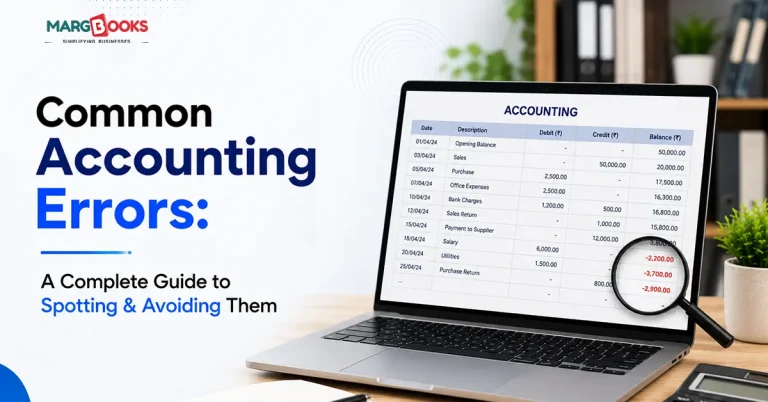
Each entrepreneur has faced the problem at least once. You’re in front of your accounts, but for some strange reason the numbers don’t match up, and you try to get to the bottom of exactly where that extra ₹5,000 cropped up or disappeared. In many cases, the mishap is not even an instance of fraud and is not a major concern. In fact, it is just a trivial mistake made some time ago that is still causing havoc.
Accounting mistakes are never exciting: they happen during a dull moment in history when unforeseen circumstances occur. A misplaced number in a sequence of numbers. An invoice recorded in the same manner twice, without the first person communicating with the second. An expense entered in the wrong section due to the fact that after branching out into a new product line, no one updated the chart of accounts. None of this brings any sensational news story, yet in reality, all of this adds up to a trial balance that does not tally, a GST return that does not align with your books, or a loan application that has been postponed because it shows inconsistencies. This guide deals with the most common problems, their reasons, and ways to solve them.
Why These Mistakes Keep Happening
When you talk to accountants and ask them about the reasons for accounting mistakes, most often you will end up getting three similar answers: too much manual work, shortage of supervision, and people performing accounting procedures differently.
Manual data entry is the prime offender. Each time a digit is entered manually when copying it from the invoice, bank statement, or some receipt, there is always a chance to make a mistake. It is not a question of being careless; it is just simple maths: the more manually entered data you process, the higher the probability of making an error.
Then you have the issue of supervision. Small businesses usually do not have anyone ready to check their records, so an error the accountant has made in March is unlikely to be revealed until an auditor discovers it in September, which is usually too late already, nobody will remember what happened back then, and the time needed to clarify the situation will be far longer than what would have been needed to make corrections at that moment.
And finally, inconsistency. If your business runs partly on a spreadsheet, partly on paper vouchers, and partly on whatever the bookkeeper remembers, you don’t really have one accounting software; you have three, loosely stitched together. Errors live in the gaps between them.

The Errors That Show Up Again and Again
Transposition errors.
Writing ₹5,470 as ₹5,740. These sound trivial until you realize how often they happen and how hard they are to spot just by looking; the trial balance might still be off by a multiple of 9, which is actually a useful diagnostic clue if you know to look for it.
Errors of omission.
A transaction that never got recorded at all. A cash sale that didn’t make it into the register, a small expense paid out of petty cash and forgotten. These are dangerous precisely because there’s no wrong entry to find; there’s just a missing one.
Misclassification.
Recording a capital expense as a revenue expense, or filing cost of goods sold under general operating expenses. This one doesn’t just mess up your books; it distorts your actual profit margins, which then feeds into every decision you make based on those margins.
Duplicate entries.
Especially common with purchase invoices when more than one person has access to the books, or when a payment gets recorded once against the invoice and again against the bank statement.
Accrual and prepayment errors.
Forgetting to adjust for expenses incurred but not yet paid, or income received but not yet earned. This is where a lot of small businesses trip up at year-end, because day-to-day bookkeeping doesn’t naturally include these adjustments; they have to be added deliberately.
Bank reconciliation drift:
It is less an error in the pressing sense but rather a result of the lack of reconciliation over time. When small discrepancies accumulate over time, it can be hard to build any understanding of what caused a mismatch when one finally tries to reconcile three months’ worth. MargBooks has a decent breakdown of this exact scenario, the classic 11 PM before a GST filing deadline moment where a spreadsheet has quietly produced a negative GST figure and nobody can trace which formula broke.
Purchase return mistakes:
Getting the value of returned goods wrong, or recording the return in the wrong accounting period, throws off your inventory account, your payables, and your GST input claims all at once. There’s a good walkthrough of exactly what to check when recording a purchase return journal entry if this is a recurring headache for you.
Confusing contra entries with regular journal entries:
This trips up more people than you’d expect, especially anyone new to bookkeeping. A contra entry only records money moving between your own accounts, cash to bank, bank to bank, while a journal entry covers actual external transactions. Mixing the two up messes with your cash and bank balances in ways that are annoying to trace later. This explainer on the difference lays it out clearly if the distinction still feels fuzzy.
How to Actually Catch Errors?
Reconcile your bank account on a schedule, not “whenever there’s time.” Weekly if your transaction volume is high, monthly at the very least. The longer the gap, the harder the eventual cleanup.
Look at your trial balance the way an accountant would, not just “does it tally,” but “does anything here look unusual compared to last month.” A sudden spike in an expense category, a debtor balance that hasn’t moved in months- these are worth a second look even if the totals technically match.
Regularly verify a certain number of entries against source documents. You don’t need to conduct a full audit, but spot-checking will prevent sloppy occurrences from becoming habitual.
Pay attention to receivables specifically; a business juggling payments from dozens of customers is exactly where entries get missed or duplicated. There’s a solid piece on why getting bills receivable journal entries right matters for your trial balance that’s worth a read if this is where your errors tend to cluster.
Where Software Actually Helps (and Where It Doesn’t)
The Accounting software may not prevent an individual from incorrectly categorizing their expenditures through lack of knowledge, as this is related to a lack of training rather than technology. However, it can eliminate a whole range of mistakes quite effortlessly, such as input errors, repeating one’s entries manually, or failing to reconcile the records because no one has the time or energy to go through 200 transactions manually.
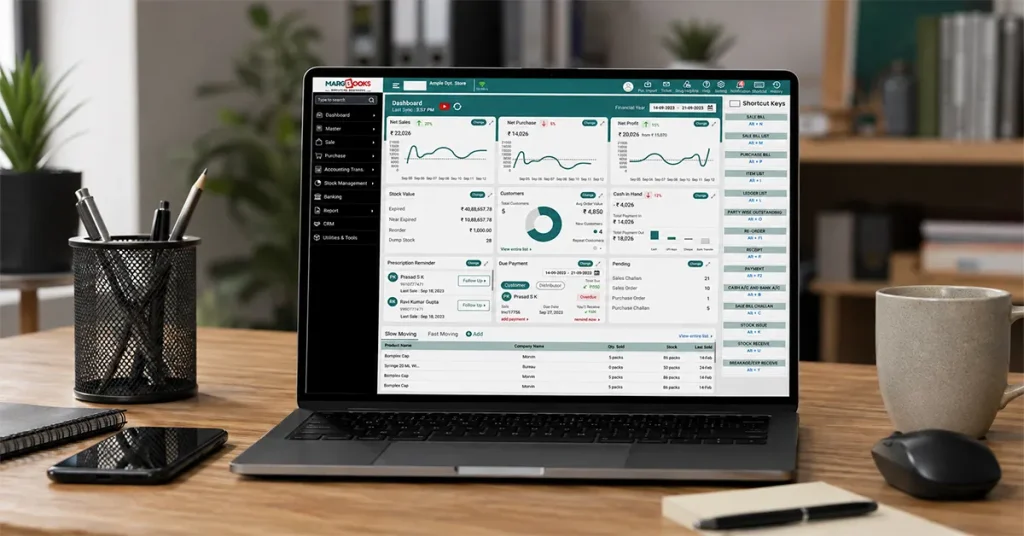
That’s really the value proposition of a GST billing software. Bank feeds get pulled in automatically instead of typed in, so transactions match against your books without someone manually eyeballing a bank statement. Every invoice you raise follows proper double-entry rules in the background, whether or not you’re thinking about debits and credits at that moment. And because it’s built around GST from the ground up rather than bolted on afterward, your books and your returns are less likely to drift apart in the first place.
None of that replaces understanding the basics, though. If you genuinely want to get faster at spotting when something’s off, it still helps to know what the basic rules of accounts actually are, personal, real, and nominal accounts, and why each behaves differently. Software makes the mechanical part faster. It doesn’t make the judgment part unnecessary.
When You Do Find an Error
Don’t just overwrite the wrong number. Record a correcting entry that shows what was wrong and what it’s being changed to; this keeps an audit trail intact, which matters more than it seems like it should until the day someone actually asks for one. If the error affects a period you’ve already closed or reported on, loop in your accountant before making the fix; some corrections need to be reflected differently depending on whether the books for that period are still open.
And if the same type of error keeps showing up- same account, same kind of mistake, different month- that’s not bad luck. That’s a process problem. Worth fixing the process, not just the entry.
Conclusion
Books rarely go wrong all at once. One small, forgettable mistake at a time – that’s how it all starts: a little typo now and then, an invoice that’s forgotten, or a wrongly classified expense. There are too many mistakes that happen without urgency or anyone taking them seriously to turn into a snowball effect over time.
Clean accounting does not imply perfect accounting: on the contrary, it only means that errors are caught early enough, as reconciliation becomes a regular activity, rather than an activity you eventually do when you have time. Whether it is due to hiring a great bookkeeper, following a good checklist, or even using software to automate all the things that are easy to make mistakes in – it does not really matter, as what is important is the idea: that many small checks layered one over another can prevent massive cleanups the minute right before the deadline.
If your current process still relies on typing every transaction by hand and reconciling once a quarter, it might be worth looking at what a tool like MargBooks Software actually automates before assuming the fix has to be “hire more people” or “work more carefully.” It could be possible that errors are removed just because the manual steps have been removed. It so happens that it is at this stage that small discrepancies develop into something massive.
FAQs
Q1. What kind of mistakes in accounting are usually made by small organizations?
The skipping of bank account reconciliation. Since it’s not a special operation, it is the first one missed when there are many things to do. Unfortunately, it’s the place where tiny discrepancies grow into huge ones.
Q2: What approach would enable you to detect this type of error?
This method isn’t difficult. The amount should be indicated with a value that is divisible by nine, which enables switching of the figures (for instance, 54 instead of 45).
Q3. Are compensating errors dangerous even though the totals still match?
Yes, arguably more dangerous than errors that throw the balance off, precisely because nothing looks wrong on the surface. Two mistakes canceling each other out means your trial balance tallies while the underlying numbers, like a specific expense or asset account, are still wrong.
Q4. How often should I reconcile my bank account?
Monthly is the bare minimum for most small businesses. If you are missing a lot of operations, it is better to conduct the operations on a weekly basis. The more time has elapsed since the time of the error, the more difficult it may be to locate it.
Q5. Does accounting software help completely eliminate mistakes or does it just reduce their number?
Just some, the mechanical ones. Software is very good at stopping typos, duplicate entries, and reconciliation drift because it automates the manual steps where those happen. It won’t stop someone from misclassifying an expense out of misunderstanding; that still comes down to training and review.
Q6. What are my next steps if I spot any mistakes from a timeframe which I’ve already closed or submitted my returns for?
It’s not sufficient only to fix the past entry. Record a correcting entry instead, so there’s a clear trail of what changed and why, and talk to your accountant before touching anything that’s already been reported. Closed periods sometimes need the correction handled differently than an open one.
Q7. Is it normal for a small business’s books to have errors at all?
Yes, honestly. The goal was never zero errors; that’s not a realistic bar for any business doing real volume. The goal is catching them quickly, before they compound into something that affects a loan application, a tax filing, or a decision made on bad numbers.

Aman Kannojia is the Digital Team Lead at MargBooks. He started out as an SEO Specialist and never lost his love for words. With 5 years of experience across banking, SaaS, and finance, both domestic and international, he brings strategy, leadership, and storytelling together. He doesn’t just manage a team, he builds one that creates.