Retail Software
 Distribution Software
 Retail Chain

Why Accurate Bills Receivable Journal Entry Important for Accounts and Trial Balance?

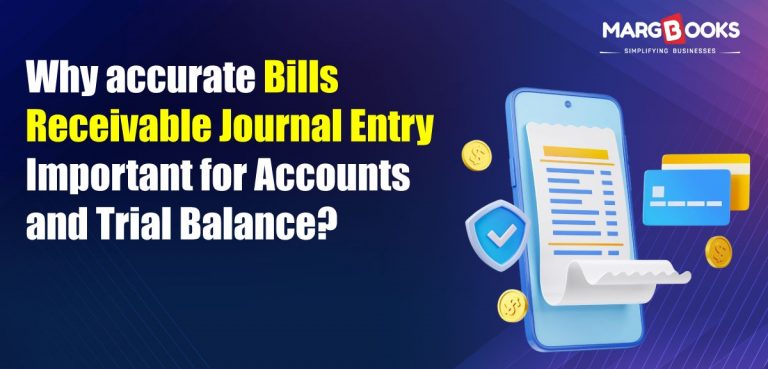
Keeping on top of your business accounts can sometimes feel like being a juggler, especially when you have payments and receipt from many customers. This is where bills receivable journal entry are useful. Essentially, it is the record of money your customers owe your business and keeping this record accurate is paramount to your accounts.
Incorrectness in these entries could propagate your financial statements creating imbalances in your trial balance and creating confusion so much that it could be ignored during audits. In India, the correct tracking and maintenance of these entries allow smooth operations and better visibility of finances for SME firms.
Understanding Bills Receivable Journal Entry
A bills receivable journal entry is literally an inventory of customers who have a debt to your business. It helps to consider it as an IOU raised by the clients for sales on account or services provided on account. Accurate documentation of these will let you know precisely how much money you expect to enter your hands and this is crucial when it comes to managing your business finances.
Example: Suppose there is a fabric supplier in Gujarat who supplies textile to different retailers in various parts of India. Similarly, when a bill is prompted by the trader to the retailer, it should be entered in the book of accounts bills receivable. The entry may be omitted or written incorrectly and the trader could think that the retailer owes less money than is actually owed due to this and get confused at account reconciliation.
Why Accuracy Matters in Accounting and Trial Balance?
When there are mistakes made in bills receivable entries, they may cause the trial balance to be imbalanced and give a wrong projection of your financial model. Consider the following reasons for the criticality of accuracy:
- Profit and Loss Reality: Mistakes in the original income and expense records can overstate or understate your revenue or, by extension, your net profit.
- Financial Statements: Balance sheets and income statements are rendered inaccurate if any of the receivables are incorrectly recorded.
- Audit and Compliance Reports: Mistakes can lead to audit questioning and compliance protests – resulting in potential unnecessary stress and penalties.
Using accounting software can assist businesses in their success in ensuring accuracy and timeliness of all records made in their Bills receivable journal entries and avoid potential errors and save time during reconciliations.
Connection Between Bills Receivable and Business Cash Flow
In other words, the right management of bills receivable directly influences the liquidity of your business. If records are inaccurate, your cash on hand might be overestimated and this might interfere with your daily operations.
Example: A Delhi based electronics wholesaler deals in suppliers delayed payments from the retailers. If they write off billed codes incorrectly, they may have plans to pay providers for items they cannot, because ultimately they spent more money than they have as a result of missing inflows-date of preceding source payment to vendor.
In addition, the sector’s integration with our software can help Indian SMEs better track stock flows which match up exactly against billings, and credit sales match receivables.
Role of Technology in Managing Bills Receivable Entries
The internet has made life easier for companies in keeping their journal entries accurate. Other tools, in contrast, provide perhaps different ways to track receivables automatically, when an auto-updating work list, like MargBooks, is used by SMEs, the chance for error is decreased.
With the use of modern software, Indian companies can easily produce precise reporting, keep a track of unawaited payments, and make sure that it gets all the clarity with regards to their accounts thus. For small business owners, this means:
- Improved visibility of the receivables.
- Minimized possibility of missed entry.
- Accelerated preparation of trial balances.
- Audit related disclosure reporting.
Accounting and entries come under GST billing software isn’t easy, especially for businesses with multiple clients and frequency of credit transactions but technology makes accounting easy and manageable. Most of the SME businesses in India do common mistakes in bills receivable journal entry.
Common Mistakes to Avoid
- Failure to book a bill issued to the customers.
- Duplicating a bill record to end up with two.
- Improper accounting of credit card revenues as revenues or allowance for advance payments.
- Turning a blind eye to the outstanding bills and not updating the book.
How to eliminate or avoid these mistakes:
- On a regular basis, verify the balance of bills with the bank.
- Send automated reminders for users having overdue payments.
Thus, use digital techniques to collect data in software like MargBooks where all bills can be entered and you are notified about any anomalies
Example from an Indian SME
Imagine a basic example of a Surat based small industrial unit of a textile company which uses MargBooks for financial bookkeeping purposes. Any time the order is sent on credit for a fabric order the receivables are entered in the system. This business noticed that making an accurate entry assisted in preventing payment controversies, supported the exclusion of convincing instructional work to keep the adjustments gatherable system adjusted, and increased the estimation of money flows.
By the end of the financial year, reconciliation was easy which made it easier for the auditors as all the books were well organized and clean. MargBooks software made it easier for the team to manage multiple clients efficiently, maintain accurate bills receivable journal entries.
Conclusion
The accurate bills receivable journal entry is the basis of balanced accounts and a fair trial balance. It helps you to report profit, loss, and financial statements accurately according to the health of your business, easier to audit and easier to make decisions. By combining digital tools such as MargBooks software with sound bookkeeping practices.
Indian SMEs will be able to ensure transparency in accounts, better cash flows and fewer errors. By diligence in recording receivables not only do businesses stay within the compliance, but these businesses gain financial discipline and confidence and set the table for a sustainable growth and the comfort of a business that runs smoothly.

MargBooks, a product of Marg ERP Ltd., is a revolutionary cloud-based billing & accounting solution for every business where the business owner can manage the business from anytime anywhere on any device. MargBooks is your one-stop platform for managing your accounting, organizing your transactions, controlling your finances and managing your inventory. It’s a single secure platform to keep up with your company’s bills and invoices, reconcile your transaction, file GST return easily, experience connected banking etc.