Retail Software
 Distribution Software
 Retail Chain


CGST, SGST and IGST on Invoices: What’s the Difference and Which One Applies?

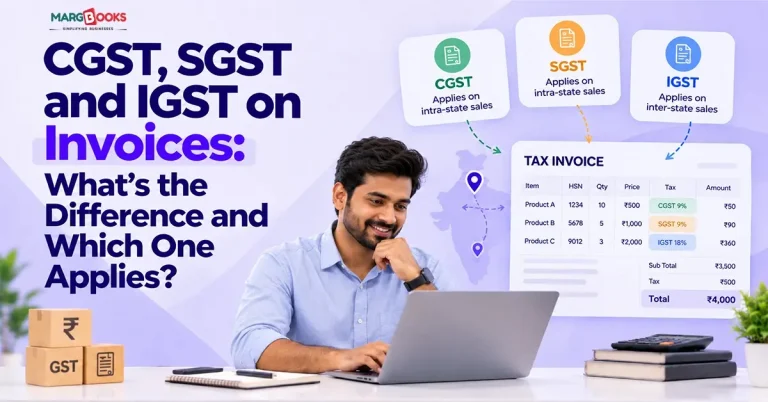
CGST and SGST are charged together when you sell within one state. The GST rate is split evenly: half to the Centre and half to the State. IGST is charged when the sale crosses state lines (or involves an import), and it’s the full GST rate in one line. What decides it is the place of supply, not where your shop or factory sits. That’s the whole rule. The rest of this post is about applying it without making the mistakes that cost businesses real money.
Picture a wholesaler in Delhi. He bills fifty customers a week. Forty are in Delhi, ten are in Haryana and Uttar Pradesh. For years he’s been adding “GST 18%” to every bill and letting his accountant sort out the rest at month-end.
Then a buyer in Noida writes back: “Your invoice shows CGST and SGST. I can’t claim credit on this.” He’s right. It should have been IGST.
A wrong tax head isn’t a typo. It can block your customer’s input credit, throw your GSTR-1 and GSTR-3B out of sync, and leave you correcting invoices months later. Let’s fix it at the source.
What are CGST, SGST and IGST?
GST in India is a dual tax. Both the Centre and the states get a share, so every sale carries two pieces of tax. How those pieces appear on your invoice depends on the type of sale.
- CGST (Central GST) goes to the central government.
- SGST (State GST) goes to the state where the sale takes place.
- IGST (Integrated GST) is collected by the Centre on inter-state sales, then shared with the state where the goods or services are finally consumed.
Union Territories without their own legislature use UTGST in place of SGST. It works the same way, so we’ll stick to SGST here.
CGST vs SGST vs IGST
CGST Vs SGST vs IGST: these are the few pointers based on which the comparison is taking place.
| CGST | SGST | IGST | |
| Full form | Central GST | State GST | Integrated GST |
| When it applies | Sale within one state | Sale within one state | Sale between states, imports, exports |
| Who collects it | Central government | State government | Central government, shared with destination state |
| Share of the rate | Half | Half | The full rate |
| Credit can be used against | CGST, IGST | SGST, IGST | IGST, then CGST, then SGST |
The total tax is the same either way. An 18% item carries 9% + 9% inside a state, or 18% across states. Only the labels change.

How to Show CGST, SGST and IGST on a GST Invoice
You only need to answer three questions to know how to show CGST, SGST AND IGST on a GST Invoice.
1. Where is the supplier located? That’s the state in your GST registration.
2. What is the place of supply? For goods, it’s usually where the goods are delivered or where their movement ends. For services, the rules are more detailed, but the customer’s location is often the key.
3. Are they in the same state?
- Same state → CGST + SGST
- Different states → IGST
- Import, export, or supply to an SEZ → IGST
That third bit catches people out. A shopkeeper in Gurugram selling to a customer who walks in and pays cash is an intra-state sale. But if that same customer asks you to ship the goods to Jaipur, the place of supply is Rajasthan, and it’s now an IGST invoice. Getting the supply type right also depends on the right classification.
Two examples with real numbers
Take an item priced at ₹10,000 with an 18% GST rate.
Example 1: Sale within the same state
A hardware dealer in Lucknow sells to a contractor in Kanpur. Both are in Uttar Pradesh.
- Taxable value: ₹10,000
- CGST @ 9%: ₹900
- SGST @ 9%: ₹900
- Invoice total: ₹11,800
Example 2: Sale to another state
The same dealer sells the same item to a contractor in Jaipur.
- Taxable value: ₹10,000
- IGST @ 18%: ₹1,800
- Invoice total: ₹11,800
Same customer cost, same total tax. Different columns on the invoice, and very different treatment in the returns.
Always check the current GST rate for your product before billing. Rates and slabs get revised, and 18% is used here only to keep the maths easy.
What a GST invoice must show
Whichever tax applies, a proper tax invoice carries:
- Your name, address and GSTIN
- The buyer’s name, address and GSTIN (for B2B)
- Invoice number and date
- HSN or SAC code
- Description, quantity, and taxable value
- Tax rate and the amount under each head (CGST and SGST, or IGST)
- Place of supply
- Total invoice value
Missing the place of supply is one of the most common gaps we see, and it’s the very field that decides your tax head.
If you’d rather not build this by hand every time, GST billing software fills in the correct split automatically once you enter the buyer’s state.
Common Mistakes When Choosing the Tax Head
Here are the common mistakes that people often make while choosing the tax head.
Charging CGST + SGST on an out-of-state sale: The most common one by far. The buyer can’t use the credit, and you’ll need to issue a credit note and a fresh invoice.
Using your own state as the place of supply for services: For many services, the customer’s location matters, not yours.
Picking the wrong HSN code: The wrong code often means the wrong rate, which means the wrong tax on top of the wrong head.
Splitting the tax unevenly: CGST and SGST must be equal. If they’re not, something is off.
Fixing everything at month-end: By then you’ve issued dozens of invoices with the same error. It’s easier to catch it at the billing counter than in the return.
How the tax head affects your credit
The split matters because of how Input Tax Credit (ITC) works. The credit you earn under one head can only be used against certain liabilities.
- CGST credit pays CGST first, then IGST. It can never pay SGST.
- SGST credit pays SGST first, then IGST. It can never pay CGST.
- IGST credit pays IGST first, then CGST, then SGST.
From invoice to return
Every invoice you raise feeds your GST return. Your outward supplies, tax head by tax head, go into GSTR-1, and your final liability is settled in GSTR-3B. If the invoice says IGST but your books say CGST + SGST, the mismatch shows up quickly.
Businesses above the e-invoicing threshold also need an Invoice Reference Number (IRN) for B2B invoices. A good e-invoice software generates the IRN as you bill, so there’s no separate step to forget.
Conclusion
On a busy Saturday, nobody wants to cross-check states and rates by hand. The easiest fix is to take that decision away from the billing counter: pick the customer, and the tax head follows from their state, with the rate coming from the item’s HSN code.
Most modern billing tools work this way. In MargBooks software, for example, the CGST and SGST (or IGST) split is applied the moment you choose the party, and the same invoice data carries into your returns. I
FAQs
Q1. What is the difference between CGST, SGST and IGST?
CGST and SGST are charged together on sales within one state, each at half the GST rate. IGST is charged on sales between states and on imports, at the full rate. The total tax is the same in both cases.
Q2. Under what circumstances is IGST applied instead of CGST and SGST?
IGST applies when the supplier and recipient are located in different states or when the supply involves an import, export, or supply to an SEZ.
Q3. Is it possible for CGST, SGST and IGST to be shown on one invoice?
No. Since a particular supply can only be either an intra-state supply (CGST + SGST) or an inter-state supply (IGST), it is necessary to issue two different invoices if two clients are in different states.
Q4. Is the IGST rate equivalent to the sum of CGST and SGST?
Yes. When an item is taxed at 18%, there will be 9% CGST and 9% SGST intrastate, whereas interstate it will be 18% IGST.
Q5. What happens if I charge the incorrect tax amount on an invoice?
The buyer might not be able to claim input credit, your returns might not be in accordance, and you might receive a notice or have to reissue the invoice. The usual remedy is to issue a credit note along with an adjusted invoice.
Q6. Can CGST credit be used to pay SGST?
No. CGST credit can pay CGST and IGST only, and SGST credit can pay SGST and IGST only. IGST credit can pay all three.
Q7. Which tax applies to online sales across states?
IGST, since the place of supply is the buyer’s state. Sellers who use marketplaces can save time with e-commerce seller software that creates GST-ready invoices for each order.

Aman Kannojia is the Digital Team Lead at MargBooks. He started out as an SEO Specialist and never lost his love for words. With 5 years of experience across banking, SaaS, and finance, both domestic and international, he brings strategy, leadership, and storytelling together. He doesn’t just manage a team, he builds one that creates.