Retail Software
 Distribution Software
 Retail Chain


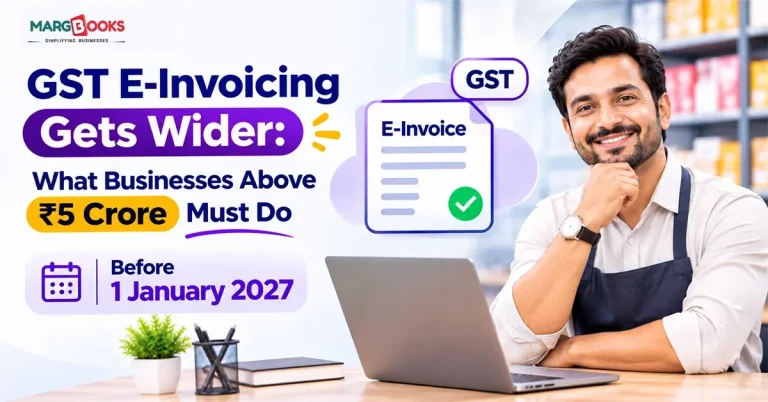
GST E-Invoicing Gets Wider: What Businesses Above ₹5 Crore Must Do Before 1 January 2027

Quick Summary
From 1 January 2027, GST e-invoicing extends to two more transactions: purchases from unregistered suppliers where you pay GST under reverse charge (RCMDOM) and imports of services (RCMIMP). Businesses already under e-invoicing, meaning turnover above ₹5 crore in any year since 2017-18, must generate an IRN for these self-invoices. There’s no new turnover limit, and your tax amount doesn’t change. The change comes from Notifications 04/2026 and 05/2026 (Central Tax), dated 26 October 2026, and you can generate IRNs voluntarily from 15 to 31 December 2026 before the requirement becomes mandatory. To prepare, check your turnover history, list your RCM and import transactions, confirm schema 1.2 support with your software provider, test in the sandbox, and decide who raises these invoices and when.
- Typical advance: 70% to 90% of the invoice value
- Typical cost: About 1% to 3% of the invoice over 30 to 90 days
- Speed: Often 24 to 72 hours once your facility is set up
- Best for: B2B businesses that wait 30 to 90 days to get paid
- Main catch: The annualized cost can be high, so always compare effective rates
As of January 1, 2027, two additional types of purchases necessitate an e-invoice: payment for goods purchased from an unregistered vendor through the reverse duty mechanism (RCMDOM) and payment for services known as the reverse charge mechanism for services (RCMIMP). If your business already generates e-invoices, your self-invoices should be approved by the IRN before the deadline.
There are no other changes. The limit of Rs.5 crores remains in place, and your tax liability is unaffected. The only aspect that changes is the paperwork and process. The information on what has been communicated, the entities, and their compliance is given below.
What has changed in GST e-invoicing from 1 January 2027?
The government has brought reverse charge self-invoices into e-invoicing. Two notifications dated 26 October 2026 set it up, and GSTN’s advisory fills in the timeline:
- Notification No. 04/2026 Central Tax extends e-invoicing to the two new categories from 1 January 2027.
- Notification No. 05/2026-Central Tax updates FORM GST INV-01 from schema version 1.1 to version 1.2, which adds the new supply types.
- GSTN Advisory No. 688 (17 November 2026) confirms the rollout dates and says the sandbox is ready.
A self-invoice refers to an invoice prepared by the buyer on their own because the supplier is either not able or does not need to prepare one. In cases of reverse charge GST, it is the responsibility of the buyer to prepare an invoice. Up until now, self-invoices were exempt from having to get an IRN. However, from January, they will be subject to the new regulation.
Two new types of supplies have been introduced:
RCMDOM: Self-invoicing for a specific domestic supply made by an unregistered person where tax needs to be paid under the RCM.
RCMIMP: Self-invoicing for the import of services from outside India, where tax has to be paid under the RCM rule.

Who needs to comply with RCM e-invoicing?
The new RCM e-invoicing guidelines hold true for those already registered for e-invoicing. So basically, it means that the business is in the e-invoicing realm if its turnover has exceeded ₹5 crore in any of the years since 2017-18.
Here is how you can see it:
- If your turnover went above ₹5 crore in any of the years since 2017-18 and you already issue e-invoices, yes, you belong here.
- If you are an e-invoicer and are paying GST under RCM because of purchases from unregistered dealers or imported services, yes, this applies to you.
- If you are an e-invoicer but you don’t have any RCM purchases and hence no output, you should ensure your system is ready in case anything changes along the way.
- If you have never crossed the ₹5 crore limit, the new mandate currently does not apply to you.
Also, regarding the exemptions, it is believed that the categories that are exempt from e-invoicing will remain unchanged, but consult with your CA to check if your status holds up.
Which transactions are covered under the new updates?
One must fulfill two conditions: first, the transaction calls into play the reverse tax credit, and second, the transaction falls into one of two categories. One should note that not all transactions involving non-registered suppliers are subject to the reverse charge mechanism, nor are all transactions that attract the reverse charge mechanism necessarily related to the terms of the reverse charge mechanism for domestic purposes. Thus, it is prudent to analyze the entries in the reverse charge mechanism ledger and find out whether any of them could be classified as reverse charge mechanism for domestic purposes.
As for imports, consider E-invoicing software subscription or cloud subscriptions, as well as design and marketing services and consultancy services provided by a supplier from a different country and on which the reverse charge mechanism is applied.
| Transaction | Supply type | IRN needed from 1 Jan 2027? |
| Specified domestic supply from an unregistered person, tax payable by you under RCM | RCMDOM | Yes, if you are under e-invoicing |
| Import of services from a supplier outside India, tax payable by you under RCM | RCMIMP | Yes, if you are under e-invoicing |
| Purchase from an unregistered supplier where RCM does not apply | None | No |
| Foreign vendor that is registered in India and charges you GST | Regular invoice | No, the vendor handles it |
One more caution. Some commentators advise against assuming the older self-invoice rules carry over to imports word for word. Read the notification text for your case, and ask your CA if you’re unsure.
Key dates for RCM e-invoicing
In the table below, we have given key dates for RCM e-invoicing.
| Date | What happened or happens |
| 16 October 2026 | GSTN’s first advisory on the new facility |
| 26 October 2026 | Notifications 04/2026 and 05/2026 (Central Tax) issued |
| 17 November 2026 | GSTN Advisory No. 688 on implementation |
| 15 December 2026 | Production accepts RCMDOM and RCMIMP documents dated on or after this day; voluntary IRN generation begins |
| 31 December 2026 | Voluntary window ends |
| 1 January 2027 | E-invoicing becomes mandatory for RCMDOM and RCMIMP |
The sandbox for the new types is already live on all six Invoice Registration Portals. Specs and validation codes are on the NIC e-Invoice developer portal.
How do you prepare in five steps?
Here are the five steps through which you can prepare for the upcoming changes.
Examine your revenue history: Check the numbers for all the years from 2017-18 onwards. Just one year in which you made more than ₹5 crore is sufficient.
Prepare a list of RCM and import transactions: Go through the RCM data for the last year and identify which ones are domestic unregistered purchases and which ones belong to imported services. This would give you an idea of the number of IRNs you will be generating.
Talk to your software vendor regarding schema 1.2: Your billing or ERP system must support RCMDOM and RCMIMP and the new schema. Get it in writing and with an appropriate date.
Test in the sandbox: Run a few test cases using a dummy self-invoice in the IRP sandbox before going live. Fine-tune the errors now and not after 2nd January.
Finalize who will be issuing these invoices and when these invoices will be issued: Self-invoices used to be generated in bulk at the end of the month. That’s no longer possible since every self-invoice would require an IRN. Thus, decide who is responsible for generating the invoices.
Common mistakes to avoid
Here are the common mistakes to avoid while you are upgrading to the new rules-
- Assuming that each foreign supplier falls under the Reverse Charge Mechanism: Some of the foreign suppliers are registered in India and charge you GST; hence, no self-invoice is required.
- Skipping the sandbox: When you practice on live records, the incorrect entries appear on the portal.
- Forgetting the previous turnover: The business that achieves a turnover of ₹5 crore in 2019-20 and then falls below the limit is still considered eligible.
- Expecting everything to commence from 1 January: The business starts only on 15 December. These two weeks’ few trial runs will be much cheaper than catching up some headway in the first week of the mandatory launch.
- Assuming that the reverse charge mechanism applies to all purchases: Confirm whether this mechanism applies to this purchase before taking it as granted.
Conclusion
If you’re already utilizing e-invoicing, then new types of self-invoices will be added to your operations from July 1, 2027. Thankfully, the list of to-dos is very brief: review your turnover history, list your entries related to RCM, obtain confirmation regarding schema 1.2 installation from your software leader, test your solution in a trial environment, and identify the ways to issue those invoices. If you have been using the software package of MargBooks, get in touch with your Marg support specialists in order to learn what RCMDOM and RCMIMP mean for your setup.
This article is general information, not tax advice. Your facts may differ, so speak to your chartered accountant before you finalise anything.
FAQs
Q1. When does e-invoicing become mandatory for RCM self-invoices?
As per Notification No. 04/2026-Central Tax, IRNs will come into force from January 1, 2027; hence, it is mandatory to obtain the IRNs. The IRNs can be obtained using the production system voluntarily from December 15, 2026; however, they are not compulsory. This period can be used for trial purposes by your company and team.
Q2. What are RCMDOM and RCMIMP?
RCMDOM and RCMIMP are the two new types of supply introduced in the e-invoice schema. RCMDOM refers to self-invoicing for domestic supply. The supplier in RCMDOM is a person who is unregistered and liable to tax under the reverse charge mechanism. RCMIMP refers to self-invoicing for services imported, and the tax under RCM is paid.
Q3. Who must generate an IRN for these transactions?
Registered businesses already subject to e-invoicing, i.e., businesses that have aggregate turnover of more than ₹5 crore in any year during FY 2017-18 and thereafter, exempted by the existing provisions. If you fit this category and you have made RCM purchases for these two types of transactions, you will generate the IRN directly as the receiving party.
Q4. Is there a new turnover limit?
All businessmen whose total turnover for any year has surpassed ₹5 crores at least since the financial year 2017-18 (but subject to the merit exemptions as per the provisions of this legislation) will presumably be within the ambit of e-invoicing. If you fall under this category of persons and have acquired goods or services under the two types of RCM purchases, you are the one to prepare IRN as a party to the transaction.
Q5. Can I generate IRNs before 1 January 2027?
Yes, though not in the way it sounds. The system is going to accept RCMDOM and RCMIMP documents starting on Dec 15 and until Dec 31, 2026, which will be beneficial for trying the system with real data. However, be advised that this is optional, and the application of the regulation comes into force only from Jan 1, 2027.
Q6. Do all imported services need an e-invoice?
No. Only those imported goods for which you need to pay GST under reverse charge and that are also subject to e-invoicing receive this treatment. Services rendered by a supplier based in India and charging GST do not fall under this regulation since such vendors are creating invoices.
Q7. Where can I test the new functionality?
In the sandbox environments of the Invoice Registration Portals, both the RCMDOM and RCMIMP versions have been deployed in different places. The technical specifications and validation codes are available on the NIC e-invoice API developer website at einv-apisandbox.nic.in, so your IT or vendor team can refer to it.
Q8. Does the GST amount change?
Not really. The partner’s liability for reverse charge remains unchanged. The only change is in registering and reporting self-invoices.

Aman Kannojia is the Digital Team Lead at MargBooks. He started out as an SEO Specialist and never lost his love for words. With 5 years of experience across banking, SaaS, and finance, both domestic and international, he brings strategy, leadership, and storytelling together. He doesn’t just manage a team, he builds one that creates.