Retail Software
 Distribution Software
 Retail Chain

What Is an Outstanding Amount? Meaning, Types & How to Manage It

Something a shop owner said once resonated with me. He claimed he was doing well month after month, but he was still borrowing money from his brother-in-law to pay his salaries. Turned out almost 40% of his sales that quarter were sitting unpaid with regular customers he’d been giving credit to for years, out of habit more than anything. Nobody had actually chased them.
That’s an outstanding amount, in one story. Money that’s technically yours but isn’t actually with you. It’s such a common problem that most business owners have some version of that shopkeeper’s story. Goods delivered, invoice raised, and then… silence. The sale looks great in your ledger. Your bank account disagrees. Let’s delve into this discussion about the term “outstanding amount”, what it means, and what forms it can take, as well as how to handle it when it builds up.
What Does Outstanding Amount Mean
Simplest way to put it: it’s money owed that hasn’t been paid yet. Could be your customer owing you. Could be you owing your supplier. Same word, either direction.
Quick example. You raise a bill for ₹50,000, give the client 30 days to pay. Until that money actually lands in your account, ₹50,000 sits as an outstanding receivable in your books. Now flip the situation – you bought material on credit and haven’t cleared your supplier’s bill yet. That’s now your outstanding payable. The term is used in the same way; it all depends on the perspective from which it is viewed.
Many people mix up the terms “outstanding” and “overdue”. Though they sound similar, there is a connotative difference between the two. Outstanding just means unpaid, full stop, and the due date could still be two weeks away. Overdue means that the date has already passed, and there’s still no payment. So yes, an overdue bill is always outstanding. But an outstanding bill isn’t necessarily overdue yet; it might just be waiting its turn.
Does the difference matter practically? It does, actually. If you’re treating every outstanding invoice like it’s already overdue, you’ll waste time calling customers who still have a week left on their credit terms, and annoy them in the process. Good accounting software separates the two automatically, so you’re not guessing which invoices genuinely need a phone call today.
Why This Isn’t Just a Bookkeeping Footnote
It’s easy to file outstanding amounts under “something the accountant handles.” Wrong instinct. This is a cash problem, and cash problems are the ones that actually shut businesses down.
Here’s the uncomfortable part – a business can be profitable on paper and still run out of money. If a big chunk of what you’ve earned is parked with customers who haven’t paid, your actual cash position doesn’t match your reported profit at all. Salaries are due Friday regardless. Rent doesn’t wait for your customer’s convenience. And this is exactly where growing businesses trip up, because sales numbers look fantastic in the monthly review while the bank balance quietly tells a different story.
Then there’s working capital, which is just the cushion that lets a business function day to day – pay people, restock, cover the boring recurring costs. Tie too much of that up in unpaid receivables, and you’re effectively running your operations on a smaller budget than your revenue should allow.
And there’s a harder truth, too. Some outstanding amounts never get collected at all. The longer an invoice goes unpaid, the closer it drifts toward becoming a bad debt instead of a delayed one. This is really the whole argument for checking your ageing reports regularly, rather than discovering half a year later that a customer was never going to pay in the first place.
The Different Kinds of Outstanding Amounts
Outstanding amounts aren’t all the same animal. Depending on where you’re looking in your accounts, they show up differently, and each type needs its own handling.
Receivables — what customers owe you
The obvious one. Goods went out, the invoice went out, and the payment hasn’t come back yet. If you’re still tracking this in a notebook or a basic spreadsheet (and a surprising number of businesses are), it holds up fine until you cross maybe 20-30 active customers, then things start slipping through. A partial payment doesn’t get logged properly. A due date gets buried under everything else you’re doing that week. Online invoice software solves a lot of this just by putting a timestamp and live status on every invoice, so nothing quietly disappears.
Payables — what you owe someone else
Flip side of the same coin. Maybe you bought stock on credit terms, or a contractor did work for you and hasn’t been paid out yet. It’s tempting to think this side matters less than receivables, but unpaid vendor bills are exactly how supplier relationships go sour over time. Nobody likes being the business that always needs a “gentle reminder” call. A decent billing system puts these due dates in front of you before the supplier has to bring them up.
Outstanding expenses
Sneakier category, this one. There’s no invoice pushing you to notice it – just salaries pending, an electricity bill sitting there, and rent that hasn’t gone out this month. Accountants call these accrued expenses. Easy to lose track of exactly because nothing’s nudging you except a date on a calendar.
Outstanding GST or tax dues
If you’re GST registered, there’s a version of this owed to the government too – tax collected but not yet deposited, or liability that’s built up but not settled. Comes up most around filing time, when you’re working through returns like GSTR-1 or GSTR-3B. Miss this or get it wrong, and penalties show up fast, so GST billing software that actually calculates your liability correctly is worth having rather than working it out by hand every quarter.
How You Actually Calculate Outstanding Amount
Nothing complicated about the math itself:
Outstanding Amount = Total Invoice Value minus Payment Received So Far
Bill ₹1,20,000. Customer pays ₹80,000. The remaining ₹40,000 is your outstanding amount on that one invoice. Fine on a single bill, anyone can do that in their head.
The problem shows up at scale. Do this across a hundred invoices, a dozen-plus customers, staggered due dates, partial payments trickling in at random times, and suddenly it’s not a five-minute job anymore, it’s practically a part-time role. Miss one entry, and your outstanding total is wrong, and you won’t know it’s wrong until reconciliation forces you to go digging through everything again. This is generally where businesses stop relying on manually maintained balance sheet formats and move to something that updates the figure the second a payment actually comes in.
Where Things Usually Go Wrong
Nobody struggles with outstanding amounts because the concept is confusing. It’s the daily tracking that falls apart. A few recurring culprits:
Manual entry slips are the easiest to spot in hindsight – one wrong cell in Excel and the whole outstanding report is off, sometimes for weeks before anyone notices. Follow-ups get postponed too; without some kind of nudge or reminder built in, chasing a payment becomes “I’ll do it tomorrow” until tomorrow quietly becomes next month.
Multiple branches make it worse – knowing your real, current outstanding position across all locations at the same moment is genuinely hard without a system doing it for you. Bank reconciliation throws up its own mess, particularly when partial payments arrive and don’t get matched against the right invoice. And if payables are linked to stock purchases, weak inventory tracking means bills can sit forgotten until the supplier calls you about it.
None of this is unusual or embarrassing, honestly. It’s just what happens once a business has outgrown spreadsheets but hasn’t yet moved to something purpose-built.
What Actually Fixes This
Everything can be managed. With some effort and a bit of help, and outstanding amounts will cease to be troublesome.
Set credit terms clearly before you extend them. Sounds like common sense, but a huge share of “late payments” trace back to nobody actually agreeing on a deadline to begin with.
Let reminders do the chasing instead of you doing it manually every time, which – let’s be honest – feels a bit awkward no matter how many times you’ve done it. An automated nudge keeps the pressure on without making it personal.
Move invoicing to digital wherever possible, WhatsApp or email, whatever your customers actually respond to. Beyond just being convenient, it also kills the “we never got the invoice” excuse, because now there’s a clear timestamp and trail.
Reconcile more frequently than feels necessary. Don’t leave it for the month-end. A weekly check against your bank statement catches small mismatches while they’re still small, instead of after they’ve compounded into something painful.
And actually look at your ageing report – the 30/60/90 day split. A ten-day-old outstanding invoice and a three-month-old one need completely different levels of urgency, and treating them the same wastes energy on the wrong accounts.
You can manage all of this by hand if you want to. Most businesses simply don’t have the spare hours for it.
Where MargBooks Comes Into the Picture
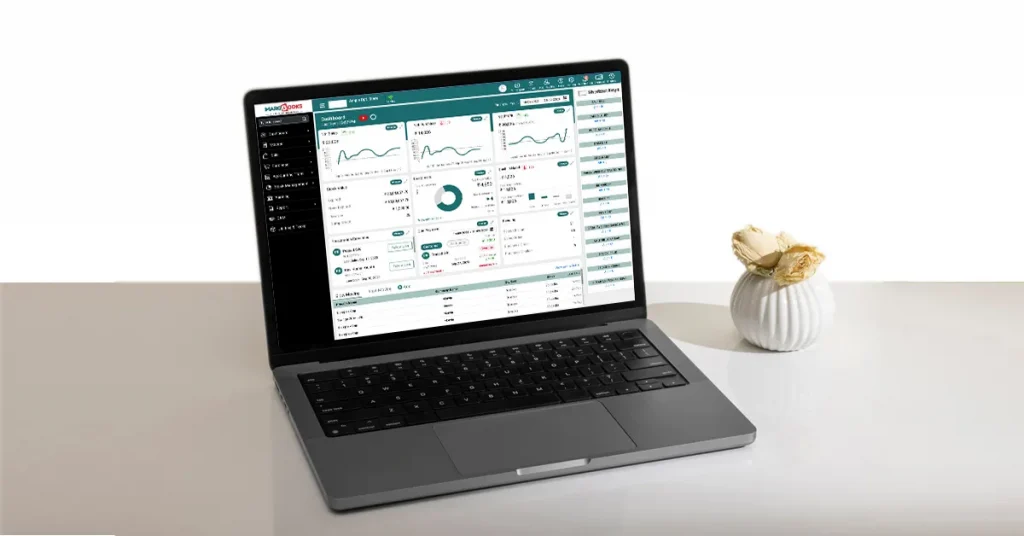
This is essentially the exact gap MargBooks was built to close. Instead of stitching together spreadsheets, WhatsApp threads, and whatever you remember, there’s one place showing what’s coming in and what’s going out, updated live rather than reconstructed at month-end.
A few specific things it takes care of: reminders go out on their own, so you’re not the one making that slightly awkward follow-up call every week. Receivables and payables both sit on a single dashboard, live, so you’re never guessing where your cash actually stands. Invoicing stays GST-compliant automatically, which cuts down disputes and keeps your filing clean when the time comes. And reconciliation runs against your actual bank feed, so the outstanding number you’re looking at genuinely matches your bank balance.
Doesn’t really matter if you’re tracking twenty invoices or running books across five branches. Once you can actually see the full picture at once, planning cash flow stops being a guessing game.
Conclusion
You’ll never get outstanding amounts to zero. That’s just what running a business on credit involves: always some transit money. But there’s a real gap between businesses that get blindsided by their own cash position and businesses that always know roughly what’s pending, who owes it, and when it’s likely to land.
If a spreadsheet is still doing all the heavy lifting for you, it’s probably worth trying MargBooks software and seeing what it looks like when this whole thing runs mostly on its own.
FAQs
What does the outstanding amount actually mean in accounting?
It’s the part of a bill still unpaid, which could be money owed to you, or money you owe someone else.
How’s that different from “overdue”?
The term outstanding refers to something straightforward, meaning that an invoice might not have been paid yet, but it still can be paid at some point in the future. On the other hand, overdue refers to something that has already passed its due date and should have been paid already, but has not yet been satisfied.
How do you get the outstanding amounts paid off?
Make sure one is clear about the credit terms before offering such a service, remind clients about payments through calls or emails, and regularly check the aging report to find the ones that need to be approached for payments urgently.
Can software handle this without me tracking it manually?
Yes, that’s basically the point of something like MargBooks. Invoices and payments get logged as they happen, and the outstanding figures update themselves.

Aman Kannojia is the Digital Team Lead at MargBooks. He started out as an SEO Specialist and never lost his love for words. With 5 years of experience across banking, SaaS, and finance, both domestic and international, he brings strategy, leadership, and storytelling together. He doesn’t just manage a team, he builds one that creates.