Retail Software
 Distribution Software
 Retail Chain

Accounts Payable vs Accounts Receivable: What’s the Real Difference?

One of the first lessons you learn when you start a new business is the truth of the saying that one is never simply a seller or a buyer. Payment needs to be made to the supplier for the goods that arrived last Tuesday. At the same time, receipt of payment is still awaited from some customers for the delivery made yesterday. A piece of paper regarding both expenses and income is sitting on the same desk, but these papers mean absolutely different things.
This is the essence of accounts payable and receivable. One account records outstanding bills that need to be settled, and the other is merely a form of debt. That sounds quite simple, but it is only until one stops keeping track of one of those accounts, and then it happens to show up in one’s bank account before being recorded anywhere else.
To put it in simple terms, accounts payable is the money owed to suppliers, i.e., a liability, while accounts receivable is the money that customers owe to the company, which constitutes an asset.
What Is Accounts Payable (AP)?
Accounts payable is, to put it simply, the money you owe. The obligation is short-term and refers to the amounts owed for the goods received or services rendered by the supplier and/or vendor. Your wholesaler dropped off the goods, sent the invoice, and you haven’t cleared it yet. That invoice is sitting in your AP right now.
One mix-up worth clearing up early: AP isn’t every rupee leaving your account. Payroll doesn’t fall under it. Neither does a long-term equipment loan, though the instalments due on that loan get treated similarly once they come up. AP is really about trade payables, inventory, raw material, services from vendors, and the everyday running costs of the business.
On the balance sheet, this shows up under current liabilities. And in most small setups, it’s whoever handles the books, sometimes just the owner, let’s be real, who’s keeping an eye on it, making sure vendor bills get checked and paid within terms. Do that well, and vendors start trusting you with better credit. Slip up a few times, and suddenly everyone wants an advance payment.
How an Accounts Payable Entry Gets Recorded
Roughly, this is how the accounts payable process is :
- A purchase order goes out for whatever stock or service you need.
- The vendor delivers and sends across the invoice, GST-compliant, ideally.
- Someone checks that the invoice against the PO and the goods actually received. Quantities, rates, GST, all of it needs to line up.
- Once it checks out, it gets entered as a liability in the books.
- Whenever payments are due, it doesn’t matter whether it is Net 15, Net 30, Net 45, etc. Most GST-compliant businesses utilize accrual accounting here, meaning that the expense is recorded at the time that the invoice comes in, not at the time that money gets withdrawn from the account.
Most GST-registered businesses follow accrual accounting here, meaning the expense gets booked the moment the invoice comes in and passes verification, not whenever the payment physically leaves the account. Keeps things compliant, and honestly, it keeps the books a lot more accurate too.
Accounts Payable Example
Take Shree Traders, a small retail distributor. They buy ₹50,000 worth of stock from their wholesaler on Net 30, GST included. Goods ship on the 5th, invoice arrives the same day.
From Shree Traders’ end, that ₹50,000 (plus GST) now sits as accounts payable. A liability due by the 4th of next month. Until it’s paid, it stays on the books exactly like that money owed, not money spent.
What Is Accounts Receivable (AR)?
Flip it around, and you get accounts receivable, what customers owe you for goods or services you’ve already handed over and invoiced. Shipped the order, sent the bill, customer hasn’t paid, that’s sitting in AR.
On the balance sheet, this lands under current assets, since it’s money you can reasonably expect to collect. Whoever runs collections in your business could be a full team, or it could just be whoever remembers to call and owns this part. Invoice fast, follow up before things go overdue, chase down what’s slipping through.
How an Accounts Receivable Entry Gets Recorded
The flow looks like this:
- Goods delivered or service completed.
- Invoice raised right then, not two weeks later.
- That invoiced amount gets booked as accounts receivable.
- Customer pays, entry closes.
Here’s a detail a lot of business owners miss: GST output liability kicks in the second you raise that invoice, not whenever the customer actually pays. So a customer can sit on an unpaid bill for two months, and you’ve still picked up the GST liability on day one. Which is exactly why sloppy AR tracking doesn’t just wreck your cash flow, it quietly messes with your GST filings too.
Accounts Receivable Example
Same transaction as before, just flip the seat. The wholesaler who sold Shree Traders that ₹50,000 of stock on Net 30 records the same amount, only now it’s accounts receivable on their books. They’re expecting to collect within 30 days.
Same invoice. Same ₹50,000. Same due date. One business calls it a debt they owe, the other calls it money they’re owed. That’s really the entire relationship between AP and AR, compressed into one transaction.
Accounts Payable vs Accounts Receivable
Let us discuss amounts payable Vs accounts receivable in tabular format.
| Basis | Accounts Payable | Accounts Receivable |
| What it represents | Money you owe | Money owed to you |
| Balance sheet classification | Current liability | Current asset |
| Whose record is it | Buyer’s own record | Seller’s record of a customer |
| What triggers it | Receiving a supplier invoice | Raising a customer invoice |
| Risk if mismanaged | Damaged vendor relationships, late fees | Cash flow crunch, bad debts |
| Key metric to track | DPO (Days Payable Outstanding) | DSO (Days Sales Outstanding) |
| GST impact | Input Tax Credit (ITC) eligibility | Output GST liability at the time of invoicing |
Key Differences between Accounts Payable and Accounts Receivable
Asset versus liability is really the fastest way to keep these two straight in your head. Accounts receivable count as an asset because you’re reasonably banking on that money landing in your account within an agreed window. Accounts payable counts as a liability because you’re obligated to pay it out on a set timeline, whether or not it’s convenient that month.
There’s a control side to this, too, and it’s worth mentioning even though it sounds like overkill for a small business. Ideally, the person entering supplier invoices isn’t the same person approving and releasing payment. Even a two- or three-person accounts team benefits from splitting this; it’s a basic guardrail against errors slipping past unnoticed, and honestly against the occasional deliberate one too.
Auditors and CAs also approach AP and AR very differently. On the payables side, they’re usually hunting for quantity mismatches or overbilling. Did you actually get what you were charged for? On receivables, the scrutiny really ramps up once an invoice crosses 90 to 120 days overdue. That’s the point where a business has to ask, honestly, whether that money’s ever showing up, or whether it needs writing off.
GST and Tax Treatment of AP and AR
This is where things look pretty different for Indian businesses compared to most generic accounting content floating around online.
On the payables side, GST paid to your supplier can usually be claimed as input tax credit, provided the goods or services actually arrived, and the invoice meets the conditions set under GST law. Getting the timing right matters here because it directly feeds into your GSTR filings and how much ITC you can set off against your own output liability.
On the receivables side, output GST liability arises the moment you raise the invoice, not when the customer eventually pays. This one catches a lot of small business owners off guard. You end up owing GST on an invoice that’s still sitting unpaid in your AR three weeks later.
There’s a TDS piece worth knowing too, particularly under provisions like Section 194Q, which affects how certain payables get treated, and separately, how TDS receivable needs tracking against Form 26AS. If you want to go deeper into that specific bit, our breakdown on recording TDS receivable entries correctly covers the mechanics.
None of this replaces an actual chat with your CA; GST provisions shift often enough, and thresholds get revised, but knowing the basic mechanics means you won’t get blindsided.
How AP and AR Work Together
Go back to Shree Traders. That single invoice was a payable on one side and a receivable on the other, at the exact same time. Every transaction your business ever does works like this: someone’s outgoing bill is someone else’s incoming one.
So what does a healthy balance actually look like? If your AR keeps running large while AP stays small, that can be a warning sign; you’re extending too much credit to customers and not collecting fast enough, even while you’re paying your own suppliers on the dot. Flip that around, and a business with a smaller AR and a comparatively bigger AP might actually be doing fine, collecting efficiently while making good use of supplier credit, as long as that reliance on supplier credit doesn’t spiral.
Two numbers help you keep score. DPO tells you how long, on average, it takes you to pay your own suppliers: average accounts payable divided by cost of goods sold, times the number of days in the period. DSO tells you how long it takes customers to pay you: accounts receivable divided by total credit sales, times days in the period. Track both monthly, and you’ll spot a cash flow issue coming long before it actually lands.
How to Manage Accounts Payable and Accounts Receivable Efficiently
Knowing the theory only gets you so far. Here’s what actually helps once you’re doing this every day.
For Accounts Payable (AP)
- Match every supplier invoice against the purchase order and goods received before you approve anything; don’t pay just because the invoice showed up.
- Keep due dates against agreed terms in view, so you’re not paying late and picking up penalties, or paying too early and giving up cash you could’ve held a little longer.
- Reconcile vendor ledgers every single month, not just when your CA asks at year-end.
- Automate the recurring supplier bills wherever you can. There are fewer chances for mistakes since people are not required to remember to input data.
For Accounts Receivable (AR)
- Prepare the bill straight away once the delivery happens; preparing the invoices at the end of the month only prolongs the process.
- One helpful hint here is that it makes sense to send a reminder before the due date arrives instead of waiting for the actual due date. A timely reminder guarantees a better response than a cold notice sent weeks after the due date.
- Age your receivables, 0–30 days, 31–60, 61–90, 90-plus, and treat that last bucket like it’s on fire. The more time passes, the harder it becomes to see that money.
- It can be a good idea to offer incentives to clients when paying received invoices.
Why Manual Tracking (Excel/Registers) Breaks Down
Here’s the honest part. A spreadsheet or a register works just fine at ten invoices a month. Cracks start showing at fifty. By a few hundred, something always slips, a follow-up that never went out, a vendor bill entered twice, a GST mismatch nobody catches until the return’s already due. Rarely one big mistake. Usually, a dozen small ones piling on top of each other.
That’s the actual gap accounting software closes, not by replacing the judgment calls a business owner makes, but by making sure the routine stuff, the entries, the reminders, the reconciliation, happens without depending on someone’s memory.
Conclusion
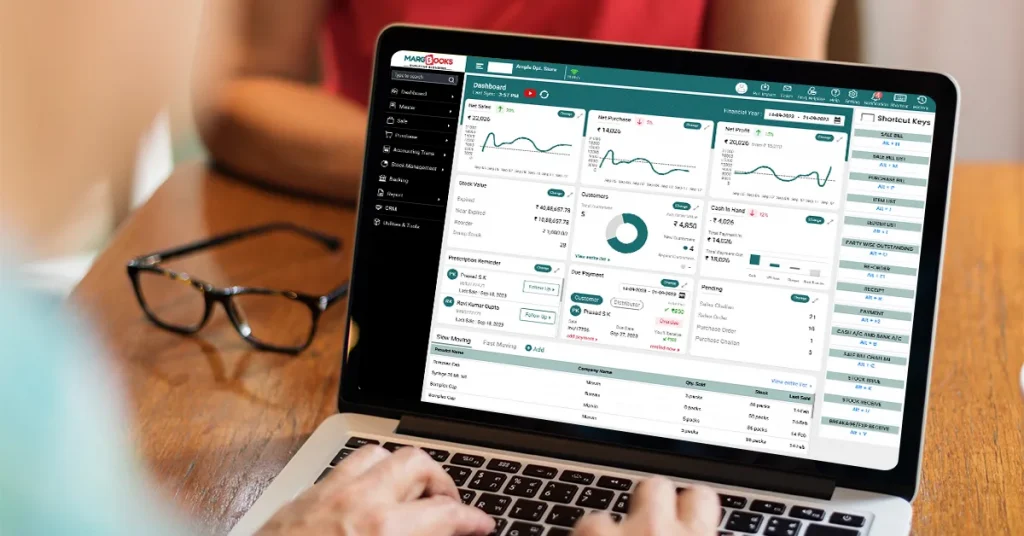
At the end of the day, accounts payable and accounts receivable are just two sides of one story: what you owe, and what’s owed to you. Track either one loosely, and the other stops meaning much on its own. Track both properly, with reminders that actually go out and entries that update themselves, and cash flow stops being something you find out about after it’s already a problem. If you’d like to see how that actually looks, MargBooks Software is worth a look. Every purchase entry updates accounts payable on its own. Every sales invoice does the same for accounts receivable; there is no separate spreadsheet running alongside it. Reminders go out to customers automatically, GST sits inside every ledger entry instead of being bolted on after the fact, and you can check exactly where AP and AR stand from your phone, your desktop, wherever, without waiting for someone else to pull the numbers.
As GST billing software goes, it’s built for how Indian SMEs actually work, and if you’d rather see it than read about it, MargBooks runs a 7-day free trial. Nothing to install. Most people are logging real transactions the same day they sign up.
FAQs
Q1. Is it possible for one individual to handle both account payables and receivable functions in the small business setting?
Technically, yes, and plenty of small setups do run it that way. Not ideal from a controls standpoint, but if that’s your reality, at least build in some regular check a monthly review by the owner or the CA, so nothing quietly slides.
Q2. Is invoicing part of accounts payable or accounts receivable?
Invoicing belongs to accounts receivable. Raise an invoice for a customer; you’ve created a receivable. The invoices that your own suppliers send you are what build your accounts payable.
Q3. What happens to AR if a customer never pays?
Past a certain point, often 90 to 120 days overdue, once it’s clear the customer just isn’t going to pay, businesses usually write it off as bad debt. There’s a correct way to record this, and it does carry GST implications. Our guide on when to pass a bad debts journal entry walks through it properly.
Q4. How does GST affect accounts payable and receivable differently?
On payables, GST paid to suppliers can generally be claimed as input tax credit once the conditions are met. On receivables, GST becomes payable the moment you invoice a customer, regardless of when they actually settle up, which is exactly why unpaid receivables end up creating a GST cash flow headache of their own.
Q5. What’s a good DPO/DSO benchmark for a small business?
No single number fits every industry, but generally, you want your DSO to be lower than your DPO, collecting from customers faster than you’re obligated to pay your own suppliers. If it’s flipped the other way for a stretch, that’s worth digging into before it becomes a bigger problem.

Aman Kannojia is the Digital Team Lead at MargBooks. He started out as an SEO Specialist and never lost his love for words. With 5 years of experience across banking, SaaS, and finance, both domestic and international, he brings strategy, leadership, and storytelling together. He doesn’t just manage a team, he builds one that creates.