Retail Software
 Distribution Software
 Retail Chain

How Will the New GST Changes Affect Small and Medium Enterprises?

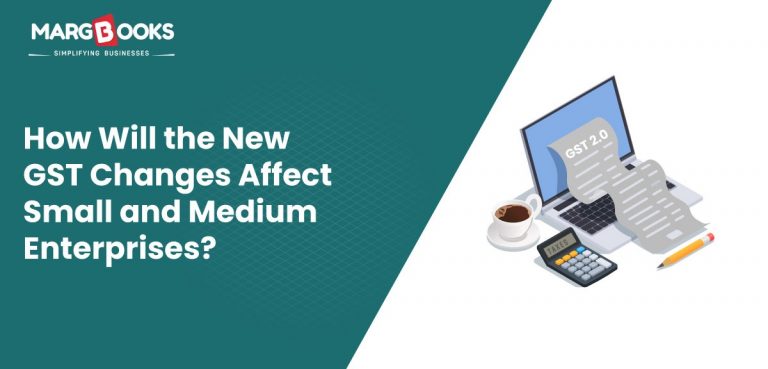
The new GST changes are altering the current trend of taxation and compliance of small and medium enterprises (SMEs) in India. This is a challenge and a chance for a large number of business owners. Under GST 2.0 simplified reporting, updated tax slab, and the requirement of invoices to be in digital form imply that SMEs have to reconsider their accounting and billing procedures.
Although such changes enhance discipline in the errors made and make the process smoother, one should adapt to the changes as fast as possible to escape reprimand. Applications such as MargBooks software would make businesses find them indispensable in their business to enable them to be compliant as well as transact effectively daily.
Understanding the New GST Changes
In the recent past, the Indian government has come up with a list of changes in the GST system in GST 2.0. These reforms are based on the facilitation of tax structures, better digital compliance, and the burden of paperwork. However, what is the implication of these changes on SMEs?
Key Highlights for SMEs
- New Tax Slabs: Multiple slabs are being replaced by several new tax slabs, including simplified tax slabs as low as 5% and 18% GST.
- Mandatory E-Invoicing: The companies that exceed specific turnover thresholds can now issue invoices in a digital format.
- Better Input Tax Credit (ITC) Process: With the help of automated tools, reconciliation of ITC has become easier.
- Real-Time Reporting: The businesses will be required to make more frequent submissions of returns, and this is to guarantee openness.
In the case of small enterprises, such reforms have a beneficial influence on decreasing the potential errors in submitting tax returns, which, however, demand the adoption of new GST changes in a timely manner.
Practical Impact on Small and Medium Enterprises
Streamlined Compliance
SMEs have always found compliance to be an inconvenience. In the past, it was time-consuming to track numerous tax rates, manual invoices, and return visits. The new GST responses deal with this through the promotion of digital.
- Using GST billing software has the ability to create a GST-compliant invoice automatically.
- E-invoicing will guarantee that all transactions will be reported immediately, and ITC claims will have fewer errors and discrepancies.
- Our software does the accounting in an automated mode, which reduces hours of paperwork.
To illustrate, a local clothing store in Pune that is now able to issue invoices in digital form and has real-time savings in time expended on manual entry and improves the precision.
Related Read :- What Are the Benefits of One Nation One Tax for Small and Medium Businesses?
Cost and Time Savings
Compliance has been a nightmare for SMEs. In the past, the control over several tax rates, forgery of invoices, and frequent returns occurred over time. This gets tackled in the new GST changes through promotions of the digital solutions.
- GST-compatible invoices can be constructed automatically when our software is used.
- E-invoicing provides real-time reporting of all the transactions and reduces the number of errors and differences in claims on ICTs.
- Our accounting software automated the reconciliation, which saves hours of hard work.
Consider an example of a local clothing store in Pune that enables the issuers of digital invoices to be instantly, which saves time invested in manual entry and increases efficiency.
Adapting Operations to the New GST Changes
Choosing the Right Software
The introduction of GST changes requires the use of new software that is not optional. The easier, cheaper, and digitally competent tools capable of addressing the SMEs’ requirements are needed.
- The MargBooks allows accounting software to be integrated at a low cost, thus simplifying the day-to-day operations of SMEs.
- The cloud-based programs enable real-time updating, whereby businesses will be up to date with the new tax regulations.
Training and Awareness
The teams should comprehend the consequences of GST reforms despite the presence of software. Knowledge gaps can be closed by regular workshops, online tutorials, and support of such providers as MargBooks software.
- The employees will easily migrate to e-invoicing and ICT reconciliation.
- Non-compliance is prevented through awareness.
Real-Life SME Examples
- Small Manufacturing Unit in Ahmedabad: By adopting GST 2.0 and using MargBooks software. It automated their purchase and sales invoices. The number of errors reduced by 80% and the monthly filing was speedier.
- Retail Pharmacy in Kochi: Stock, GST input credit records in the pharmacy were effectively maintained using cloud-based accounting software. This saved the time spent going through the audit preparation, and it also facilitated the filing of taxes.
Challenges for SMEs
The new GST simplifies some of the processes, but some difficulties occur:
- Getting All Set Up: It costs something to purchase GST-compliant software.
- Digital Literacy: E-invoicing and internet filing might also be a challenge to some of the SMEs.
- Modifying Current Processes: Inventory management, pricing, and invoicing might require some changes in accordance with new slabs.
- These obstacles notwithstanding, the long-term potential will pay off with the challenges within the short-term, especially using such tools as MargBooks.
Related Read :- How Does the GST Applicable Date Affect Invoicing and Input Tax Credit?
Tips for Smooth Transition
Test your existing accounting software by employing an audit of GST 2.0 readiness.
- Invest in accounting software that is user-friendly and easy to use.
- E-train employees regarding e-invoicing and electronic filing of returns.
- Assess ITC compliance reports on a regular basis.
- Monitoring of new tax slabs and government announcements.
Such rudimentary steps would make the going easier and see businesses go on with their operations and uphold their standards without interfering with the day-to-day activities.
Conclusion
The new GST changes are changing the operation of SMEs in India. The advantages in consent, conformity, and time saving are high, whereas digital adaptation and initial setups create problems, especially when the reforms should be implemented. The businesses that have already adopted automation using MargBooks software and other software will be in a better position to cope with the GST 2.0.
Life experiences in retail, manufacturing, and services indicate that anticipated adaptation is easier to operate and lowers the mistakes. To Indian SMEs, knowing how to make use of these changes is not an obligation but rather an opportunity to rationalize business operations and expand in a sustainable manner.

MargBooks, a product of Marg ERP Ltd., is a revolutionary cloud-based billing & accounting solution for every business where the business owner can manage the business from anytime anywhere on any device. MargBooks is your one-stop platform for managing your accounting, organizing your transactions, controlling your finances and managing your inventory. It’s a single secure platform to keep up with your company’s bills and invoices, reconcile your transaction, file GST return easily, experience connected banking etc.