Retail Software
 Distribution Software
 Retail Chain

GST 2.0: The Next Big Revolution in Small & Medium Businesses

It is regarded that the launch of the GST 2.0 is one of the most marking events in the life of the small and medium business in India. Since the implementation of GST in 2017, the taxation system has simplified the procedure of indirect taxes, yet the business owners still encountered such obstacles as complex submission of documents, the delay of the refunds process, and the lack of correspondence between invoices.
The government is making a bold move towards ensuring that these gaps are removed with the GST 2.0. This upgrade, to the small shopkeepers, traders, manufacturers, and service providers, is not an item on the agenda of the policy scheme.
Why GST 2.0 Matters for SMEs?
At the time GST was initially introduced, a number of Indian based businesses did not know its impact on their businesses. Uniform taxation has benefited some who can immediately see the advantages, but those who do not benefit like other businesses, such as the SMEs, find it difficult to comply based on the distinct platform. GST 2.0 is now going to make that a comfortable ride.
The Roadblocks SMEs Faced
- Several registrations each month.
- Delays at the cash to refund.
- Cases of mismatch with input tax credit frequently occur.
- Problem in coping with evolving rules.
It has been a common occurrence that SMEs will spend more time on compliance than running their shops or services. There is one side of the coin in managing tax, and the other side of the coin is balancing books. Even a small manufacturing company in Ludhiana has an accounting software that keeps a tab on the sales and purchases, but it also keeps an eye on matching GST records with the financial statements. This reduces the stress of audits.
What Changes with GST 2.0?
GST 2.0 aims to make life easier, introduce a similarity of rates, and accelerate e-connection. It is simply this in plain English:
1. Uniform Tax Rates
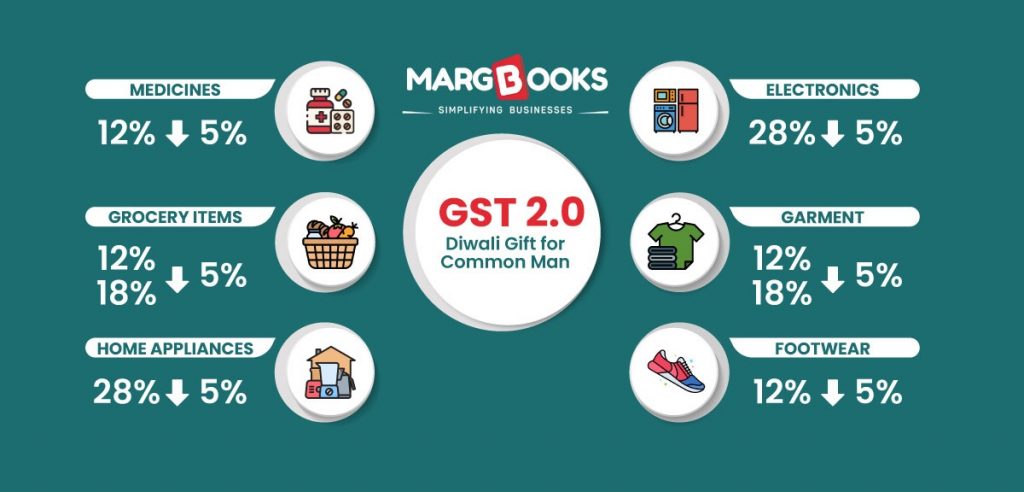
Previously, any enterprise that sold products as clothing, shoes, or electronics was prone to inverted hierarchies of duty. GST 2.0 is meant to introduce uniform rates to ensure traders do not incur losses on refunds.
2. Faster Refunds and Credit Flow
Cash flow is life for SMEs. Under GST 2.0, the time for returning funds is being reduced, thus no funds remain stuck in the government.
3. Simpler Filing
As opposed to multiple returns, one form is targeted ,and it is easy to navigate. It is an example of a shopkeeper in Ahmedabad returning the returns in minutes and not in hours.
4. Digital Push
The increased use of digital tools leads to fewer human errors. At this juncture, MargBooks comes onto the scene to assist SMEs in updating GST rates automatically, creating invoices, and submitting returns, with the minimum number of clicks.
Related Read :- Who Will Benefit the Most from GST 2.0 in 2025?
Real-Life Examples Indian SMEs Can Relate To
- A Surat textile trader can no longer fear inverted loss of duties on a fabric and a garment tax rate. GST 2.0 smoothens it.
- One of the advantages is that a restaurant owner will be able to track paid credits with GST at a faster rate and use the funds to realize expansion as opposed to support refunds.
- A pharma distributor located in Deliver with MargBooks will be able to immediately implement new tax regimes without receiving updates and notifications.
These do not necessarily fit within the realms of possibility; they are realistic things that owners of businesses will experience in their day.
How Technology Fits In?
Despite the simplicity of GST 2.0, the paperwork is not going to be sold out altogether. That is where technology will be on the center stage.
The Role of GST Billing Software
An effective GST billing software would minimize errors, automatically calculate taxes, and ensure that invoices are reviewed to be valid. In the case of a footwear shop located in Jaipur, an example can provide a tax invoice immediately without worrying whether the right rate has been charged.
With MargBooks software, SMEs get:
- Real-time tax updates.
- In invoice generation, it is free from any mistakes.
- Combination with online GST returns.
- Serenity of knowing that they are in rule.
The Bigger Picture for India’s SME Growth
The economy of India is supportive of 63 million plus SMEs. When there is less resistance to compliance, such enterprises can move on with the areas of growth, staffing, and innovation.
Related Read : – How Does the GST Applicable Date Affect Invoicing and Input Tax Credit?
Key Benefits of GST 2.0 for SMEs
- Fewer papers to fill in – more time to do business.
- Healthier flow of cash – quicker growth.
- Less conflict – Increased relationship with suppliers.
- Elevated digital strategy – business strategy of the future.
Since almost a third of the Indian GDP comes through SMEs, any measured alleviation in compliance may have a trickle-down effect in the economy.
Preparing Your Business for GST 2.0
Assuming you operate some sort of shop, factory, or service company, the following measures are useful:
- Get alerts about the new GST.
- Go digital with tools that are proven to be reliable, to avert errors made by people.
- Educate your employees to work with the GST-linked billing systems.
- Always be in contact with your accountant regarding rate changes.
- It is not about burdening oneself with the spirit of preparation, but it makes life much easier tomorrow.
Conclusion
Our GST 2.0 is not only a tax reformation, but it is an entryway to a new era of speed, cleanliness, and transparency of the Indian small and medium enterprises. Ranging from simplified filings and faster refunds to the ease of digital compliance, the revolution has centred on SMEs. With proper tools such as MargBooks software, companies will be able to remain compliant.
But also much more prosperous in an environment that is growing towards digital-first business practices. To each small trader, retailer, and manufacturer, GST 2.0 does not simply represent a revision of the rulebook, but it is the second-largest opportunity to expand without worry of tax troubles.

MargBooks, a product of Marg ERP Ltd., is a revolutionary cloud-based billing & accounting solution for every business where the business owner can manage the business from anytime anywhere on any device. MargBooks is your one-stop platform for managing your accounting, organizing your transactions, controlling your finances and managing your inventory. It’s a single secure platform to keep up with your company’s bills and invoices, reconcile your transaction, file GST return easily, experience connected banking etc.