Retail Software
 Distribution Software
 Retail Chain

What Are the Benefits of One Nation One Tax for Small and Medium Businesses?

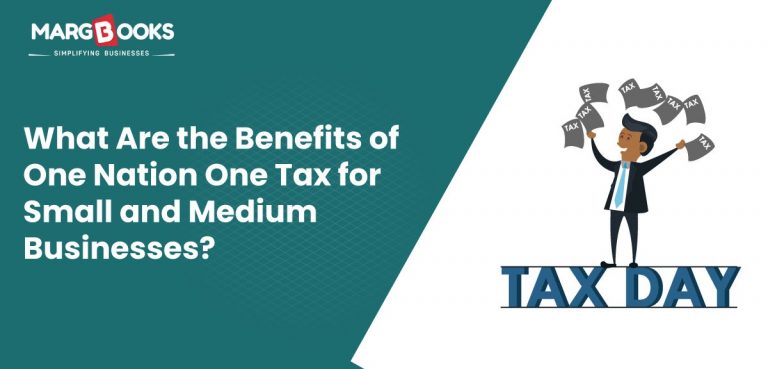
One nation one tax is an idea that sees the entire nation as a single market and a single indirect tax that will bring the large number of state and federal levies down. It is important to small and medium businesses in that it eliminates friction among states, reduces the paperwork in the case of multi-state sales and brings easy pricing awareness to the consumers.
Traders have recorded an accelerated flow of goods and the possibility of input tax credits since the inception of GST. Transitions to GST 2.0 on the horizon also bring with them a triumph of the creative, accurate rate simple processes and online procurements that will enable shop owners, textile traders, and small businesses to have a hassle-free work routine and retailers.
Understanding the Concept of One Nation One Tax
The term one nation one tax represents the concept that indirect taxation on goods and services must be homogenous throughout India, eliminate some of the invisible barriers between states, and designate a unified Indian marketplace. Goods and Services Tax (GST) led to the implementation of numerous levies within a single framework, and it substituted state VATs, excise, and various cesses, making the process of transporting goods easier for traders.
It has been this concerted action that lets us enjoy a modern and interconnected market, and the reason why small businesses are no longer treated differently by different states in taxation.
Key Benefits for SMEs
1. Simple Tax Structure
One indirect tax saves levels of calculating. SMEs do not have to make a platform on several tax rates, certificates, or individual state filings on the same transaction. The better organization eliminates confusion when invoicing, pricing, and quoting, a time-coping welcomed by textile dealers, groceries, and corner stores.
2. Reduced Compliance Burden
The submission of a single set of returns and common procedures facilitates the daily effort of the shop owners and accountants. Having a regular reconciliation process of outward invoices against summary returns is less hard, and the automation of this is now possible. As an illustration, our GST billing software can accelerate monthly GST returns filed with drafted forms and HSNs to save hours for merchants every month.
3. Improved Cash Flow
The system will prevent payment of tax on tax because it will permit input tax credit (ITC) at various levels of production and structural distribution. Such elimination of the cascading charge saves the cost effective and releases funds to inventory, wages or local building up.
By SMEs factoring in to the reconciliation of its supplier invoices, more credits are not held to an increased number, and supplier invoices receive faster refunds which lend assistance to working capital.
4. Encouragement for Transparency and Growth
Paper trail and use of uniform rules promote cleaner books and credibility of business. Most loans or vendor credit to businesses are easier to obtain; banks and lenders will favour a business that demonstrates good invoicing and constant returns. Small dealers and exporters are more scalable due to the fact that the tax system will uniformly ship transactions throughout India.
An example of these is the dashboard of our software, as it assists a small firm in visualizing more accurate ledgers and is clearer to gain access to better transparency when the addition presents itself in front of a bank or an auditor.
Related Read :- Who Will Benefit the Most from GST 2.0 in 2025?
Role of Technology in Supporting One Nation One Tax
The transition between day-to-day compliance and rules-on-paper is made with the help of digital tools. Most of the tasks that are done in taxation can now be practiced with the help of software since the government is urging companies to go digital as far as filling and machine-readable invoices are concerned. The new systems will be minimising incorrect automated reports and reconciliation of invoices and returns.
Major benefits for SMEs
- Single return eliminates the use of paper work and time is saved.
- Input tax credit averts cascading tax.
- The simpler across-state sales increase market access.
- To access credit and suppliers, better books help to increase accessibility.
Common mistakes SMEs avoid
- IRA Payment to late filing and interest.
- ITC-blocking mismatched invoices.
- The occurrence of wrong HSN or SAC codes that causes notices.
- Inadequate reconciling is causing a lack of refunds.
Our reliable GST billing software is able to produce tax-compliant invoices and charge the right rates of HSN at the point of purchase. At the other end, the Books are managed by an appropriate Accounting software that balances the receipts and relates the bank declaration with the returns, eliminating the paperwork and human error. The second tool is a part of the first, namely, a digital industry health check that an SME must have. Real-life software alternatives are beneficial.
Real-world Examples
- Various general stores have also been automated with MargBooks software that matches supplier invoices to GSTR summaries and marks discrepancies early, which enables the creation of lender-ready reports that will not block its credit.
- A trader in textiles in Surat quoted a uniform GST to both Mills in Maharashtra and Karnataka without re-since it would not be correct to pay the same taxes. And through clearer rates and claims on input credit, margins got better.
- A local grocery converted into a single invoice and experienced fewer inventory holdups as train recommendations and state-level examinations dissolved. That saved on deliveries time as well as saved on spoilage.
Billing and bill reconciling were automated in a small retail chain within a tier-2 city. By producing purer books, the bank gave the chain a second store through a straight forward loan, which pushed the bank into the working capital.
GST 2.0 — What SMEs Should Watch
GST 2.0 reform wave focuses on getting the slabs simplified by enhancing the refund system and facilitating the process of going digital. This will lead to higher levels of claim settlement as well as less ambiguity on rates, thereby increasing cash flow and operating certainty. Keep up to date and receive official notifications, and prepare using digital ledgers.
Next steps to follow in practice by SMEs
Since the HSN or SAC codes must be kept up-to-date, start monthly reconciliation cycles, digitize invoices, and make use of the composition schemes where possible. With the steps now reduced, it may take small steps before one is able to implement GST 2.0 and maintain a steady cash flow as rules are settled.
Prepare a basic compliance list and review with your accountant or partner monthly so that difficulties will be avoided.
Related Read :– How Does the GST Applicable Date Affect Invoicing and Input Tax Credit?
Conclusion
In the case of small and medium businesses, one nation one tax does not only sound like a headline, but a restructuring of indirect taxes forces traders to serve the customers rather than state regulations. Easier portrayal of invoices, interstate sales not accompanied by supplementary checks, and input tax credits liberate working capital.
HSN’s correct coding and regular reconciliation of simple credits will keep the credits flowing and minimize notices. With MargBooks software, it is easy to file, reconcile, and make audits, which also means owners devote less time to creating paperwork and more time to operating and expanding their shops, contributing to establishing a robust and stronger business.

MargBooks, a product of Marg ERP Ltd., is a revolutionary cloud-based billing & accounting solution for every business where the business owner can manage the business from anytime anywhere on any device. MargBooks is your one-stop platform for managing your accounting, organizing your transactions, controlling your finances and managing your inventory. It’s a single secure platform to keep up with your company’s bills and invoices, reconcile your transaction, file GST return easily, experience connected banking etc.