Retail Software
 Distribution Software
 Retail Chain

Benefits of Using Garment Billing Software in Retail Shops

On this Saturday night, you have hit a peak sale period, and the store has customers lined up in front of your register. Someone asks for a medium-sized blue kurta. Another customer is waiting for the discounted price of the two shirts that they hold up. And you are flipping through your register, trying to remember which week the medium-sized shirts were replenished from a previous batch.
If you have owned a clothing store for more than one season, you have experienced the very same scene in your store before. It’s not really about the queue. It’s about how much of the day gets eaten up by things that shouldn’t take this long, checking stock, calculating a bill, figuring out if a discount applies, writing it all down so you can tally it later.
This is exactly where garment billing software earns its place. Not as some flashy upgrade, but as the thing that quietly removes the friction from a job that’s already hard enough.
What Garment Billing Software Actually Is
Most retail billing software is built to handle one item, one price, one quantity. That works fine for a grocery store or a hardware shop. It falls apart the moment you’re dealing with clothes.
A single shirt design might exist in five sizes and four colors, that’s twenty variations of what looks, on paper, like “one product.” Regular POS billing software wasn’t built with that in mind. Garment billing software was. It’s really a category of garment store management software designed around the specific mess that clothing retail creates: sizes, colors, seasons, exchanges, and stock that moves fast during sales and sits still the rest of the year.
The Real Benefits — Not the Brochure Version
It cuts down billing time properly
Manual billing means writing or typing every item, checking the price list, calculating the discount by hand, and hoping the maths is right. Having barcode or QR scanning within the garment billing software reduces the time it takes to process an item from a couple of minutes down to around the same amount of time it takes to scan a barcode or QR code when selling an item. When you have 10 people lined up waiting to be serviced, this difference is huge! A long, delay-free evening is much better for a customer than having to leave because of a long queue.
It actually understands sizes and colors
This is the one thing generic retail billing software gets wrong most often. Ask it how many medium-sized blue shirts are left, and it might tell you how many “blue shirts” are left without breaking it down by size. Garment store management software tracks stock at the variant level, so you know exactly what’s left in every size and color, not just a vague total.
Fewer billing mistakes, less stock going missing
Also, with manual billing, you can make mistakes based on a few reasons: Wrong price, Wrong item, incorrect pricing being applied, etc. All of those small errors add up to be a lot of money in a month. Automated billing also makes it much harder for stock to quietly disappear without anyone noticing, since every sale is logged against inventory in real time.
Tax invoicing without the headache
GST calculations, invoice formatting, keeping records audit-ready, none of this is anyone’s favorite part of running a shop. Good billing software handles the maths and generates a proper invoice automatically, so you’re not scrambling before a filing deadline or during an audit.
You always know what’s actually on your shelves
This matters more in garment retail than almost any other kind of shop. A customer asks for a large in navy, and if your stock data is even slightly off, you either oversell something you don’t have or miss a sale sitting right there in the back room. With real-time tracking, especially across multiple branches, if you have them, this kind of guesswork mostly disappears.
Customers notice the little things
The availability of past purchases, loyalty points, and size preferences helps make checkout quick and personalized. Customers who repeatedly buy from a retail store will recognise the store for basic personalised services.
You Make Decisions Based on Numbers, not Guesswork
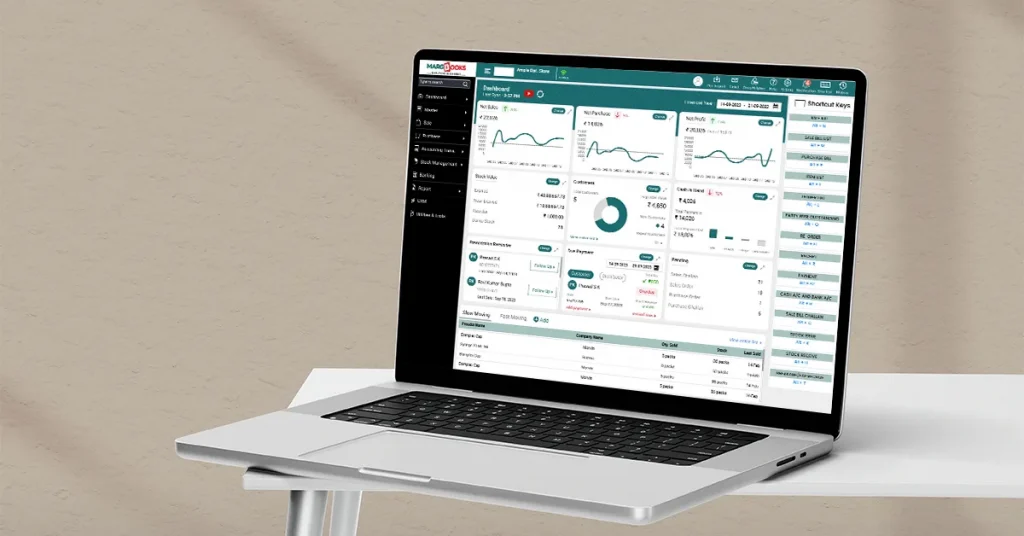
Which sizes sell out first? Which colors barely move. Which season needs more stock, and which one did you overorder for last year? This kind of data is sitting inside decent garment billing software already; you just need to look at it. Over time, this changes how you order stock, not just how you bill customers.
Exchanges and returns stop being a mess
Garment shops deal with exchanges constantly, wrong size, changed mind, gift returns. Managing this on paper means separate notes, memory, and hoping nothing gets lost. Software handles it as part of the same system, linked to the original sale.
A Quick Example
Take a shop like the one run by a shopkeeper named Ramesh, two floors, mid-sized, somewhere in a city like Jaipur. For many years, billing occurred by hand, and stock was counted by walking to the shelf and counting. During sale season, this caused people to stand in line longer than usual because of price mistakes or items being sold out early due to a lack of proper visibility to what was on the shelf. After switching to garment store management software, one of the biggest changes was just simply a reduction in time taken to bill and wait on customers; it wasn’t a huge change, just now when the stock was counted versus what was on the shelf was accurate. However, those changes resulted in fewer disputes at the counter and less time spent reconciling manually after store closure.
What to Actually Look For
Not every retail billing software on the market is built for garments. Before choosing one, it’s worth checking for:
- Size and color variant management — this is non-negotiable for clothing retail
- Offline billing support — useful in areas where power or internet isn’t always reliable
- Built-in GST invoicing
- Barcode or QR scanning
- Multi-branch stock sync, if you run more than one outlet
- A simple interface that your staff can actually learn in a day or two, not a month
Conclusion
None of this is about chasing the latest retail trend. It’s about removing the small, repeated frustrations that come with running a garment shop by hand, the miscounted stock, the slow billing line, and the exchange nobody remembers correctly. Garment billing software, such as MargBooks Software, doesn’t change what you sell. It just makes selling it a little less exhausting. If you’re on the fence, the easiest way to know is to try it during your next sale season, when the pressure is highest, and the difference will be the most obvious.
FAQs
What is garment billing software?
The software is designed specifically for clothing retailers; it allows you to manage all of your inventory from one location instead of having to look at three locations (i.e., size/color/variant), which is what generic billing systems do not do very well.
How is garment billing software different from regular POS billing software?
A Point of Sale (POS) system that has been designed specifically for the apparel customer has accounting and inventory management systems as part of its functionality. The typical retail POS systems are based on an item-based system of billing. An apparel billing system separates individual items by size, so that inventory and sales reports are developed and tracked accurately for apparel stores.
Is garment store management software only useful for large chains, or does it help small shops too?
It helps small shops just as much, arguably more. One counter store selling clothing items that come in many different sizes and colors will encounter similar issues regarding stock management as stores that have more than one counter, however, on a lesser scale.
Does garment billing software function without an internet connection?
A number of the systems available provide offline billing so that information can be synchronized when the equipment regains its Internet connection. Therefore, this (offline billing) is worth considering if your location suffers from frequent power outages or unreliable Internet service.
Can it handle GST billing automatically?
Most garment billing Software will automate the calculation of GST and generate compliant invoices, thereby lessening the time required to manually enter tax amounts each year during tax time.
How long does it take for staff to learn?
Most systems could take a couple of days of normal operation before you become accustomed to navigating the software. Most of the newer systems will have simple graphical user interfaces and will work just like you would expect them to (i.e., intuitively); however, a few older systems could be very confusing due to being cluttered with hundreds of menu options.
Can it manage stock across multiple store branches?
Yes, if the software includes multi-branch sync, stock levels update across locations in real time, which helps avoid overselling or uneven stock distribution.
Is it worth the cost for a single small shop?
For most shops, yes. Even a modest reduction in billing errors and stock mismanagement tends to cover the cost within a few months, especially during high-sales periods.

Aman Kannojia is the Digital Team Lead at MargBooks. He started out as an SEO Specialist and never lost his love for words. With 5 years of experience across banking, SaaS, and finance, both domestic and international, he brings strategy, leadership, and storytelling together. He doesn’t just manage a team, he builds one that creates.