Retail Software
 Distribution Software
 Retail Chain

What is GSTR 6 and Why Does It Matter for Your Business?

If you have looked at the screen on the GST portal and felt confused as to which return applies to you, you are not alone. Many clients we speak to have mastered the completion of GSTR-1 and GSTR-3B returns, but as soon as GSTR 6 enters the conversation, there is a deafening silence within the room.
And honestly? It’s reasonable to be confused about GSTR 6, as it applies to a narrow category of businesses, and if you haven’t received a clear explanation about how it should be used, there is a good chance that you have either not reported your GST correctly or you have completely ignored GSTR 6. In either case, this could lead to penalties and fines that you’ll never see coming! Let’s set some ground rules so that you can understand what GSTR 6 is, why it was created, and what it means for your business.
What Is an Input Service Distributor?
Picture this. You own a business with headquarters located in Mumbai, and branch offices located in Delhi, Bengaluru and Hyderabad. The Mumbai branch receives one invoice for the cloud-based software used by the entire company. The GST on that invoice is ₹5 lakh.
Now here’s where it gets tricky. Each of your branches is registered separately under GST. So that ₹5 lakh in Input Tax Credit sitting with your Mumbai office? Your branches technically can’t touch it, not without a proper legal mechanism to transfer it.
That mechanism is called an Input Service Distributor, or ISD. And the return of an ISD file every month to report exactly who received what credit, how much was distributed, and to which branch is called GSTR 6.
That’s it. That’s the whole concept. Your head office acts as a distributor of tax credit, and GSTR 6 is the paperwork that makes it official.
So What Actually Goes Into GSTR 6?
GSTR-6 is a monthly return, and it captures four key things:
- All the Input Tax Credit your ISD received that month from supplier invoices
- How was that credit split and distributed across your branches
- Any credit that had to be reversed
- Corrections or amendments to distributions you made in previous months
Once you’ve filed it, each branch can see the credit allocated to them in their GSTR-2A, the auto-populated statement that shows incoming credit. From there, they can use it to offset their own GST dues.
This is exactly where good GST billing software earns its keep. Instead of manually hunting through invoices to figure out what’s eligible for distribution, a proper system tracks it for you and flags what can and can’t be passed on, before you even open the portal.
Who Actually Needs to File This?
Not every business needs to worry about GSTR 6; only those registered as an Input Service Distributor. You’re in this category if your setup looks something like this:
- Your head office and branches each have their own GST registrations
- The head office regularly receives invoices for services used by the whole organisation
- You’ve registered separately as an ISD on the GST portal
Large IT firms, banks, retail chains, and manufacturing conglomerates are the most common examples, but plenty of mid-sized businesses fall into this bucket too, especially if they’ve expanded to multiple cities.
One thing that catches people off guard: even if nothing happened in a particular month, no invoices, no distributions, nothing, you still need to file a nil GSTR-6. Skipping it because “there’s nothing to report” is not an option the GST system recognises.
The Deadline and What Happens If You Miss It
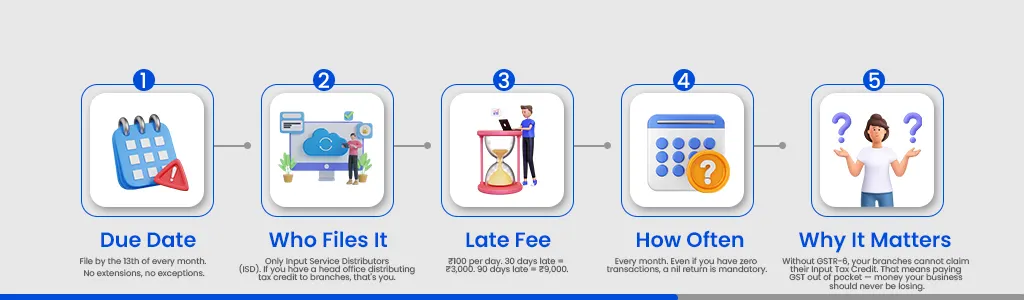
GSTR-6 is due on the 13th of every month for the previous month’s activity. April’s transactions? File by May 13th. Simple enough in theory, harder to stay on top of when you’re managing multiple registrations across states.
| Detail | Info |
| Frequency | Monthly (no quarterly option) |
| Due date | 13th of the following month |
| Late fee (CGST) | ₹50 per day |
| Late fee (SGST) | ₹50 per day |
| Total late fee | ₹100 per day |
A hundred rupees a day doesn’t sound catastrophic until you realise you’ve missed three months and the meter’s been running the whole time. We’ve seen businesses rack up penalties that dwarf the actual tax value involved, simply because no one had a system in place to track filing deadlines.
This is one of the most practical reasons to use accounting software that manages your compliance calendar. When due dates are automated and visible across your finance team, late fees stop being a recurring line item in your books.
What Information Goes Into GSTR-6?
If you’re the one sitting down to actually file GSTR-6, here’s what each section is asking for:
Tables 1–3 cover the basics, your GSTIN, your legal name, and the period you’re filing for. Most of this auto-populates from your registration details.
Table 4 is where your incoming ITC lives. It pulls in data from your suppliers’ GSTR-1 filings, so you can see what credit has been reported against your GSTIN.
Table 5 is the sorting table, you’re separating eligible credit from ineligible credit (things like blocked input tax that can’t legally be distributed) and arriving at your net distributable amount.
Table 6 is the heart of the return, who gets what. You’ll enter each branch’s GSTIN, the amount being distributed, and the ISD invoice reference number.
Table 7 handles corrections. If you distributed the wrong amount to a branch last month, this is where you fix it.
Table 8 covers redistribution, situations where credit was sent to one branch but needs to be recalled and reallocated.
Doing all of this accurately without a dedicated GST billing software like MargBooks is genuinely painful. The kind of software that pulls live invoice data, auto-segregates eligible ITC, and maps it to the right table isn’t a luxury for multi-branch businesses, it’s what keeps you out of trouble during an audit.
Conclusion
Let’s come back to that ₹5 lakh example. If your Mumbai office has paid that GST but GSTR-6 isn’t filed or is filed with errors, none of your branches can legally claim that credit. Every branch ends up paying GST out of pocket without any offset. Multiply that across several months and several common invoices, and you’re looking at a significant, avoidable drain on working capital.
Get it right, and the story flips completely. Each branch receives its allocated share, uses it to reduce what it owes, and your organisation’s overall tax outgo shrinks. That’s not a technicality that’s a real, tangible financial benefit that compounds every single month.
There’s also the compliance angle. A clean GSTR 6 filing history signals to the tax department that your ISD mechanism is well-managed. It protects you during scrutiny, strengthens your position in assessments, and quietly builds the kind of compliance credibility that matters when your business is growing.
The good news is you don’t have to figure all of this out manually. MargBooks Software is built specifically for this, handling everything from ISD invoice generation to auto-filling your GSTR-6 tables, so your finance team spends their energy on the work that actually moves the business forward.

MargBooks, a product of Marg ERP Ltd., is a revolutionary cloud-based billing & accounting solution for every business where the business owner can manage the business from anytime anywhere on any device. MargBooks is your one-stop platform for managing your accounting, organizing your transactions, controlling your finances and managing your inventory. It’s a single secure platform to keep up with your company’s bills and invoices, reconcile your transaction, file GST return easily, experience connected banking etc.