Retail Software
 Distribution Software
 Retail Chain

What Does Rule 43 of CGST SGST Rules Say About ITC on Capital Goods?

Suppose you’ve purchased machinery/equipment that cost you thousands of dollars for your business. Of course, you want to claim Input Tax Credit (ITC) for these capital goods, thereby reducing your tax liability. But what happens when you use them partially for business purposes and partially for something else? Also, what happens if you use them to make both taxable and non-taxable sales?
When a business purchases or acquires capital goods, it may think it can claim back all the input tax credits (ITC) associated with those capital goods. However, this is not true. There is a specific rule that governs how businesses can calculate and claim ITCs for capital goods, which is Rule 43 of the CGST/SGST Act.
Businesses are increasingly turning to accounting software as a means of successfully tracking, managing, and utilizing their ITC for sales and other purposes. This blog will explain Rule 43 of the CGST/SGST Act, including how to apply and calculate ITCs and best practices for being compliant.
What is Rule 43 of CGST SGST Rules?
Rule 43 of the CGST SGST Rules provides instructions on how to calculate input tax credit (ITC) for capital goods.
ITC for capital goods is calculated for:
1.) Business-related purposes compared to non-business-related purposes
2.) Taxable and exempt supplies
This rule is designed to allow taxpayers to receive ITC only for business-related taxes. Therefore, only the amount eligible to receive ITC will be claimed; the remainder of unclaimed ITC will be reversed.
Main Idea Under Rule 43
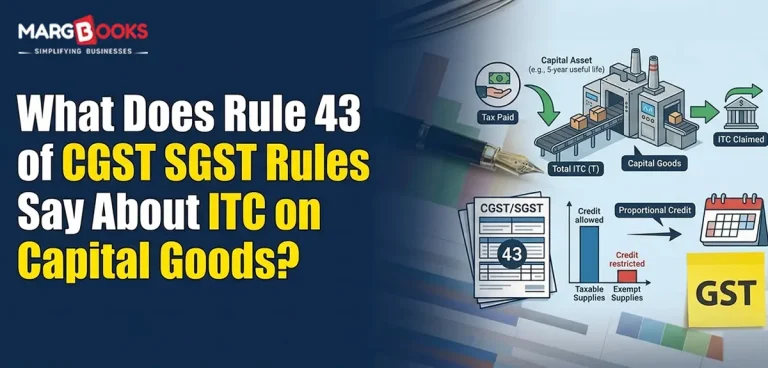
The premise behind this rule is that capital assets will benefit the company over a period of years. For that reason, you do not take an immediate Input Tax Credit Adjustment (ITC) all at once; ITC is allocated to a five year useful economic life (60 months).
Therefore, your calculation for ITC will occur on a month-to-month basis, and the portions that are not eligible will be reversed.
How to Calculate ITC under Rule 43?
Rule 43 states that to see what the monthly credit of your total ITC on capital goods is, you take your total ITC on all of your capital goods, divided by 60, to determine the monthly credit.
The equation for monthly credit looks like this:
Tm=T/60
Where:
T = Total ITC on Capital Goods
Tm = Credit Amount Per Month
Once you calculate your monthly credit, you will:
1. Determine the amount of ITC that has to be reversed (used to make exempt supplies/non-business purposes) from your monthly credit.
2. You will have a remaining amount of ITC (from your monthly credit) that you will be able to claim.
Key Elements of Rule 43 of the GST Laws
1. Useful Life of Capital Goods
Useful life of capital goods will be assumed as being a period of five (5) years or sixty (60) months for the purpose of calculating input tax credit (ITC).
2. Monthly Reversal of ITC ineligible portion
ITC will be calculated for the month, and the ineligible portion will be reversed based on actual use.
3. Apportionment of common credit
If a capital good has been used for both taxable supply and exempt supply, the ITC will be treated as common credit and will be apportioned accordingly.
Cases Eligible for Application of Rule 43
Rule 43 is applicable in these circumstances:
1. “Capital Goods” used for sales, taxable and exempt supplies, are subject to the provisions of Rule 43
2. Capital goods that are used partly in the course of making supplies, and partly in the course of making non-supplies, qualify for Rule 43 application.
3. Excess credit taken on ITC that forms part of capital goods must be reversed under the provisions of Rule 43.
Importance of Billing Software and Accounting Software
Managing ITC on capital goods manually can be complex and error-prone. MargBooks – a Billing software can help you with the same.
Billing Software can help businesses as they have:
- The ability to keep accurate records of purchases
- The ability to keep track of the GST that was paid on Capital goods
- Report generation for ITC calculation
Accounting Software will support businesses by-
- Correctly allocating ITC
- Automating calculations and reversals
- Reducing compliance errors
- Easily reconcile the GST refund with the purchase order.
Businesses can simplify ITC tracking with tools like MargBooks, ensuring full compliance with Rule 43.
To achieve proper compliance, businesses should do the following:
- Keep detailed records of your Capital Goods
- Keep track of the use of products under taxable and exempt supplies
- Reconcile your ITC regularly
- Avoid incorrectly claiming too much ITC
- Use trusted Billing Software.
Conclusion
Rule 43 of the CGST SGST Rules provides a very important benefit for businesses through appropriate accounting of ITC on Capital Goods by way of averaging the ITC over five years and being limited to proportional ITC for an equitable and transparent GST System. Businesses need to understand this Rule to avoid missteps, mistakes, penalties, and compliance issues. Using proper record keeping and systems, such as MargBooks Software simplify the ITC for business. This makes for a smooth GST System Process.

MargBooks, a product of Marg ERP Ltd., is a revolutionary cloud-based billing & accounting solution for every business where the business owner can manage the business from anytime anywhere on any device. MargBooks is your one-stop platform for managing your accounting, organizing your transactions, controlling your finances and managing your inventory. It’s a single secure platform to keep up with your company’s bills and invoices, reconcile your transaction, file GST return easily, experience connected banking etc.