Retail Software
 Distribution Software
 Retail Chain

How to Streamline the GST File Process

Nobody starts a business because they love filing tax returns. Yet here we are every month, like clockwork, watching the due date creep closer while the invoices pile up and the spreadsheet refuses to make sense. For most business owners in India, GST filing has become that one task that never feels done, never feels simple, and never quite leaves the back of your mind. It doesn’t have to be this way. Seriously. With a few deliberate changes to how you work, the GST file process can go from being a monthly ordeal to something you handle almost without thinking about it.
Why the Old Way Stops Working
Let’s call it what it is: most businesses are still winging GST. Invoices live in inboxes. Purchase records sit in someone’s downloads folder. The accounts are updated in a rush, usually by whoever has the least amount of leave that week. And somehow, every month, it all gets filed just barely, and with considerable stress. This works when you’re small. It starts breaking down the moment your transaction volume picks up.
More invoices mean more chances to apply the wrong tax rate, miss an entry, or mix up an HSN code. And in the GST world, small errors don’t stay small. They turn into ITC blocks, compliance notices, and back-and-forth with the department that can stretch on for weeks. The effort is there. The system just isn’t built to hold it together. That’s why using a cloud-based accounting software can help you in this crisis.
Make Compliance a Rhythm, Not a Rush
The single biggest mistake businesses make with GST is treating it as a month-end activity. It shouldn’t be that difficult to complete business filing.
Every business that files on time will do far less work at the last minute than one that does a lot of work the last three days of the month – that is because filing a small amount of work each day throughout the month will have left very little left to do at the deadline.
For example: To have your invoices recorded as they come in; logging purchases as they come into inventory, and checking figures once a week is much less of a panic than checking all at the end of the month. A good online GST billing software can help you in making sure you are compliant, which has become a regular activity; filing will just be a matter of going through the forms. But when it doesn’t, filing day becomes a fire drill.
Stop Letting Invoicing and Accounting Live in Separate Worlds
There’s an unnoticed gap in business that creates big problems, and the majority of companies aren’t aware of it. In a typical setup, someone raises an invoice, and someone else, maybe the same day, maybe four days later, manually recreates that entry in the accounts. Every handoff is an opportunity for something to go wrong, the wrong tax category, a figure transposed, or CGST recorded instead of IGST.
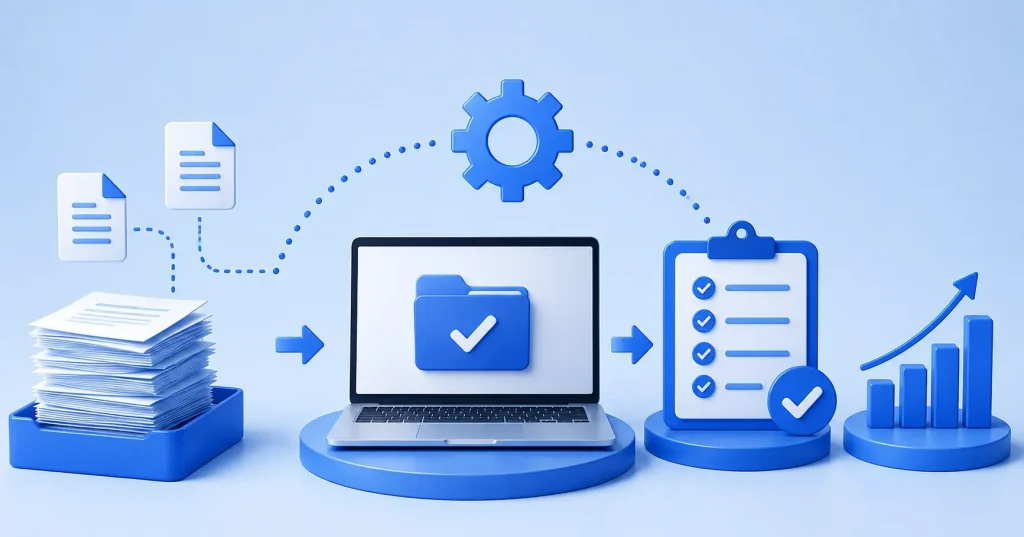
When your invoicing and accounting are connected, that handoff disappears. An invoice raised is an invoice recorded. The correct taxes are applied automatically based on who you’re selling to and where they’re located. Your books update in real time, and your GST liability is always accurate. The following things can be done in a smooth manner by using a cloud-based accounting software, as it removes an entire layer of manual work and, with it, an entire layer of risk.
Don’t Leave ITC Reconciliation for Filing Week
If there’s one part of the GST process that makes accountants visibly tense, it’s ITC reconciliation. The task itself is straightforward: match your purchase records against what your suppliers have uploaded on the GSTN portal. The problem is that mismatches are common, fixing them takes time, and discovering a mismatch on the day you’re meant to file leaves you with no good options.
The fix is simply to do this work earlier. Check your purchase records against supplier uploads once a week, or at least twice a month. When a discrepancy shows up early, you have time to chase your supplier, get it corrected, and protect your credit. When it shows up on the 20th, you don’t. This one habit alone can take a significant amount of pressure off your entire filing process.
Give Everyone Access to the Same Numbers
Version confusion is more expensive than most businesses realise.
When the billing team, the accounts department, and the business owner are each working from different records, different spreadsheets, different files, and different mental tallies, someone is always working from outdated information. When the end of the month comes, and the records do not match up, it takes an awful lot of time to determine which version is correct – and there isn’t a lot of time available to find out!
With one master live record available on an online GST Billing software such as MargBooks to everyone working from anywhere, as soon as a transaction is written in, it can be viewed by everyone who needs to view it right away. There’s no version to compare, no file to email around, no confusion about which numbers are right.
This pays off in ways beyond GST, too. When your CA needs to look at your books for an audit, a review, or a loan, the records are already in order. You share access and step back. No weekend spent compiling documents.
Build in a Pre-Filing Review
Here’s a habit worth stealing from businesses that have made peace with GST: block out time two or three days before the filing deadline specifically to review your returns.
Do not file them. Review them. Carefully review your GSTR-1, ensuring full accuracy of all reported goods or services provided out to customers as an outward supply. Validate your GSTR-3B totals using trial balances maintained in your accounting software.
Look for anything that seems off an invoice that didn’t make it in, a purchase where ITC hasn’t been claimed, or a number that doesn’t match what you’re expecting.
When you do this with two days to spare, problems are fixable. When you do it on the deadline, you’re filing and hoping. The buffer is small. What it protects you from is not.
Let the Right Tools Carry the Load
There’s no virtue in doing this the hard way. Good Cloud-based accounting software designed specifically for how GST works in India, not adapted from a generic global template, automates the parts of the filing process that are most likely to go wrong when handled manually. Invoices flow straight into your returns. Tax calculations happen in the background. ITC mismatches get flagged before they become a filing-day emergency.
Software like MargBooks is built around exactly this workflow. Note, compliance work does not cease, but instead occurs sooner with less publicity, and you are not actively involved in every stage of the process. Where it may have taken you up to 1 week to complete, you will now complete in a concentrated period (< 5 hours).
Conclusion
GST filing will continue to appear on your calendar. That’s not changing. What can change is how much of your time, attention, and energy it takes up. The businesses that have figured this out aren’t doing anything complicated. They use MargBooks so that they can be consistent with their record-keeping, they reconcile early, they use tools that work with them instead of against them, and they don’t leave everything for the last possible moment. The result isn’t just less stress at month-end. It’s more clarity, more time, and more capacity to focus on the things that actually move your business forward. Pick one thing from this list. Start there. The rest follows.

MargBooks, a product of Marg ERP Ltd., is a revolutionary cloud-based billing & accounting solution for every business where the business owner can manage the business from anytime anywhere on any device. MargBooks is your one-stop platform for managing your accounting, organizing your transactions, controlling your finances and managing your inventory. It’s a single secure platform to keep up with your company’s bills and invoices, reconcile your transaction, file GST return easily, experience connected banking etc.