Retail Software
 Distribution Software
 Retail Chain

What is GST Exemption? A Complete Guide for Businesses

If you run a business in India, chances are someone has told you at some point, “relax, that item is GST exempt.” And maybe you nodded along and moved on. But here’s the thing: GST exemption isn’t a loophole or a grey area. It is a specific type of relief that is available under the provisions of the GST law. The understanding that we gain from notifications provided, whereby we consider taxable supply as exempt, may result in the incurrence of penalties and interest, which could not be anticipated. Allow us to elaborate upon GST exemption, its nature of working, and how it affects your day-to-day billing and compliance activities.
What is GST Exemption?
GST exemption implies that the government has taken a decision not to charge Goods and Services Tax for a certain good or service or even for specific goods and services. The government grants exemptions through notifications issued under the CGST Act, 2017 and the IGST Act, 2017, along with the respective State GST provisions and enactments.
Apart from that, we would like to point out that the term “exempt supply” bears much wider meaning than an ordinary person would generally expect:
- Supplies that attract a nil rate of tax
- Supplies that are wholly exempt under Section 11 of the CGST Act or Section 6 of the IGST Act
- Non-taxable supplies
If your supply of goods or services falls into any of these categories, you don’t charge GST on it. Not a reduced rate, not a discount, simply no GST at all.
It’s also worth understanding that not every exemption looks the same. Some are what’s called an absolute exemption, unconditional, applying regardless of who’s supplying or receiving the goods or services. Some notifications are conditional, which means they only become effective if specific conditions set out in the notification are satisfied. Getting this right in the very beginning prevents you from correcting it again later.
An Overview of the GST Framework and Why Exemptions Exist
Before getting into specifics, it helps to zoom out. The overview of the GST framework is fairly simple in concept: tax is levied on the supply of goods and services, input tax credit flows through the chain, and the end consumer bears the final cost. Exemptions are the deliberate exceptions carved into this framework.
They’re not arbitrary generosity from the government. Exemptions exist to keep essential goods and public-interest services affordable, think basic food items, healthcare, and education. They’re also used strategically to support certain sectors the government considers important, whether for economic or social reasons, and to prevent the movement of goods and services from becoming needlessly expensive at every stage of a supply chain.
For a business, this matters because it directly affects your pricing, your invoicing, and, this is the part people often miss, your GST liability and Input Tax Credit position.

GST Exemption vs Nil-Rated vs Non-Taxable: Where People Get Confused
The terms ‘exempt’ and ‘nil-rated’ are confused by many business owners because they have different meanings.
A nil-rated supply is classified as one for which 0% tax is applicable according to the GST rate schedule, indicating that the supply is not totally free from GST liability. An exempt-from-GST supply, on the other hand, is the broader category; it includes nil-rated supplies, items wholly exempted through a notification, and non-taxable supplies (things GST doesn’t apply to at all, like alcohol for human consumption).
Why does the distinction matter? Because your ITC treatment and reporting can differ slightly depending on which bucket you’re in, and getting this right protects you if a return is ever scrutinised under GST compliance checks. If you want to go deeper into how GST obligations stack up more broadly, our GST compliance guide for Indian businesses is a good next read.
How GST Exemption Actually Works, Step by Step
Here’s roughly how a business should think through it:
1. Figure out what kind of supply you’re making: It is very important to have some clarity about the kind of supply being undertaken, namely whether it is taxable, exempt, nil-rated, or a non-taxable supply.
2. Check if the exemption actually applies to you: Some exemptions are unconditional (absolute exemption). Others come with fine print; certain conditions have to be met before you can treat the supply of goods or services as exempt. Skipping this step is where a lot of businesses trip up.
3. Work out your GST liability: If the exemption genuinely applies, you simply don’t charge GST on the invoice or bill of supply.
4. Look at your Input Tax Credit position: This is the part that catches people off guard. If you’re using inputs exclusively for exempt supplies, you generally can’t claim ITC on them. And if you’re using the same inputs for both taxable and exempt supplies, you’ll need to apportion or reverse the credit as per the CGST Rules. If ITC mechanics feel like a maze, our piece on Section 16(2) of the CGST Act and how it governs ITC walks through the backbone of the credit system.
5. Report it properly in your GST returns: Exempt supplies still need to show up in your filings, and your records need to be maintained as per GST law.
GST Registration Exemption: Threshold Limits for Small Businesses
Separate from supply-level exemptions, there’s also an exemption from the requirement to register for GST at all, and this trips up a lot of small business owners.
Under the current threshold, businesses dealing purely in the supply of goods generally don’t need to register for GST until their aggregate turnover crosses ₹40 lakhs for goods in most states (₹20 lakhs in special category states). For businesses supplying services, the gst exemption limit is lower, turnover up to ₹20 lakhs for services (₹10 lakhs in special category states) doesn’t require registration.
This threshold-based exemption is essentially a built-in relief for very small businesses and gives them lower GST compliance overhead; you could think of it as one of the ways the system offers lower GST rates for small businesses indirectly, by keeping them out of the tax net entirely until they scale up. However, when you go beyond the prescribed limit, you must register for GST and add tax to taxable products and services provided by you at that stage.
Real-World Examples
Take a small diagnostic clinic. Healthcare services provided by a clinical establishment are exempt from GST under the relevant notification. So the clinic doesn’t add GST to the fees it charges patients, straightforward enough.
But here’s the catch: because these are exempt services, the clinic generally can’t claim Input Tax Credit on goods or services it buys specifically to deliver that exempt care. No GST charged, no ITC claimed. That trade-off is the core logic of how exemptions work across most sectors, whether it’s healthcare, education, or certain financial services.
List of Common Categories of Exempt Goods and Services
While the full exemption list runs into hundreds of entries across various notifications, a few categories come up again and again for Indian businesses:
- Healthcare and education, services provided by recognised institutions and clinical establishments
- Agricultural produce, most unprocessed farm goods
- Government services, several services provided by government bodies and government-authorised entities
- Certain financial services, specific banking and financial services notified as exempt, though many financial services remain taxable, so this needs individual checking
- Basic, unbranded food items; many staple food items sold without a registered brand name
- Public transport, certain modes of passenger transport
Suppose you are unsure if your goods/services qualify for the tax exemption. In that case, you can always refer to the valid notification instead of relying on what your rival or supplier is doing.
Getting Your GST Classification Right
Before you can even decide whether something is exempt, you need to classify it correctly, which usually comes down to the HSN or SAC code attached to your items and services. Misclassify the item, and you might end up treating a taxable supply as exempt (or vice versa) without even realising it. We’ve covered this in more detail in how goods and services are identified under GST classification, if you want to get this foundational piece right first.
Movement of Goods and Services Across State Lines
One area that regularly confuses businesses expanding beyond their home state is how exemptions apply to the movement of goods and services across state boundaries. GST as a destination-based tax was designed specifically to avoid double taxation on inter-state trade, and exempt supplies carry that treatment through; an item that’s exempt for goods and services across state lines stays exempt regardless of whether it’s sold within the state or shipped to another one.
That said, businesses that supply goods or services across state lines need to be extra careful about documentation. Just because services across state lines don’t attract GST doesn’t mean there’s no compliance trail; you still need to record and report these transactions accurately, especially if the services used or services like transportation and logistics, are bundled into the transaction.
What Happens If You Get It Wrong?
This is the part that should make every business owner sit up. If you treat a taxable supply as exempt by mistake, you don’t just owe the GST you should have charged; you’re also on the hook for interest, and potentially penalties under GST law. Interest liability kicks in automatically once tax is paid late or short-paid; it doesn’t wait for a notice from the department. If you want to understand exactly how that interest gets calculated and how to avoid it, we’ve broken it down in our guide to Section 50 of the CGST Act.
Being subject to GST taxation isn’t optional once your supply qualifies as taxable, and businesses dealing in goods across multiple categories, some taxable and some exempt, need to be especially disciplined about keeping these separated in their books.
Exemptions Aren’t Permanent, Keep an Eye on Notifications
One thing worth remembering: an exemption notification isn’t set in stone. The government can amend, withdraw, or replace it with a fresh notification whenever it decides the policy needs to change. It is important to stay informed about the status of your exempt supply as it can change tomorrow depending on the applicable conditions. Companies that neglect these changes can end up getting wrong tax filings and suffering losses.
Where MargBooks Fits Into All This
Manually tracking which of your items and services are exempt, which need ITC reversal, and which notifications have changed is a lot to keep in your head, especially if you’re running a retail counter or managing a distribution business with hundreds of SKUs and a mix of goods and services.
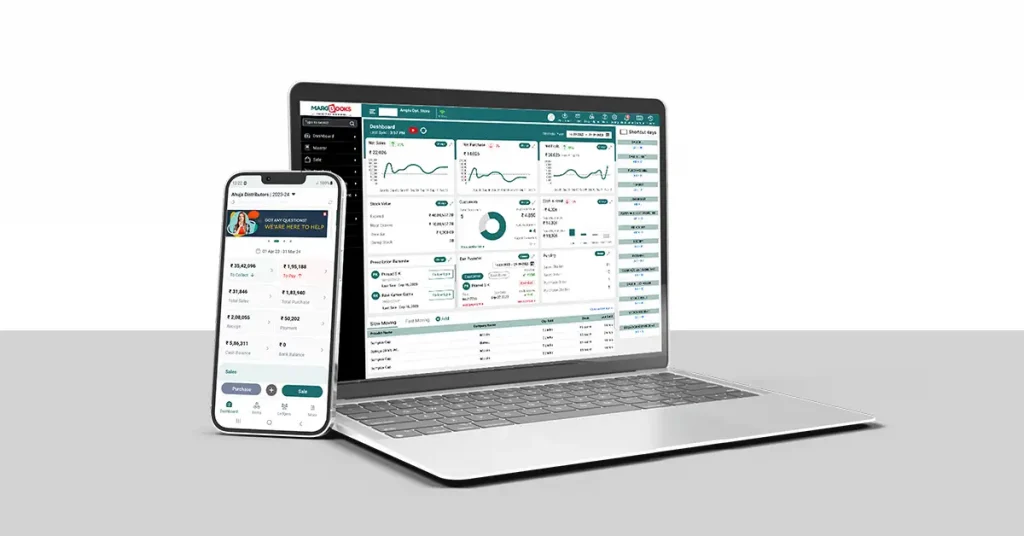
This is exactly the kind of thing GST billing software is built for. With MargBooks, you can mark items as exempt or taxable at the item-master level, so your billing staff never has to make that judgment call at the counter. The system also helps with ITC apportionment when you’re dealing with a mix of taxable and exempt supplies, and it pulls together GSTR-1 and GSTR-3B-ready reports so your GST returns line up with what you’ve actually billed.
Pair that with our accounting software for ledger-level accuracy, and you’ve got a setup where exemption handling isn’t something you have to remember; it’s built into how your invoices get generated in the first place.
Conclusion
GST exemption isn’t something you can set once and forget. It requires knowing your classification, tracking the relevant notifications, understanding your ITC exposure, and reporting things correctly in your returns. Get it right, and you’re compliant and stress-free. Get it wrong, and it’s interest, penalties, and a lot of after-the-fact cleanup. If you’d rather have your billing software handle the exempt-vs-taxable logic, try a free demo of MargBooks to see how it fits into your existing workflow.
FAQs
Q1. How do exempt supplies and nil-rated supplies differ?
Exempt supply doesn’t mean nil-rated supply. Nil-rated supply can be described as a kind of exempt supply. Thus, we can say that it can be regarded as a type of exempt supplies.
Q2. What is GST exemption limit for registration?
Majority of businesses are required to obtain GST registration only after their turnover has exceeded the limit of ₹40 lakhs for the goods and ₹20 on the services side (for special category states, they have to comply with limits of ₹20 lakhs and ₹10 lakhs respectively).
Q3. Can GST Input Tax Credit be claimed on exempt supplies?
Generally, ITC regarding exempt supplies cannot be availed. When the same goods are used for both taxable and exempt supplies, proportionate or reversal of the credit is to be taken as per the CGST Rules.
Q4. Can the exemption notification be cancelled by the government?
Yes, the authorities have the power to change or withdraw an exemption notification whenever they believe it necessary by issuing another notification as per the provisions of the Indian laws.
Q5. What happens in case an exempt product/service is wrongly classified as taxable?
In the event that an exempt item/service is incorrectly classified as a taxable one, the business will be responsible for the GST to be collected with interest and penalties in accordance with GST law.

Aman Kannojia is the Digital Team Lead at MargBooks. He started out as an SEO Specialist and never lost his love for words. With 5 years of experience across banking, SaaS, and finance, both domestic and international, he brings strategy, leadership, and storytelling together. He doesn’t just manage a team, he builds one that creates.