Retail Software
 Distribution Software
 Retail Chain

A Practical GST Compliance Guide For Indian Businesses

GST doesn’t ask much of you conceptually; it’s just relentless about the calendar. There’s no “off month” where you get to skip filing, no buffer for forgetting a deadline, and no leniency just because your business is small. One missed return, one mismatched invoice, one late payment, and the interest and late fees start piling up before you’ve even noticed.
The frustrating part is that most GST trouble doesn’t come from businesses trying to cut corners. It is about tiny, preventable mistakes, an erroneous HSN code here, an omitted invoice number there; it is about filing ITC returns without considering whether the supplier has filed theirs. Now, none of this is too difficult if only you knew where to look for it, and as it happens, nobody simply gives you the list of everything needed upfront.
So here’s the practical version, broken into points so it’s easy to actually use, what to register for, what to file and when, where ITC claims quietly fall apart, and where a bit of the right software takes the repetitive part off your hands entirely.
What is GST Compliance?
- ₹40 lakh turnover for goods, ₹20 lakh for services, that’s the official cutoff (₹20 lakh in a few special category states)
- But turnover isn’t the only trigger. Selling on Amazon or Flipkart? You’re registering regardless of how small your revenue is
- Shipped goods to another state, even once? Same story
- Most small traders assume registration only matters once they’re “big enough”; that assumption is exactly what gets people penalty notices
GST Registration Essentials
- PAN, address proof, bank account, signatory documents, straightforward at the start
- Moved offices? Update the registered address immediately, not “whenever”
- Don’t let registration go quiet for months without filing NIL returns
- Turnover under ₹1.5 crore? Talk to your CA about the composition scheme vs. the regular before picking one blindly
- Composition = lower tax, less paperwork, but no ITC and no inter-state sales
- Regular = full ITC, more filing work
- Neither is “better”; it depends entirely on your business
Invoice Accuracy & Documentation
- An invoice needs: your GSTIN + buyer’s GSTIN (if registered), a proper sequential invoice number, correct HSN/SAC code, taxable value with CGST/SGST/IGST split, and place of supply
- Most GST notices trace back to something boring, an outdated HSN code, a skipped invoice number, or a GSTIN with one wrong digit
- E-invoicing (IRN generation) thresholds keep dropping. If you’re anywhere close to the current limit, check it yourself, don’t wait for a notice

GST Return Filing Compliance
- GSTR-1 → 11th of the following month
- GSTR-3B (tax payment) → 20th of the following month
- On QRMP? You file quarterly, but you still pay monthly, this is the part people forget
- GSTR-9 (annual return) and GSTR-9C (if you cross the audit turnover limit) come months after year-end, right when most people have stopped thinking about GST
- Miss a deadline → 18% annual interest + daily late fee. It adds up quicker than expected
Input Tax Credit (ITC) Compliance
- You can only claim ITC if:
- You have a valid tax invoice
- Your supplier has actually filed and reported it (this is the one people forget)
- You’ve received the goods/service
- Payment went out within 180 days
- Reconcile your purchases against GSTR-2B every month, this is how you catch mismatches before the department does, not after
Timely Tax Payments
- Interest starts the day after the due date. No grace period, no exceptions for “I meant to pay yesterday”
- Pay a day or two early instead of racing the deadline, portal traffic and bank delays are common right when everyone files at once
E-Way Bill Compliance
- Mandatory above ₹50,000 per consignment
- Distance doesn’t matter, even a local delivery needs one if it crosses that value
- Penalty is a flat percentage of goods value, not scaled down for smaller shipments
GST Compliance Checklist
- GSTIN active, address/bank details current
- Invoices numbered correctly with proper HSN/SAC
- E-invoice IRN generated (if applicable)
- GSTR-1 filed by the 11th
- GSTR-3B filed & paid by the 20th
- GSTR-2B reconciled monthly, before claiming ITC
- E-way bill generated above ₹50,000
- Annual return deadline actually marked somewhere you’ll see it
Common GST Compliance Mistakes Businesses Make
- Filing GSTR-3B without reconciling GSTR-1 first
- Claiming ITC before checking if the supplier filed
- Using an old HSN code after a rate change
- Skipping e-way bills for “local” deliveries
- No one internally owns the annual return deadline
Where GST billing software helps
- GST Billing Software auto-fills HSN codes and generates compliant invoices without you double-checking every field
- Cuts down on the sequencing and formatting errors that trigger most GST notices
- Handles e-invoice IRN generation automatically once you cross the applicable threshold
Where cloud-based accounting software helps
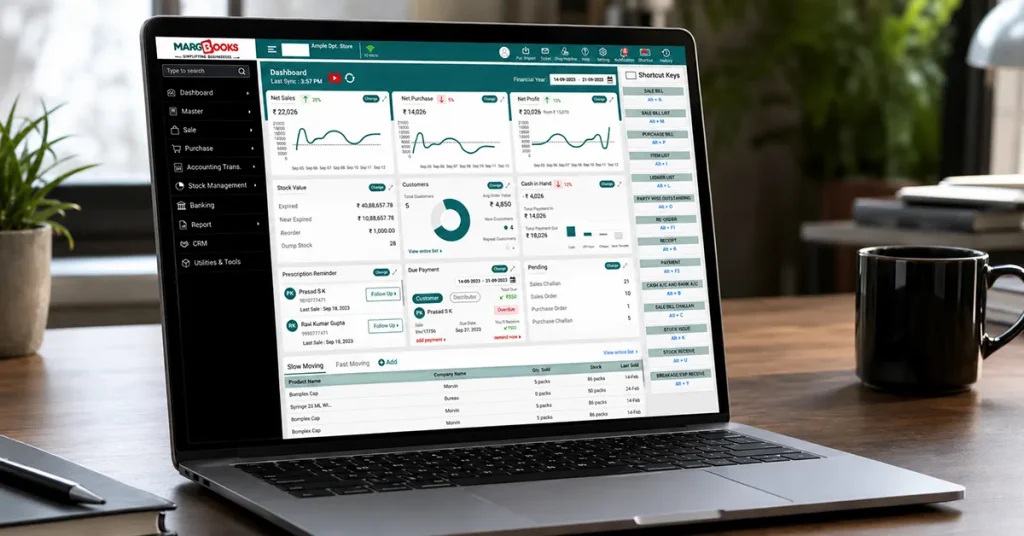
- Cloud based accounting software keeps your books, invoices, and returns in sync in real time, useful if more than one person handles finance, or you’re checking numbers on the go
- Runs ITC reconciliation quietly in the background instead of you doing it manually every month
- Reminds you before a deadline, not after a penalty
- Won’t replace your CA’s judgment on scheme selection or disputes, but it removes the repetitive errors that cause most compliance problems
Conclusion
None of this is hard to understand. It’s just unforgiving about repetition, same tasks, every month, no skipped cycles. Businesses that are free from any penalties mostly have boring, repetitive processes instead of having sharp accountants. Software like Margbooks allows you to handle everything from invoicing to GST filing reminders and ITC reconciliation in the same software, thereby eliminating the hassle of tracking compliance.
FAQs
Q1. What will happen if I do not file my GST return when it is due?
Interest accrues at the rate of 18% per annum from the day following the due date, along with a penalty for delayed filing each day. There’s no grace period; even a one-day delay counts.
Q2. Can I claim ITC if my supplier hasn’t filed their GST return yet?
No. Your ITC claim depends on your supplier actually reporting that invoice in their return. If the return has not been filed, the claim for the input tax credit will not be available in GSTR-2B, and any attempts to claim it will generate a mismatch notice eventually.
Q3. Is e-way bill necessary for making deliveries within the city?
Yes, as long as the value of the consignment crosses Rs. 50,000. The distance or route does not make any difference.
Q4. Should I choose the composition scheme or the regular GST scheme?
It depends on your business. The composition scheme means lower tax and less paperwork, but no ITC and no inter-state sales. The regular scheme gives full ITC benefits but comes with more filing work. Worth discussing with your CA before deciding.
Q5. Do I need to issue an e-invoice while running my enterprise?
You must issue an e-invoice if your turnover exceeds the appropriate limit, which is reduced periodically by the government. It’s worth checking the current limit directly rather than assuming your business is exempt.

Aman Kannojia is the Digital Team Lead at MargBooks. He started out as an SEO Specialist and never lost his love for words. With 5 years of experience across banking, SaaS, and finance, both domestic and international, he brings strategy, leadership, and storytelling together. He doesn’t just manage a team, he builds one that creates.