Retail Software
 Distribution Software
 Retail Chain

Who Should File Returns for Section 92B TDS Deducted?


There are many international deals taking place in India, every Indian business needs to be aware of a specific term used in taxation, section 92B TDS. It’s not just another compliance requirement, but it is a very important part of the way in which cross-border dealings are regulated under the Indian taxation system.
This section ensures that when you are dealing with associated enterprises in a foreign land you account payable and you pay tax at source as per the law. Understanding Section 92B TDS, helps you stay compliant to avoid any penalties, and creates a transparent customer financial record – something every smart business owner, CFO, or CFO unit is trying to find.
What Is Section 92B TDS?
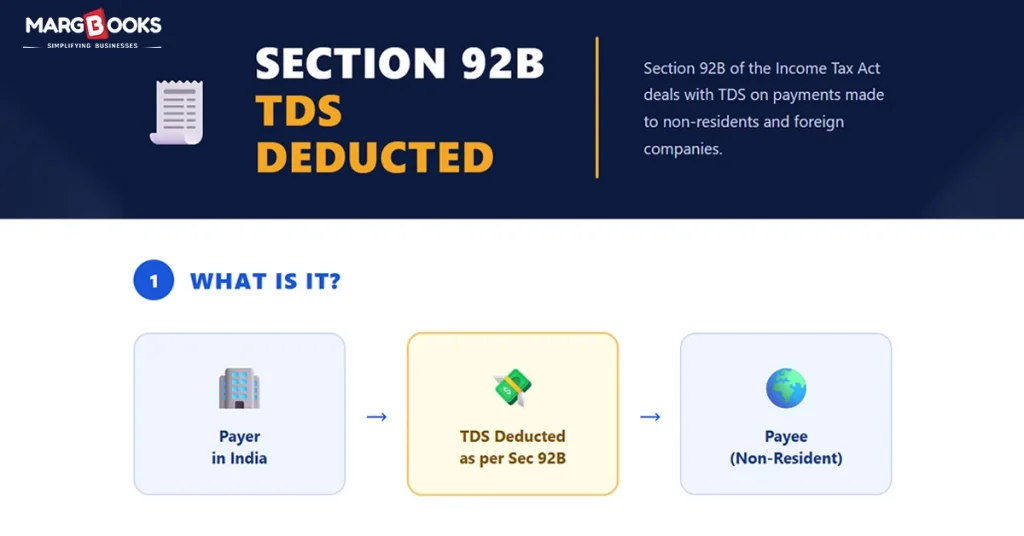
The section 92B TDS of the Income Tax Act is applicable to ‘international transactions’ between associated enterprises (meaning two entities which are related as owning, controlling or managing each other and are situated in different countries) and especially with respect to resident non-residents.
For example, when an Indian company makes payments to its foreign parent for technical services, consultancy or software usage, it will fall within this section. In order for this to be done correctly, the Indian entity must calculate TDS (Tax Deducted at Source) while making such payments so as to report the income in both jurisdictions.
Who Should File Returns Under Section 92B TDS?
The objectives are to eliminate the profit shifting and tax evasion by transfer pricing. In simple terms, this means that both Indian and foreign entities are to pay reasonable taxes on their income derived from the actual market value.
The simple rule here is that if an enterprise has entered into any foreign trade transactions with an enterprise with which it has any association during the financial year, then it has to report and file returns under this section of the Act. The following are the ones that typically need to file:
- Indian companies that buy or sell services or goods from the foreign subsidiaries or parent companies.
- Import or export of services or royalty payments by partnership firms or LLPs.
- Freelancers or consultants that pay foreign agents for marketing services or technical services.
- Startups with international software license and cloud infrastructure providers.
The return shall declare all such international transactions in Form 3CEB with accounting software, which is signed by Chartered Accountant. Failure to report or misreporting these may invite intense punishment and scrutiny from the Income Tax Department.
Why Timely Compliance Matters?
When it comes to cross-border taxation, when you miss the TDS return deadline, it can snowball into serious matters. If you file under TDS early AF (in section 92B), you can:
- Avoid liability for penalties under Section 271BA and other provisions.
- Ensure you are credible with the Income Tax Department.
- Get around double tax returns with foreign jurisdictions.
- Simplify your audits and make your books clean and transparent.
The catch is that most small-scale Indian businesses tend to mistake that these rules apply only to big corporations. In fact, even smaller cross-border service payments (such as software subscriptions or marketing fees) can also be subject to this part.
Common Mistakes to Avoid
While doing the transfer pricing bother TDS, there are common errors businesses end up struggling to clearly such as:
- Failure to identify associated enterprises properly.
- Neglecting small-value foreign transactions, which they believe to be exempt.
- False deduction of TDS or expressing wrong type of payment.
- Failure to file Form 3CEB in time.
- Lack of digital tools in automation of TDS and calculations and records.
An easy way of keeping everything organized is through the use of digital accounting solutions that auto track, record, and reconcile all such payments.
How Indian Businesses Manage This?
An IT services firm in India pays for a U.S.-based holding firm for technical support at the backend. The payment was an international transaction under Section 92B. The Indian company is required to make TDS, keep the transfer price records and file Form 3CEB.
Likewise, if a new business imported high-price cloud services from a UK provider it also needs to ensure its TDS component is calculated and reported properly. At the request of such clients, many Indian CA companies now use integrated software solutions for keeping track of every transaction that takes place.
The Role of Digital Tools in TDS Compliance
With such a vast amount of financial records, invoices and statutory deadlines to deal with, digital tools make compliance easier.
Our GST billing software utilization by businesses helps in the generation of invoices capable of TDS Payments, which are automatically linked with statutory reports. It also helps decrease the manual mistakes in calculating tax.
On the other hand, the modern accounting software keeps a record of domestic and international transactions in real time so that you have full control over your financial compliance trail. These tools can ensure that your TDS deducting are as follows – 1. systematic recording 2. ready for return filing.
Why Businesses Prefer MargBooks for TDS & Return Filing?
MargBooks software is now the go-to option of many Indian SMEs and CAs with digital management of TDS and taxes. It makes complicated work like tracking of TDS deduction, return filing reminder, reports easy. Reasons for businesses to use MargBooks:
- After using IATI code, it automatically computes the TDS for international and domestic transactions.
- It safely stores all documents for audit and compliance purposes.
- It integrates with GST reporting format and income tax reporting formats perfectly.
- It reminds and alerts you about the filing deadlines.
Whether you’re a small business owner or a professional tax consultant, MargBooks makes keeping accounting records in order applicable, uncomplicated, and correct.
Conclusion
Aside from the penalties you might face for non-compliance with Section 92B TDS, changing how you operate your business is about creating a culture of transparency and responsibility in business. Taxes must be calculated and reported correctly and as such, all deals with foreign counterparties are subject to a corresponding obligation for taxation.
For Indian businesses to handle such complexities, using digital tools such as MargBooks software will ensure precision and compliance at the air of peace of mind. By combining modern and smart solutions with old-fashioned accounting wisdom businesses can remain compliant and focus on what really matters, sustainable growth and long term trusts in India’s evolving Tax Ecosystem.

Aman Kannojia is the Digital Team Lead at MargBooks. He started out as an SEO Specialist and never lost his love for words. With 5 years of experience across banking, SaaS, and finance, both domestic and international, he brings strategy, leadership, and storytelling together. He doesn’t just manage a team, he builds one that creates.