Retail Software
 Distribution Software
 Retail Chain

How Does Section 7 of CGST Act Determine Taxable Supply?

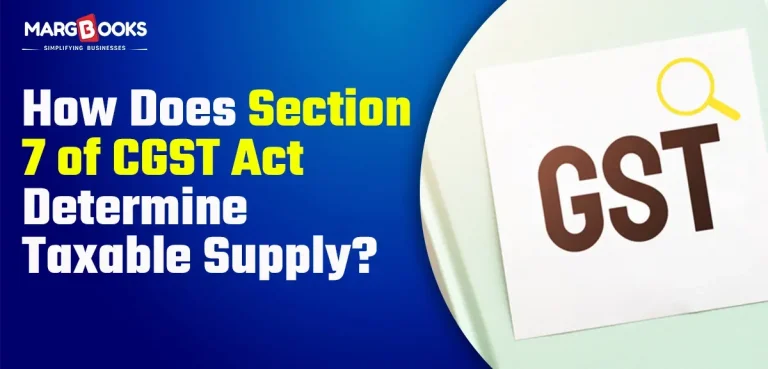
GST is levied on the concept of “supply.” That makes it essential for businesses to understand what transactions attract tax. Section 7 of the CGST Act plays a crucial role. It defines taxable supply. It sets the foundation for GST applicability. It does not matter whether a business sells goods, provides services, or transfers assets. Identifying whether the transaction qualifies as a supply is essential. It helps ensure compliance and avoid penalties. Here are the provisions of Section 7 in a simple and structured manner.
Understanding the Concept of Supply Under GST
Under GST, tax is imposed on the supply of goods or services. However, not every transaction automatically becomes taxable. The definition of supply determines whether GST should be charged. This includes activities carried out in the course or furtherance of business. It also covers certain transactions even without consideration. Proper classification of supplies is important. It ensures correct invoicing and filing. This is especially crucial for growing businesses.
Section 7(1)(a): Supply Made for Consideration
Do you know what the most common category of taxable supply is? Transactions made for consideration. These may involve:
- Sale of goods
- Transfer or exchange
- Rental or lease
- Licensing or disposal
Such activities must occur in the course of business. Otherwise, they cannot qualify as a supply. For example, a retailer sells products or a consultant charges service fees. GST applies in both cases. Businesses often rely on GST billing software. It automatically identifies taxable transactions. It also applies appropriate tax rates. This ultimately reduces manual errors.
Section 7(1)(b): Import of Services
Import of services for consideration is treated as a supply under GST. Interestingly, this applies even when the service is not used for business purposes. For example, assume an individual subscribes to an overseas software platform. GST may still be applicable under reverse charge. This provision ensures that services consumed in India are taxed. It does not consider the supplier’s location.
Section 7(1)(c): Activities Specified in Schedule
Certain activities are considered supply even when no consideration is involved. These include:
- Transfer of goods between related persons
- Branch transfers across different states
- Permanent transfer of business assets
- Supplies between principal and agent
These transactions are taxable. They help prevent revenue leakage. Many companies track such internal movements through accounting software. This ensures accurate GST compliance and proper documentation.
Section 7(2): Activities Not Treated as Supply
Some activities are explicitly excluded from the scope of supply. These are listed in Schedule III. Examples include:
- Services provided by an employee to the employer
- Sale of land and completed buildings
- Functions performed by public representatives
- Funeral, burial, and cremation services
Recognizing these exclusions is vital. It helps avoid charging GST incorrectly. It also promotes proper compliance maintenance.
Section 7(3): Classification of Supply
The government holds the authority to specify whether a particular transaction is treated as a supply of goods or services. GST rates may differ. That’s why this distinction matters. Understanding Section 7 of CGST Act helps businesses classify transactions correctly. It ensures accurate tax treatment. It also reduces compliance risks.
Practical Importance for Businesses
Understanding taxable supply significantly helps businesses. They are easily able to identify GST-applicable transactions. Companies avoid penalties and interest. They ensure accurate invoicing. At the same time, they effortlessly maintain proper GST records. Automated solutions like GST billing software also assist businesses. It simplifies invoice generation and calculating tax liability. All possible due to supply classification.
Role of Technology in GST Compliance
Digital tools are becoming essential for managing GST. Businesses increasingly use accounting software. It helps record transactions, track supplies, and reconcile GST returns. This reduces manual work. It also improves accuracy. This is especially important when dealing with complex supply classifications.
Conclusion
In summary, Section 7 of the CGST Act defines the scope of taxable supply under GST. It also helps businesses determine the tax applicability. Understanding its provisions is essential for organizations. This ensures compliance and reduces errors. It also helps streamline operations. Modern tools and platforms further simplify this process. Also, softwares like MargBooks help businesses manage GST billing efficiently. Moreover, they assist companies in maintaining accurate financial records.

MargBooks, a product of Marg ERP Ltd., is a revolutionary cloud-based billing & accounting solution for every business where the business owner can manage the business from anytime anywhere on any device. MargBooks is your one-stop platform for managing your accounting, organizing your transactions, controlling your finances and managing your inventory. It’s a single secure platform to keep up with your company’s bills and invoices, reconcile your transaction, file GST return easily, experience connected banking etc.