Retail Software
 Distribution Software
 Retail Chain

Section 125 of the CGST Act: Penalty Rules Every GST Taxpayer Should Know

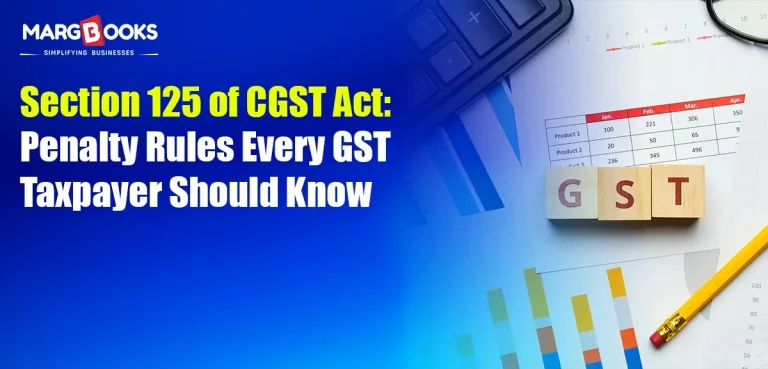
Most individuals think GST compliance in India is limited to the timely filing of returns. But it also involves adherence to various procedural requirements. Non-compliance, even if unintentional, may lead to penalties. That’s why all GST taxpayers must be aware of Section 125 of the CGST Act. It is also referred to as the general penalty clause.
This section serves as a safety net for the tax department. It facilitates imposing penalties for non-compliance that may not be specifically provided for elsewhere in the GST law. Knowing how this section works may help avoid trouble for a business.
What Is Section 125 of the CGST Act
Section 125 of the CGST Act is a residual penalty provision. It applies when a taxpayer violates any GST rule or provision. However, one condition applies. The violation must not be prescribed under other sections of the Act, i.e., Sections 122, 123, or 124. Then, authorities may invoke this section.
The section applies to any person who contravenes the provisions of the Act or rules made. Thereunder, he/she shall be liable to a penalty. It may extend to ₹25,000. This makes it a broad and flexible penalty tool for tax officers.
Common Situations Where This Section Applies
A large number of taxpayers believe penalties are only for significant offences like tax evasion. However, they may also incur this act due to a procedural error. The following actions may lead to procedural errors:
● Not displaying the GST registration certificate at the place of business
● Failure to maintain proper books of accounts
● Issuing invoices that do not comply with GST format rules
● Delay in updating the required business information on the GST portal
These may appear to be minor errors. That’s why some leave them unrectified or continue to repeat them. This can attract penalties. That’s why choosing a reliable GST billing software is essential.
How Authorities Decide the Penalty Amount
The maximum penalty that can be levied under this section is ₹25,000. However, this amount may vary. It depends on particular factors, such as:
● Nature of violation
● Whether the violation was intentional or accidental
● Compliance history of the taxpayer
Another important aspect of GST law is that the taxpayer gets a chance to be heard before any penalty is levied.
How Businesses Can Avoid Penalties
Avoiding penalties is not a demanding task. It is largely about maintaining proper compliance systems. Businesses should:
● Maintain accurate and updated financial records
● Make sure invoices have all mandatory GST details
● File returns and update information within prescribed timelines
Using reliable GST billing software can help significantly. It can reduce the risk of invoice-related errors. Automated invoice generation ensures that tax rates, HSN codes, and other details are always accurate.
Role of Technology in Preventing Compliance Errors
Manual accounting processes are more prone to mistakes. This is where accounting software steps in. Modern tools facilitate business tracking. Sales and purchase transactions are automatically tracked. They successfully generate GST-compliant reports. Businesses are able to maintain digital records. They are easy to retrieve during audits.
Similarly, advanced GST billing software is beneficial. It ensures that every invoice generated aligns with current GST rules. This reduces the chances of procedural violations.
What to Do If You Receive a Penalty Notice
Receiving a notice is not always equated with the necessity to pay the penalty. Taxpayers have the right to respond and present their case.
Key steps include:
1. Carefully review the show-cause notice.
2. Collect supporting documents.
3. Submit a written reply within the specified deadline.
4. Attend hearings if required.
If the penalty still seems unjustified, businesses can file an appeal. It can be filed under the GST appellate provisions.
Conclusion
Understanding penalty provisions is essential. It promotes a GST-compliant business. Major offences receive more attention. General penalty under Section 125 of the CGST Act generally arises from common procedural lapses. Therefore, an organization must have preventative measures in place.
That makes an effective accounting software and an automated system essential for compliance. It can drastically reduce the risk of errors. Solutions like MargBooks streamline billing and bookkeeping. It also saves you from avoidable penalties and compliance stress in the long run.

MargBooks, a product of Marg ERP Ltd., is a revolutionary cloud-based billing & accounting solution for every business where the business owner can manage the business from anytime anywhere on any device. MargBooks is your one-stop platform for managing your accounting, organizing your transactions, controlling your finances and managing your inventory. It’s a single secure platform to keep up with your company’s bills and invoices, reconcile your transaction, file GST return easily, experience connected banking etc.