Retail Software
 Distribution Software
 Retail Chain

What Role Does Section 74 of CGST Act Play in GST Enforcement?

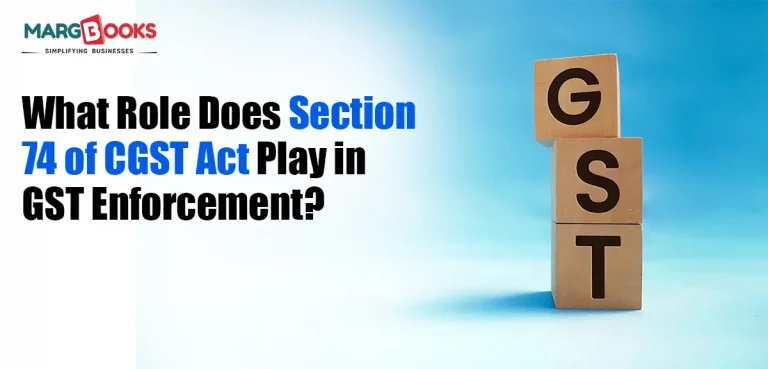
Before GST, multiple tax systems often led to confusion, and there was a lack of transparency as well. But after GST implementation, certain sections under GST compiled the tax system into a more structured and tech-driven process. Because of this, if you are not able to manage your accounts well, then it can often lead to significant consequences under Section 74 of CGST Act. The mismanagement that we are talking about contains suspicion of fraud, willful misstatement, or suppression of facts. To avoid such scenarios, Businesses today use GST billing software tools to maintain proper records and timely and accurate filings to stay compliant and confident at all times.
In this blog, we will discuss the role Section 74 of the CGST Act plays in GST enforcement, its penalties, process, and best practices that every business should follow.
What is Section 74 of the CGST Act?
GDST Enforcement has been greatly aided by the inclusion of Section 74 of CGST Act, which ensures proper action is taken against those found guilty of tax evasion, committing fraud, or otherwise not complying with the provisions of the GST Act in respect of taxes paid/short-payed/claimed wrongfully. It is one of the strictly followed provisions under GST and is especially designed to manage intentional non-compliance.
Here is a list of situations that are considered under Section 74 of CGST Act, where a taxpayer has-
- Not paid GST
- Short-paid tax
- Claimed incorrect Input Tax Credit (ITC)
- Received excess refunds
In the above mentioned cases, tax authorities have the power to initiate proceedings and recover the tax along with interest and heavy penalties. Sometimes the tax can go upto 100% of the tax amount, depending on the timing of the payment. However, reduced penalties are allowed if the dues are cleared at an early stage. Meanwhile, using a GST Billing Software can avoid such proceedings.
What Role Does Section 74 of CGST Act Play in GST Enforcement?
Here, we will discuss how Section 74 of CGST Act helps in strengthening GST Enforcement.
- Acts as a Deterrant Against Fraud
According to this provision, heavy penalties are imposed on intentional tax evasion, which discourages businesses from engaging in fraudulent activities.
- Accountability
Holds the taxpayer accountable for any major false statements and for withholding information. This allows the government to ensure that businesses obey the GST laws.
- Voluntary Compliance
Promotes compliance by allowing the taxpayer to voluntarily disclose any amounts owed before actual enforcement occurs at a lower fee for doing so. This will help reduce the number of tax disputes.
- Gives strength to Tax Administration
Provides tax authorities with the ability to take strict actions, providing for the efficiency of the overall enforcement of the GST.
- Protects government revenue
Protects government revenue from the reduction of tax fraud and helps to maintain the public trust in the taxation system.
What are the Penalties Under Section 74?
Under section 74, there are strict penalties for follow-up due to the fraudulent nature of offenses.
As already discussed, based on the timings of the payment, there can be a hundred percent penalty of the tax amount. Additional interest liability is also there. However, relief is available at different stages. The brief regarding the same is given in the table below-
| Stage of Payment | Penalty Payable |
| Before SCN | 15% of tax |
| Within 30 days of SCN | 25% of tax |
| Within 30 days of the order | 50% of tax |
| After 30 days of the order | 100% of tax |
The above structure promotes early compliance and reduces legal complications. A trustworthy and accurate accounting software, such as Margbooks, can help taxpayers to prevent accountability issues and avoid such penalties.
Process Under Section 74 of the CGST Act
Under the CGST Act, the procedures provided for under Section 74 are intended to ensure fair enforcement, as well as to provide for adequate communication:
Step 1: Detection of Default/Fraud
The authority detects the case during the audit, inspection, or through a source of data that it has acquired.
Step 2: Show Cause Notice (SCN) issued by the authority
Receipt of an SCN or Show Cause Notice from the relevant authority that details fraudulent activities or omissions in connection with facts unknown by the entity involved.
Step 3: Reply by Taxpayer
The taxpayer must respond to this show-cause notice with a justification of all claims made, with appropriate supporting documents.
Step 4: Adjudication
The authority will review the response made by the taxpayer and will then issue an order establishing whether any tax, interest, or penalty is due.
Step 5: Recovery Proceedings
If any amount owing under the order of the authority is not paid, recovery action will be taken in accordance with the provisions of the GST.
Strategies for Avoiding Section 74 Issues
Businesses can adhere to good business practices to assist them in achieving proper compliance with the corresponding penalties:
- Keeping accurate and updated account records
- Timely filing of GST returns
- Regularly reconciling ITC
- Not reporting incorrect data or hiding any data
- Timely response to any notice sent
- The use of reliable GST billing software.
Conclusion
In summary, the way that Section 74 of the CGST Act functions in relation to the enforcement of GST is by identifying fraud and purposely avoiding paying taxes by the taxpayer. It’s important to understand this provision for businesses to prevent legal complications and financial losses. When you utilize the MargBooks Software, you can get assistance to improve your company’s overall accountability, correctness, and conformity with regulations related to indirect taxes (GST).

MargBooks, a product of Marg ERP Ltd., is a revolutionary cloud-based billing & accounting solution for every business where the business owner can manage the business from anytime anywhere on any device. MargBooks is your one-stop platform for managing your accounting, organizing your transactions, controlling your finances and managing your inventory. It’s a single secure platform to keep up with your company’s bills and invoices, reconcile your transaction, file GST return easily, experience connected banking etc.