Retail Software
 Distribution Software
 Retail Chain

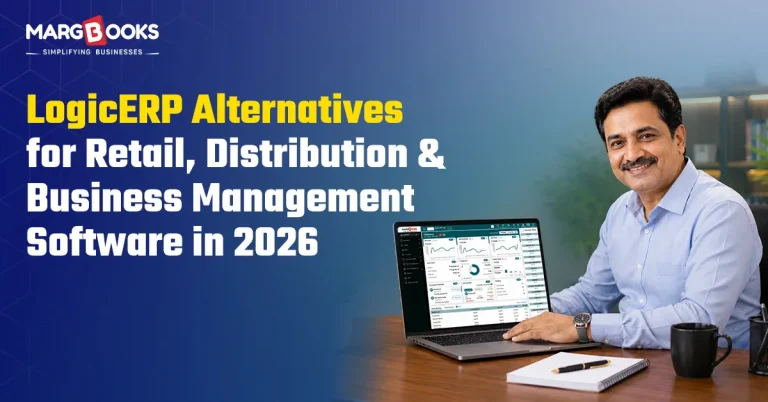
Best LogicERP Alternatives for Retail & Distribution ERP Software in 2026

Thirty years in the market. Trusted by more than 10,000 retailers. Clients like SNITCH and V-Bazaar. LogicERP has earned its reputation; nobody’s arguing that. But reputation doesn’t always translate to the right fit.
Talk to a mid-sized retailer that tried implementing LogicERP without a dedicated IT team. Or a growing distributor who looked at the pricing and quietly closed the tab. The GST Billing Software is built for enterprises, genuinely large ones, and when you’re not in that bracket, it starts to feel like you’re paying for a truck when you needed a car. That’s the tension. And it’s why a lot of Indian retail and distribution businesses are quietly shopping for something else in 2026. This guide covers the LogicERP alternatives, what they’re good at, where they fall short, and who they’re actually built for.
Reasons behind finding LogicERP Alternatives?
No one changes their ERP software out of spite. Changing ERP software is a complex and time-consuming task that carries significant risks. When businesses do it anyway, there’s usually a real reason — sometimes a few.
Here’s what keeps coming up.
Implementation takes forever. You can’t just sign up and start using it. LogicERP needs a trained implementation partner. Weeks go by. The go-live date shifts. Meanwhile, your business is running on whatever workaround you stitched together.
The pricing isn’t what it looks like upfront. Per module, per store, per user — it compounds. A business with 15 outlets and a small team can end up with a monthly bill that made sense on a spreadsheet but hurts in practice.
You have purchased things that you will never use from your ERP provider. WMS. Manufacturing planning. Full omnichannel infrastructure. If you’re a retail chain with under 50 stores, a chunk of what you’re licensed for is just sitting there. That’s not value — that’s overhead.
Getting help takes time. Support goes through implementation partners. Which means when something breaks, you’re not calling LogicERP — you’re calling your partner, hoping they’re available, and waiting. For businesses that run on daily operations, that’s a real problem.
The cloud version doesn’t feel cloud-native. It exists. But there’s a difference between a product that was designed for the cloud and one that was adapted for it. The heaviness of the platform comes through.
None of this makes LogicERP a bad product. For a 200-store enterprise with a proper IT team and budget to match, it probably makes total sense. The problem is when a 20-store chain gets sold the same solution.
Comparison between LogicErp Alternatives
| Software | Best For | Deployment | Multi-Location | Mobile App |
| MargBooks | Cloud ERP, Retail, Distribution & Inventory | True Cloud | Yes | Yes |
| TallyPrime | Financial Accounting & Statutory Compliance | Hybrid | Limited | Companion App |
| Busy Accounting | Trading, Manufacturing & Multi-Warehouse | Desktop-First | Yes | Companion App |
| Vyapar | Offline-First Small Retailers | Offline-First | No | Yes |
| myBillBook | Mobile-First Micro Businesses | True Cloud | No | Yes |
The Top 5 LogicERP Alternatives in 2026
1. MargBooks
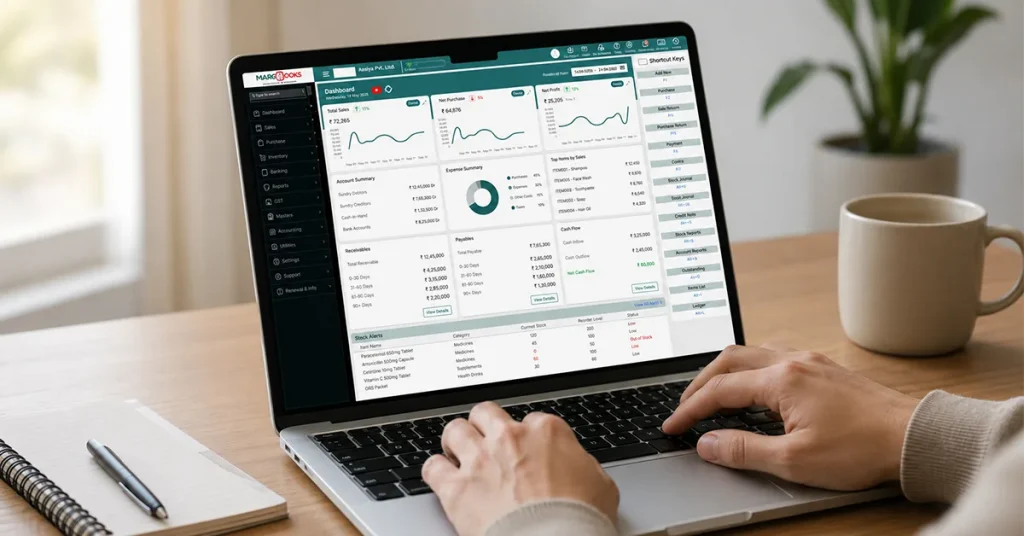
MargBooks is the one that most directly replaces what LogicERP does, just without the implementation nightmare and enterprise price tag.
It has been serving the Indian retail and distribution sector for over three decades. But MargBooks itself was built cloud-first, not retrofitted. That distinction matters more than it sounds. A cloud-based GST Billing Software allows your company to check in from anywhere, have information updated in all locations in real-time, and to not have to rely upon a server that is stored in a single office.
An ERP system provides capabilities for branch management, such as a centralized inventory control, the ability to run reports across all branches, as well as functions associated with an inventory tracking system down to the level of granularity needed for the pharmaceutical and fast-moving consumer goods (FMCG) industry, including parcel, expiry date, rack location, and warehouse location.
A POS system that will allow for the scanning of barcodes, touch screen functionality for billing, and offline functionality while the internet is down will allow your business to remain productive regardless of the state of the internet.
A CRM system will allow your business to have functions such as loyalty programs and the ability to send invoices through WhatsApp. A full accounting stack — P&L, balance sheet, bank reconciliation, and ledger management. And compliance automation covering e-invoicing, e-way bills, and GSTR, all built in, not patched on.
One thing worth flagging: if you’re switching from LogicERP, MargBooks handles data migration for free. Inventory masters, customer ledgers, billing history, and financial records — it all comes across. That’s not a small thing when you’re staring down an GST Billing Software switch.
Pros
- Genuinely cloud-native — any device, any location, no server required
- Feature depth that holds up against LogicERP at a fraction of the cost
- No implementation partner needed — faster to get live
- Built specifically for Indian GST compliance
- Free data migration from LogicERP
Cons
- Highly specialised manufacturing workflows may need additional configuration
- Global third-party integrations are more limited than some enterprise platforms
Best For
Growing retailers, wholesalers, pharma distributors, and multi-store chains that want serious ERP capability without the enterprise complexity.
2. TallyPrime
TallyPrime is a different category of product. It’s not trying to run your operations, it’s trying to make sure your books are airtight.
India’s chartered accountant community has standardised on it for a reason. If your primary concern is financial accuracy, audit trails, and statutory compliance rather than store-level operations, TallyPrime is the more focused and far less complex option.
Balance sheet, P&L, multi-currency transactions, bank reconciliation, audit trail management, GST compliance, it handles all of that well. What it doesn’t handle: multi-location retail, POS, supply chain, or anything resembling operational ERP. The mobile app is companion-only, not a standalone product.
If you’re a finance-heavy business where accounting is the hard part, and operations are relatively predictable, it’s a strong choice. If you need both, look elsewhere.
Pros
- Trusted across India’s finance and CA community
- Deep statutory compliance and audit functionality
- A large ecosystem of trained professionals who know the platform
Cons
- Not built for retail operations or distribution management
- No native POS or supply chain features
- Desktop-first at its core
Best For
Medium businesses and accounting-focused operations where financial precision matters more than operational depth.
3. Busy Accounting
Busy has carved out a specific lane: structured manufacturing businesses, material processors, and high-volume wholesale traders who need real ERP depth without any of the retail-chain features they’d never touch.
It’s desktop-first, inventory management software. That’s not a bug for its target users; these are established, fixed-location operations, not businesses chasing mobile-first flexibility. Multi-location warehouse management, inter-branch stock transfers, bill-of-materials, production order tracking, high-volume transaction processing — Busy handles all of it, along with GST compliance on the trading side.
The product: it will not help with omnichannel retailing, mobile-first businesses, or something known as the modern chain. That being said, for those businesses that do not have this need, it will work fine for them.
Pros
- Strong manufacturing and multi-warehouse capabilities
- Well-established in traditional trading and distribution
- Handles high transaction volumes without issues
Cons
- Not cloud-native
- Limited mobile access
- Wrong fit for retail chains or omnichannel businesses
Best For
Manufacturers, material processors, and traditional mid-sized wholesalers with no omnichannel ambition.
4. Vyapar
Vyapar exists for one reason: a lot of small retailers in India don’t have reliable internet, and a lot of software breaks without it.
It’s built for the neighbourhood shopkeeper, the regional trader, the solo merchant who just needs billing, inventory, and payments to work without worrying about connectivity. Every core feature works offline. You sync when you have internet, but you’re not blocked when you don’t.
Basic inventory alerts, receivables and payables tracking, localized billing, and purchase orders cover daily operations cleanly. It’s not trying to scale with you or replace a real ERP. That’s not the point. The point is reliability for small, standalone operations.
Pros
- Works fully offline — genuinely useful for areas with poor connectivity
- Near-zero learning curve
- Priced for very small businesses
Cons
- No multi-location support
- Not designed to grow with the business
- Thin reporting and analytics
Best For
Small neighbourhood shops, standalone traders, and micro-retailers who need dependable daily operations, nothing more.
5. myBillBook
myBillBook is for a very specific person: the business owner who’s been running everything from a notebook and wants to go digital for the first time. It’s mobile-first by design, not by adaptation.
Transactions, customer records, inventory alerts, WhatsApp and SMS communication with customers and suppliers, and a digital catalog it keeps things simple. That’s the product’s entire strategy, and for the right user, it works. It’s not a stepping stone to an inventory management software. It’s a standalone tool for micro-businesses that don’t need one yet.
Pros:
- Genuinely easy to use from day one
- Built for the phone, not shoehorned onto it
- Very affordable
Cons:
- No multi-location support
- Too limited for businesses with real operational complexity
- This is not a long term solution if you expect to grow as a business.
Best For
Single owner/entrepreneur, small vendors/micro vendors, or any new small store that is trying to become an eCommerce site for the first time.
How to Pick the Right LogicERP Alternative?
In the table below, we have mentioned what can be the best LogicERP Alternative for you based on your needs.
| Go with | If your main need is |
| MargBooks | Cloud ERP across retail, distribution, POS, inventory, CRM, and multi-branch — without enterprise overhead |
| TallyPrime | Accounting depth, audit compliance, and financial reporting precision |
| Busy Accounting | Multi-warehouse trading or manufacturing with complex production workflows |
| Vyapar | Simple offline operations for a small standalone shop |
| myBillBook | Mobile-first basics for a micro-business going digital |
Conclusion
LogicERP works. For the businesses it was designed for, large chains, enterprise-level distributors, and operations with proper IT infrastructure, it holds up. The problem is when growing SMBs get sold an enterprise product and spend the next six months figuring out why it doesn’t quite fit. For most retail and distribution businesses in India that are growing but not yet enterprise-sized, MargBooks Software is the most sensible switch. The ERP depth is there. The cloud accessibility is real. The cost is a fraction of LogicERP. And because you will receive assistance when migrating to this system, you are not starting fresh. If you are undecided as to whether you want to purchase this system or utilize the free demonstration and migration consultation, it is worth your time of 30 minutes to find out more about this solution.
FAQs
What is the best LogicERP alternative for mid-sized businesses?
MargBooks has an equivalent feature set across all branches, including Retail, Distribution, ERP, and Inventory/CRM systems, and MargBooks provides a full-featured, cloud-based ERP solution with no need for large-scale implementations required by many ERP solutions.
Which are the top LogicERP alternative in India?
There are differences between what MargBooks, TallyPrime, Busy Accounting, Vyapar, and myBillBook provide to you in terms of how long they’ve been around, the size of businesses for whom they’re intended, and the types of features (that is, the ability to adapt to meet specific needs). You’ll receive different types of software depending on your criteria, as well as what your needs are.
Is there a cloud-based alternative to LogicERP?
MargBooks is fully cloud-native, not a cloud-adapted desktop product. Affordable, real-time multi-branch access from any device without needing a server.
Which LogicERP alternative is best for retail chains?
MargBooks.The base product includes multi-branch point of sale systems, inventory control, customer loyalty programs, WhatsApp invoicing, and chain-level reporting.
Which LogicERP alternative works best for distribution businesses?
MargBooks for modern cloud-based distribution with batch and expiry-level tracking. Busy Accounting for traditional high-volume trading with complex warehouse structures.
Does MargBooks migrate data from LogicERP?
Yes, inventory masters, customer ledgers, billing history, and financial records all migrate over at no extra cost. It’s part of the onboarding process.

Aman Kannojia is the Digital Team Lead at MargBooks. He started out as an SEO Specialist and never lost his love for words. With 5 years of experience across banking, SaaS, and finance, both domestic and international, he brings strategy, leadership, and storytelling together. He doesn’t just manage a team, he builds one that creates.