Retail Software
 Distribution Software
 Retail Chain

Inventory Carrying Cost: Meaning, Formula & How to Reduce It

If you own a retail or distribution firm or are the keeper of a tiny pharmaceutical shop, you most likely have experienced this without any calculations: your business premises are crowded, your store inventory appears to be fine, and nevertheless, your account balance is disappointing. The most probable reason is inventory carrying cost, an invisible cost of maintaining items in your inventory that haven’t been sold yet.
Most business owners in India track their sales obsessively but rarely sit down and calculate what it actually costs them to keep that unsold stock sitting on a shelf. This blog breaks down what inventory carrying cost really means, how to calculate it with a proper formula, a worked example, and, most importantly, practical ways to bring it down.
What is Inventory Carrying Cost?
Inventory carrying cost (or holding cost) refers to the total cost associated with keeping unsold goods during a certain period of time that would typically be measured on an annual basis. Inventory carrying cost is not simply the rent for the inventory; it also includes various costs concerning the cash invested in it and the cost of goods deteriorating or becoming obsolete before they are sold.
In general, the inventory carrying cost consists of four components:
- Capital cost – the money you’ve locked into buying that stock, which could’ve earned interest or been used elsewhere in the business
- Storage cost – rent, electricity, warehouse staff, racking, and handling equipment
- Service cost – insurance premiums, software/IT systems, taxes on inventory
- Risk cost – shrinkage, damage, theft, and the big one for many Indian retailers, dead stock and expired goods
If you’ve ever had to write off expired medicines or last season’s clothing at a steep discount, that loss falls squarely under risk cost.
Why is Inventory Carrying Cost Important?
Because it eats into your working capital without you noticing. A distributor might feel “rich” on paper, lakhs of rupees worth of stock sitting in the godown, but that same money isn’t available to pay suppliers, cover salaries, or grab a bulk-purchase discount when it comes along.
Expenses regarding inventory are interrelated with the inventory turnover ratio. The more slowly your goods are sold, the more you pay for their storage, thus affecting your profit margin.
It is customary for businesses to evaluate inventory carrying expenses as being between 20% and 30% of the inventory value, which means that if a business has inventory worth Rs. 10 million, it may be losing about Rs. 2-3 million every year without being aware of the situation.
For businesses involved in the trade of perishable items, such as drug stores, fast-moving consumer goods manufacturers, or milk factories, this figure could be greater if inventory is not managed properly.
Who Should Track Inventory Carrying Cost?
Honestly, any business holding physical stock benefits from tracking inventory carrying cost, but it matters more for some than others:
- Retailers and retail chains managing multiple stores
- Distributors and wholesalers dealing in bulk purchase cycles
- Pharmacies and wholesalers involved in the trading of goods with expiry date face great chances of losing some revenue.
- E-commerce businesses that have to manage dozens or even hundreds of SKUs.
- E-commerce sellers juggling dozens or hundreds of SKUs
- Any SME running more than one warehouse or godown
If your business fits into even one of these, this isn’t an “accounting nicety”; it’s a number that should show up in your monthly review.
How to Calculate Inventory Carrying Cost (Formula)
Here’s the standard inventory carrying cost formula used across the industry:
Inventory Carrying Cost (%) = (Inventory Holding Sum / Total Value of Inventory) × 100
Where Inventory Holding Sum = Capital Cost + Storage Cost + Service Cost + Risk Cost
Here’s how to work through it step by step:
- Add up your capital cost – the value of inventory multiplied by your cost of capital or interest rate
- Add your storage costs – rent, utilities, labour tied to warehousing
- Add service costs – insurance, software subscriptions, taxes
- Add risk costs – estimated losses from shrinkage, damage, or expiry
- Divide this total (the “holding sum”) by your average inventory value
- Multiply by 100 to get your carrying cost as a percentage
Example
Let’s say a pharma distributor is holding stock worth ₹10,00,000 on average throughout the year. Their yearly costs break down like this:
| Cost Component | Amount (₹) |
| Capital Cost | 80,000 |
| Storage Cost | 60,000 |
| Service Cost (insurance, software, etc.) | 30,000 |
| Risk Cost (expired/damaged stock) | 50,000 |
| Total Holding Sum | 2,20,000 |
Using the formula:
Carrying Cost = (2,20,000 / 10,00,000) × 100 = 22%
So this distributor is spending 22% of their inventory’s value every year in carrying cost just to hold it. If they could bring that down to, say, 15% through better stock control, that’s a straight ₹70,000 saved annually, money that could go back into the business instead of sitting idle in the godown.
How to Reduce Inventory Carrying Cost
There’s no single fix here; it’s usually a combination of better planning and better tools.
- Get your demand forecasting right. A lot of excess stock comes from ordering based on gut feeling rather than actual sales patterns. Even a rough month-on-month sales trend helps you avoid over-ordering.
- Use FSN analysis. Classifying stock as Fast-moving, Slow-moving, or Non-moving tells you exactly where your money is stuck. Non-moving stock is usually the first thing worth clearing out, even at a discount.
- Apply VED analysis alongside it. The classification of inventory into two or three priority types: Critical, Important, and Nice-to-have, helps businesses determine what has to be kept in stock and what can be ordered when necessary.
- Watch your inventory ageing. Stock that’s been sitting for 90+ days behaves very differently from stock that arrived last week. Ageing reports flag this before it turns into dead stock.
- Move to a perpetual inventory system. Instead of counting stock periodically (and finding surprises), a perpetual system updates stock levels the moment a sale or purchase happens. You always know exactly what you have.
- Set sensible safety stock levels. Too much “just in case” buffer stock is one of the biggest hidden contributors to carrying cost. Calculate safety stock based on actual lead times and demand variability, not a round number that feels safe.
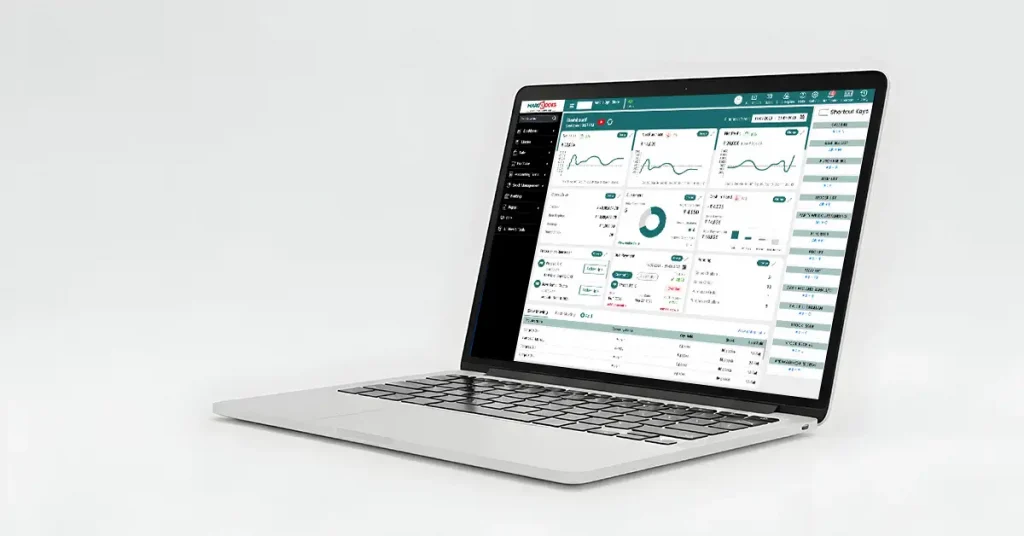
- Bring in inventory management software. Many small and medium-size enterprises lose business owing to inefficient inventory tracking. Manual tracking via ledgers or rudimentary spreadsheets makes it almost impossible to identify slow-moving or expired items. A cloud-based system gives you real-time stock visibility across locations, automatic low-stock and expiry alerts, and batch/serial tracking — which matters a lot if you’re in pharma, electronics, or FMCG.
- Connect it with an order management system. When your sales, billing, and inventory update together, stock counts stay accurate automatically instead of depending on someone remembering to update a register at day’s end.
This is essentially what MargBooks is built for, GST billing combined with inventory management software, so stock movement, expiry tracking, and reordering all happen from one dashboard instead of three different tools that don’t talk to each other.
Summary
- Inventory carrying cost is the total cost of holding unsold stock, capital, storage, service, and risk combined
- It typically runs 20-30% of inventory value annually and directly affects your cash flow and working capital
- The formula: (Inventory Holding Sum / Total Inventory Value) × 100
- Reducing it comes down to better forecasting, stock classification (FSN/VED), ageing checks, and the right safety stock levels
- Cloud-based inventory management software permits you to carry out everything quickly and efficiently.
If everything seems to require more manual actions and effort than can be justified, software programs like MargBooks Software have been created to provide solutions: tracking real-time stock, monitoring expirations, receiving notifications related to low stock levels, and much more.
FAQs
Q1. What could be regarded as an appropriate inventory carrying cost percentage?
The usual practice for businesses is to have inventory carrying costs maintained between 15% and 25% of total inventory valuation. Anything over 30% regularly indicates high inventory or inadequate stock rotation.
Q2. What’s the difference between carrying cost and ordering cost?
Carrying cost is what you pay to hold stock you already have. Ordering cost is what you pay to place and receive a new order — things like shipping, processing, and admin work. They pull in opposite directions: order too often and ordering cost rises, order too much at once and carrying cost rises.
Q3. How does dead stock affect carrying cost?
Dead stock sits in the risk cost bucket and can be one of the biggest single contributors, since that inventory isn’t generating any return while still consuming space, insurance, and capital.
Q4. Can inventory management software actually reduce carrying costs?
Yes, indirectly but meaningfully. By providing you with correct real time stocks information, inventory management software prevents you from over-ordering inventory, identifies slow-moving inventory as soon as possible, and establishes proper reorder points, which help to reduce holding costs over time.
Q5. Is carrying cost the same as holding cost?
Indeed, in most contexts related to inventory and accounting, both terminologies can be used interchangeably.
Q6. How often should I calculate carrying cost?
Annually at minimum, though quarterly reviews are better if your stock levels or seasonality fluctuate a lot.

Aman Kannojia is the Digital Team Lead at MargBooks. He started out as an SEO Specialist and never lost his love for words. With 5 years of experience across banking, SaaS, and finance, both domestic and international, he brings strategy, leadership, and storytelling together. He doesn’t just manage a team, he builds one that creates.