Retail Software
 Distribution Software
 Retail Chain

Billing Software vs Manual Billing, Which is Better for Your Business?

Most businesspersons in the country remember when they first opened their shops and filled their first notebook. Some of them are still using it, honestly. Handwritten bills, a calculator on the side, and a ledger that only makes sense to the person who wrote it.
That system isn’t broken. It just wasn’t built for the scale at which a lot of businesses are operating now. Once you’re doing 50, 100, 200 bills a day, or trying to keep GST filings clean, manual billing starts fighting you instead of helping you.
So the question a lot of business owners end up asking is simple: is it time to switch to billing software, or is manual billing still good enough? Let’s actually go through it.
What manual billing looks like in practice
Manual billing is bills written by hand, or typed into Excel one at a time. No automatic tax calculation, no built-in stock update, nothing talking to anything else. If a customer asks what they bought three weeks ago, someone has to physically go dig through a register or scroll through old spreadsheet tabs.
It’s still the default in a lot of small stores, especially where the owner does the billing themselves and knows their regulars by name. While this is definitely quite impressive, things get complicated when the business expands beyond the capabilities of the notebook.
What billing software actually does
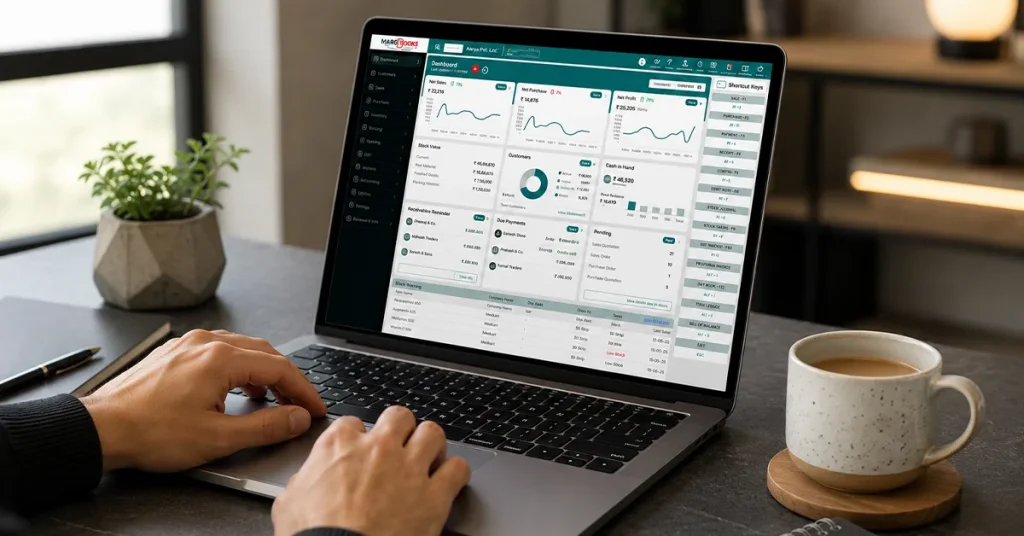
Billing software takes the manual steps out of invoicing. You add the item, the software pulls the price, applies tax, and prints or shares the bill, all in a few seconds. The better ones also connect billing to inventory and accounting, so a sale doesn’t just create an invoice; it also updates your stock count and your books at the same time.
Most businesses in India specifically look for GST billing software, because getting GST right by hand, correct HSN codes, correct tax split between CGST/SGST/IGST, and correct invoice format is one of those things that’s easy to mess up even if you’re careful.
Manual billing vs billing software
| Manual Billing | Billing Software | |
| Speed | One bill at a time, slow during rush hours | Bills generated in seconds |
| Accuracy | Depends on the person doing the math | Tax and totals calculated automatically |
| GST compliance | Manuals and mistakes are common | Auto-generated, correct HSN/SAC codes |
| Where data lives | Paper registers or scattered files | Cloud, backed up automatically |
| Real cost | Looks free, isn’t really | Fixed monthly cost, usually cheaper long-term |
| Growth | Falls apart past a certain volume | Handles growth without extra staff |
The “manual billing is free” argument is the one that trips most people up. It’s not free. It just hides its cost somewhere else, in wasted hours, in errors that need fixing later, in the odd GST penalty because a return didn’t match up.
Where manual billing actually hurts you
A few things tend to show up eventually, no matter how careful someone is:
- Small errors on handwritten bills that throw off the day’s totals
- No real idea of stock levels until someone physically counts
- Records that live in one register or one laptop, with no backup
- A system that works fine at low volume and just stops working past a point
If stock tracking is the part that’s bothering you most, that’s usually where the difference shows up fastest. Inventory management software tells you what’s running low before you find out the hard way, mid-sale.
What actually improves once you switch
Businesses that move off manual billing usually notice a few things right away:
Billing gets faster, particularly during busy hours when a queue is the last thing you want. Taxes get calculated correctly without anyone doing mental math. Stock updates on its own with every sale. Your records are backed up somewhere that isn’t a single laptop that could crash tomorrow. You can bill from your phone if you’re not at the counter, using something like the mobile billing app. And customers get a proper, itemized bill instead of something scrawled by hand, which sounds small but does affect how seriously people take your shop.
None of this is about replacing the owner’s judgment. It’s about not wasting that judgment on things a computer can do faster and more accurately.
Is it actually worth paying for?
This is the real hesitation for most people. Manual billing feels free because there’s no invoice for it every month. But add up the time spent fixing mistakes, the sales lost because nobody noticed stock had run out, or the odd penalty from a GST return that didn’t reconcile, and it stops looking free.
Billing software comes with a fixed, predictable cost instead. For most businesses, it ends up cheaper than the manual approach once you account for everything the manual approach quietly costs. You can look at the pricing page to get a sense of what different plans actually cost month to month.
So who should actually switch?
There’s no single right answer here.
A very small shop doing a handful of bills a day can sometimes get away with manual billing a little longer. It’s not ideal, but it’s not urgent either.
Retail stores and supermarkets with any real footfall usually feel the difference almost immediately with POS billing software, checkout, stock, and GST handled together instead of separately.
Distributors and wholesalers dealing with high invoice volumes basically need automation just to keep operations moving without constant firefighting.
And any business running more than one location or branch needs software that scales with them; paperwork doesn’t scale, it just multiplies.
Why is this shift happening now?
Part of this isn’t really a choice anymore. GST requirements have gotten stricter about accurate, traceable invoicing, and e-invoicing rules apply to more businesses each year. Filing on time and matching records with the government portal is a lot harder to do by hand than it used to be.
There’s also a business reason beyond compliance. Real-time accounting and reporting means you actually know how the business did today, not three weeks from now when someone finally finishes updating the ledger.
Where MargBooks fits in
And that’s exactly where MargBooks comes in. It combines billing software with all the necessary features for compliance, which has already been chosen by more than ten million businesses, including big chains and small shops alike. If you are still at the early stage of manually running your firm and want to learn more about the service, don’t hesitate to book a free demo.
Conclusion
Manual billing isn’t a bad system. It’s just a system with a ceiling, and most growing businesses hit that ceiling faster than they expect. MargBooks Billing software completely solves the problem, offering amazing efficiency and speed for your work and eliminating the need to remember rules. Thus, the real question is not about the superiority of various applications.
FAQs
Is billing software better than manual billing?
Definitely, for businesses of a certain threshold size is obligatory. It minimizes errors, allows saving time, and ensures compliance with GST, which is hardly possible when using manual billing.
Is billing software mandatory for GST?
Not legally mandatory in every case, but e-invoicing requirements now apply to more businesses each year, and it’s genuinely hard to stay compliant by hand.
Can a small business get by with manual billing?
For very low transaction volumes, yes, for a while. It usually becomes a bottleneck once sales pick up.
How much does billing software cost in India?
That will be determined by the vendor, the user count, the number of GSTINs, and the total volume of invoices processed by the software. Check the MargBooks pricing page for current numbers.
Is MargBooks free to try?
MargBooks offers a free demo so you can try it before subscribing. Visit margbooks.com to set it up.

Aman Kannojia is the Digital Team Lead at MargBooks. He started out as an SEO Specialist and never lost his love for words. With 5 years of experience across banking, SaaS, and finance, both domestic and international, he brings strategy, leadership, and storytelling together. He doesn’t just manage a team, he builds one that creates.