Retail Software
 Distribution Software
 Retail Chain

Apparel Inventory Management Software: Features, Benefits & How to Choose the Right One


Walk into any clothing store during a season change, and you’ll see the problem up close: racks of last month’s stock nobody wants, and a customer at the counter asking for a size that sold out three days ago. The difficulty of clothing inventory lies in the difference between what is available and what consumers wish to buy, and this is one of the reasons so many clothing retailers in India are starting to rethink their ways of keeping stock.
In the case of t-shirts, you are not only dealing with one product, as a t-shirt can come in many forms, such as size, colour, fabric, etc, and every one of these t-shirt types is linked to the same SKU number, so it has to be accurately counted in every store. That complexity is exactly why the usual stock-tracking habits fall apart for apparel brands and apparel companies, and it’s why clothing inventory management needs its own approach instead of something borrowed from grocery or electronics retail.
Below, we’ll look at what apparel inventory management actually covers, where retailers tend to get stuck, what to look for in software built for this industry specifically, and how MargBooks handles all of it, whether you’re selling through physical stores, a website, or a marketplace listing.
What Is Apparel Inventory Management?
Inventory management is the process of knowing what you have, where it is, and roughly when you’ll need more of it. For apparel, that means tracking every variation of every design, not just the design itself.
A proper inventory management system for a clothing business has to hold onto a few different things at once. The inventory items are sitting on shop floors right now. There are finished goods waiting in a warehouse somewhere. And for anyone who also manufactures, there’s raw material inventory that hasn’t even been cut and stitched into something sellable yet. It also has to keep that inventory information current across every location, because a shirt marked “in stock” on a screen but missing from the shelf is arguably worse than just knowing you’re out of it.
That’s really the difference between a basic spreadsheet habit and actual apparel inventory management software. One tells you what the truth was true last week. The other tells you what’s true right now, down to the individual apparel item and its size.
Common Apparel Inventory Challenges
Talk to enough store owners, and you start hearing the same handful of problems, whether they run one outlet or twenty.
Stock runs out on the sizes and colors people actually want, which technically counts as one of many stockouts but feels more like lost sales in real life, the moment someone can’t find their size. Every one of those is one of the sales opportunities walking straight out the door, and enough disappointed customers stop bothering to check twice. On the flip side, whatever didn’t sell last season just sits there. First, it’s excess inventory, then it quietly becomes slow-moving inventory, and eventually it’s dead stock that only moves once it’s marked down to almost nothing.
Money gets tied up along the way, too. High inventory carrying costs, or inventory holding costs if you want the other name for it, chip away at cash flow, since every folded shirt sitting in a storeroom ties up cash that isn’t going toward next season’s apparel items. Some brands lean on JIT, just-in-time ordering, specifically to avoid this, keeping stock levels lean rather than sinking money into stock that just sits there looking pretty.
Then there’s the operational side of it. Managing inventory across three or four stores using nothing but a spreadsheet gets messy fast, and inventory numbers drift out of sync between locations before anyone notices. Add in the occasional bout of supply chain disruptions from a supplier running late, which throws off a store’s safety stock with basically no warning, and staff end up trying to prevent overselling by manually checking stock before every big sale weekend. None of this is unique to any one retailer, honestly. It’s just what happens when apparel stock gets tracked by memory and paper instead of a system that was actually built for it, which is why so many owners eventually go looking for real inventory management strategies instead of patching the same problem store by store. Keeping inventory levels healthy across every location without automated inventory alerts doing the watching for you gets close to impossible once a business grows past a single shop, and that’s really the whole point of effective inventory management: catching the problem before a customer does.
Key Features to Look for in Apparel Inventory Software
Not every inventory software on the market is actually built with clothing retail in mind, so it’s worth knowing what matters before picking one.
Start with genuine real-time inventory tracking, the kind that gives you real-time visibility into every store and warehouse the second a sale happens, not a nightly sync that catches up hours later. Inventory tracking should go down to size and color, not just the product name, because that’s usually where apparel stock actually lives or dies.
From there, good garment inventory management software handles the busywork on its own. Alerts should fire automatically when something’s running low, so a manager can set automated reorder points instead of manually checking shelves every single morning. Barcode scanning speeds up counts on the floor and in the warehouse, and a built-in WMS helps if there’s bulk stock spread across multiple godowns.
A few other things worth checking: solid supplier management and purchase order tracking, support for 3PL or third-party logistics if shipping gets outsourced, and demand forecasting that actually looks at past sales instead of guessing at what’s next. Reports on KPIs and other key performance indicators, turnover rate, sell-through by SKU, that kind of thing, tell you what’s actually working versus what just feels like it’s working. And if a store sells beyond the shop floor, it’s worth checking whether the software keeps stock in sync across commerce channels and marketplace listings too, with fulfillment tools that don’t need someone re-typing order details by hand every time.
Put all of that together, and you get something close to automated decision-making: a system that flags what needs attention instead of a manager finding out too late, after the shelf’s already empty. That’s more or less what modern inventory management looks like now: software that helps optimize stock levels and just plain optimize what gets ordered next, instead of relying on gut feeling and a half-remembered sense of what sold last month.
How MargBooks Solves Apparel Inventory Problems
MargBooks was developed to deal with just such issues found in Indian garment manufacturers and retailers.
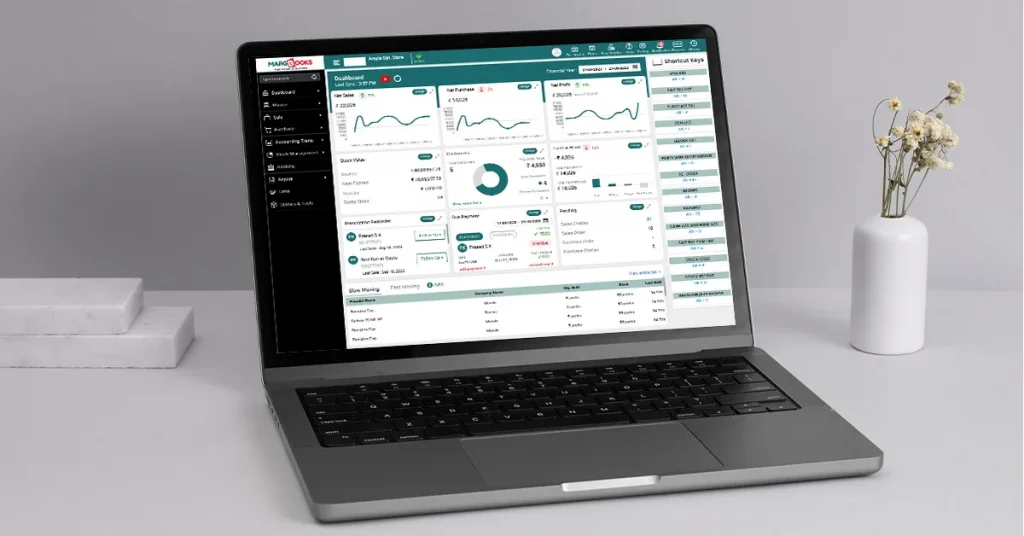
Thanks to the real-time stock tracking technology, stock counting remains accurate across all the outlets. The system updates stock info as soon as a sale occurs, whether at a cash register or through an online order. When stock runs low, MargBooks sends an alert straight to WhatsApp or email, which makes it a lot easier to improve inventory habits without someone manually scanning stock sheets every day of the week.
Billing is GST-compliant and built into the same management process as stock tracking, so a single sale updates accounts and stock count at the same time, instead of two separate jobs someone has to remember to do. Because it’s cloud-based, checking numbers works from any device, which matters a lot if a business is running inventory across multiple stores or warehouses and needs one place to actually look. And the dashboard surfaces what’s really selling, what’s quietly turned into dead stock, and where margins are getting thin, which makes it easier to build real strategies for apparel retail instead of reacting store by store whenever something goes wrong.
You can see this in action on MargBooks’ Textile Software, Garment Retail Chain Software, and Retail Garment Software pages, all built around the same best practices and inventory management practices described here.
Benefits of Using MargBooks for Apparel Businesses
The payoff tends to show up fast once a business moves off spreadsheets. Billing errors and stock miscounts drop, mostly because less of the process depends on someone remembering to update a number by hand at the end of a long day. Inventory carrying costs shrink, too, since cash isn’t sitting around in stock nobody wants anymore.
Profitability and profit margins both tend to improve, largely because it’s easier to spot fast-moving items and reorder them before they vanish off the shelf entirely. Inventory turnover usually picks up as a result, since stock isn’t stuck in a back room waiting for someone to notice it exists. Shoppers get a better customer experience too, since staff can check availability on a screen instead of walking to the back to dig through boxes. And whether it’s one boutique or a chain spread across the apparel industry, the system scales alongside the business instead of turning into something to outgrow, which is honestly what running a modern apparel brand in India looks like these days.
Who Should Use This
MargBooks fits a fairly wide range of setups. There’s the boutique owner who’s finally tired of a spreadsheet falling apart at month-end. There are apparel brands and apparel companies selling across physical stores and a marketplace listing at the same time, trying to keep both in sync. Garment retail chains are trying to keep numbers consistent across several outlets that don’t always talk to each other. And there are textile or garment manufacturers who need to track raw material inventory right alongside the finished stock that’s already waiting to ship out.
Conclusion
Getting apparel inventory under control isn’t really about buying more software for the sake of it. It’s about finding software that actually understands how clothing retail works, sizes, colors, seasons, and all the popular items that need restocking before they’re gone for good. Apparel inventory management built around real data instead of guesswork is what turns a chaotic back room into a business that runs on its own logic, without someone having to hold all of it in their head.
If spreadsheets and manual stock counts are still running the show at your store, it might be worth a change. Book a free MargBooks Software demo and see what apparel inventory management actually looks like when it’s working the way it should.
FAQs
1. What’s the biggest mistake clothing stores make with inventory?
Probably relying on a spreadsheet for too long. It works fine when you’ve got one store and a handful of styles, but the moment you add a second location or a new size range, someone’s always a step behind on what’s actually on the shelf.
2. Do I need separate software if I sell online and in a physical store?
Not really, that’s kind of the point of using something like MargBooks. One system tracks stock across both, so a sale on your website updates the same count as a sale at the counter, instead of two records that never quite match.
3. In what ways is it different to manage apparel inventory versus electronics or groceries?
Mainly because of variants. A single design might exist in five sizes and four colors, so what looks like “one product” is really twenty SKUs that all need tracking separately. Most generic inventory tools weren’t built with that in mind.
4. What happens if I run out of a popular size mid-season?
You lose the sale, plain and simple, and sometimes the customer, too, if they don’t want to wait. While missing a customer after he has walked out empty-handed would definitely be a problem, automated reorder notifications catch it before it happens.
5. Does MargBooks work for a big retail chain or for a single small shop?
It works either way. A single boutique gets the same real-time stock tracking and billing as a multi-store chain; it’s just a matter of how many locations you’re managing inside it.

Aman Kannojia is the Digital Team Lead at MargBooks. He started out as an SEO Specialist and never lost his love for words. With 5 years of experience across banking, SaaS, and finance, both domestic and international, he brings strategy, leadership, and storytelling together. He doesn’t just manage a team, he builds one that creates.