Retail Software
 Distribution Software
 Retail Chain

How to Manage Garment Returns & Exchanges

Returns are part of selling clothes. Accept that early, and you’ll save yourself a lot of stress. Think about how it goes. Someone orders a shirt because it looked great on the model. It arrives, it pulls across the shoulders, and it goes back in the bag. Nothing was wrong with it. You still pay for the postage, the person who opens the parcel, and usually a markdown on a shirt that’s now been handled.
Online fashion has one of the highest return rates of any category. Figures I see are around 20 to 30 percent, higher for dresses and anything fitted [add a current source]. You won’t get it to zero. What you can do is make returns cheaper, rarer, and more likely to end in an exchange. That’s what this post is about.
Why are Garment Returns so high?
It’s almost always one of these five.
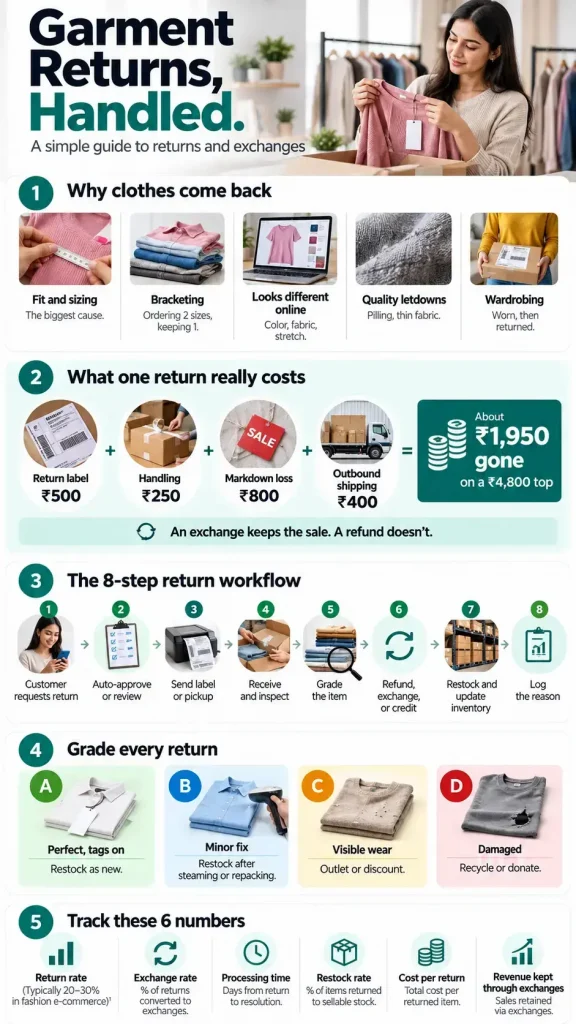
- Fit and sizing: The biggest by a mile. A medium at one brand is a large at another. Even your own sizes drift when you change factories. Customers have been burned enough to stop trusting the label.
- Bracketing: Same top, two sizes, keep one, return one. It’s deliberate, so a size chart won’t fix it.
- “It looked different online”: Colour, thickness, see-through-ness, stretch. A screen can’t show any of it properly. That cream top that turns out yellowish? Gone.
- Quality letdowns: Pilling, thin fabric, loose stitching. Sometimes a return is just a review nobody wrote.
- Wardrobing: Worn Saturday, returned Monday. Rarer than people think, but it happens. Handle it in your policy without making honest customers pay for it.
Here’s the one thing worth doing today. Pull your last 90 days of returns and tag each with a reason. Two or three SKUs will probably be behind most of the mess.
What Do Garment Returns Actually Cost Your Business?
Most brands look at the refund and stop there. This is a Wrong practice in general.
Cost per return = outbound shipping (if you paid it) + return shipping + handling time + repackaging + lost resale value
Take a Rs. 60 top. Return label: Rs.6. Ten minutes of someone’s time to check and repack it: Rs.3. It won’t sell at full price now, so say Rs.10 lost in markdown. Add the Rs.5 you paid to ship it out. That’s about Rs.24, and I haven’t counted the sale you lost. Multiply by a few hundred returns a month, and it hurts. This is why I keep pushing exchanges. An exchange keeps the money. A refund doesn’t.
Returns vs. Exchanges vs. Store Credit: What’s the Difference?
A return: item comes back, money goes back to the original payment method. An exchange: item swapped for a different size, colour, or style. Store credit: money becomes a balance to spend with you later.
You’d rank them exchange, credit, refund. Customers rank them the other way round. Don’t hide the refund button, since people hate that. Make the other two look better. A small sweetener works, like Rs.5 extra credit or free shipping on an exchange. More people take it than you’d expect.

How to Create a Garment Return Policy That Protects Margins
Your policy is a business decision first. The legal wording comes second. Four things to settle:
- Return window: 30 days is the norm. Go to 14 and wardrobing drops, but you’ll lose a few buyers at checkout. Go to 60, and it’s a nice selling point, but more items come back too late to sell at full price. At Christmas, stretch it into January. Gift buyers need the time.
- Condition rules: Tags on, unworn, unwashed. Just say it. Clear rules rarely cause fights. Vague ones always do.
- Final sale items: Underwear, swimwear, face masks, anything made to order. Usually non-returnable for hygiene or practical reasons. Put it on the product page, not only in the policy nobody reads.
- Who pays for return shipping: Free returns boost sales and cost you money. A fair middle: free exchanges, a flat fee off refunds, free shipping on store credit. It nudges people without forcing them.
Write it like you’d say it to someone:
“You’ve got 30 days from delivery to send it back, unworn with tags on. Exchanges are free. Want a refund? That’s a flat Rs.5 for shipping. Take store credit, and we’ll cover the postage.”
Step-by-Step Garment Return and Exchange Workflow
Most of the hidden cost is in a messy process. Here’s a tidy one:
- Customer starts the return in a self-serve portal, not by email. Email chains are slow, and they cost you.
- Approve or flag it using simple rules. In the window, normal item? Auto-approve. Expensive piece, or someone who returns constantly? A person looks at it.
- Send a prepaid label or book a pickup. Put a packing slip in with the reason.
- Parcel arrives. Open it, check it.
- Grade it (more on that below).
- Refund, exchange, or credit, whatever they chose. Do it fast. Wait ten days for your money, and you probably won’t shop there again.
- Restock it or mark it down, and update inventory.
- Log the reason against the SKU and size.
Everyone skips step 8. It’s also the only one that actually brings returns down over time.
How to handle exchanges so the sale sticks
The best exchange feels like it never happened. Let people pick the new size inside the portal. If you can, send the replacement before the old one is back, and hold their card in case it never arrives. It feels quick, a bit generous, and they don’t go shopping elsewhere while they wait.
Use the moment too. Someone returning a dress that was too big might love a similar one they hadn’t spotted. A little “you might also like” section in the portal turns a lost sale into a new one more often than you’d think.
How to Inspect and Grade Returned Clothing
Not everything that comes back should go on the shelf. Not everything should go in the bin either. Grade it.
- Grade A: Perfect, tags on. Back on the shelf as new.
- Grade B: Small fix needed, like steaming, a new tag, fresh packaging. Sort it, then restock.
- Grade C: Some wear or a small flaw. Outlet or discount.
- Grade D: Stained, damaged, smells. Recycle, donate, or write off.
Your checklist should cover stains, smells (perfume and smoke, mostly), stretched necklines, snags, missing buttons, and whether tags and packaging are there. One page, a few photos per grade, pinned where the team works. Consistency matters more than perfection. If two people grade the same shirt differently, your numbers are useless.
Do you need returns software?
A few returns a week? Spreadsheet and shared inbox, fine. Once you hit a few dozen a week, things slip. Labels get forgotten, refunds run late, and nobody can tell you which SKUs are the worst offenders. In such a scenario, you need GST Billing Software that can manage returns as well. When you compare tools, look for a self-serve portal, rules that approve easy cases automatically, label creation, exchange handling, reports by SKU and size, and a link to your store and inventory. That last one matters. Without it, you’re restocking by hand and overselling stuff that’s still in transit.
How to reduce return rates in the first place
Handling returns well is half the job. Stopping them is the other half.
- Fix your sizing info: Give the model’s measurements and the size she’s wearing. Add a fit note per product, like “runs small, size up.” Real garment measurements beat a generic chart.
- Show the fabric: Close-ups, a short video of it moving, and plain words on stretch, weight, and sheerness.
- Use fit feedback from reviews: A little “fits true to size” bar says more than ten five-star ratings.
- Nudge after purchase: A quick “how does it fit?” email, or an easy size swap offered before they’ve even tried it on, catches problems early.
- Watch the repeat offenders: If one item comes back three times as often as everything else, it’s the product or the page. Not the customers.
Turning returns into repeat purchases
A return is when customers are most likely to leave. It’s also one of the few moments they’re actually paying attention. Make it painless, and they remember.
Put exchange first in the portal and add a small credit bonus. A week later, send something useful, like the same style in a different cut, not a generic discount email. Brands that treat returns as part of the customer experience, rather than just a cost, tend to see better repeat rates [add your own data or a source].
Metrics worth tracking for returns
No giant dashboard needed. These are enough:
- Return rate, overall and by SKU, category, and size
- Exchange rate (share of returns that become exchanges)
- Processing time, delivery to refund or restock
- Restock rate, and how much lands in each grade
- Cost per return
- Revenue kept through exchanges and credit
Check monthly. You’re hunting for patterns, like the dress that keeps coming back in a small, or the courier whose parcels always turn up crushed.
Conclusion
They are not going to eliminate retail returns, and that is perfectly fine. Rather, make them cheaper, faster, and more successful in delivering the right-sized product to a satisfied customer. The dull bits are first: a clear policy, a tidy workflow, and a record of why things are sent back.
One of the paperwork aspects that small brands fail to realize is that every return means a refund or exchange, meaning a stock count, credit notes, and accounting for that. Keep those in separate spreadsheets; errors will come in quietly. Software like MargBooks combines billing, inventory, and accounting into one, so if you have a refund, put the item back into stock, and take a look to see which products keep coming back; it does not mean typing it three times. Once you can catch the mistakes, fixing them becomes very easy.
FAQs
Q1. What is a suitable return policy for a clothing shop?
30 days, with tags attached, unworn, and with transparent final-sale deductions, and free exchanges. You could impose a small charge on returns or provide store credit to maintain your profit margins.
Q2. How long should the clothing return policy be?
30 days is the common timeframe. You may shorten this if your returns policy is not good for your bottom line and extend this if your return policy is among your best features as a brand.
Q3. Should I provide free returns for clothing?
It boosts sales, but it also increases expenditures. Various brands allow free exchanges, but for return payments, customers have to pay extra.
Q4. What do I do with returned clothing that has already been used?
Consult your policy. If it goes against your terms and conditions, you can choose to reject it completely or refund part of its cost. If you choose to accept it, grade it B or C and sell it on an outlet or discounting platform.
Q5. Is it possible to sell returned clothes?
Yes, if they pass the quality check. Grading A and B pieces can go back to your inventory after washing. Those graded lower will be sold on the discount platform, donated, or recycled.
Q6. What’s the average return rate for clothing items?
The answer depends on the source and the product category; however, online clothing usually has a return ratio greater than the e-commerce return rate in general. You can refer to an up-to-date report from the industry to compare your rate against your category.
Q7. What are the steps to exchange clothes?
Let your buyer select the desired size and replace it quickly (preferably before your buyer returns the original piece).

MargBooks, a product of Marg ERP Ltd., is a revolutionary cloud-based billing & accounting solution for every business where the business owner can manage the business from anytime anywhere on any device. MargBooks is your one-stop platform for managing your accounting, organizing your transactions, controlling your finances and managing your inventory. It’s a single secure platform to keep up with your company’s bills and invoices, reconcile your transaction, file GST return easily, experience connected banking etc.