Retail Software
 Distribution Software
 Retail Chain

Billed Sales vs. Collected Payments: Key Differences

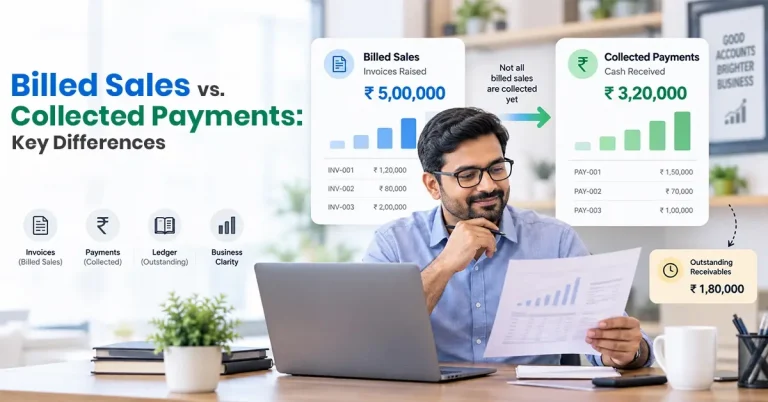
Picture a hardware distributor who closes the month with ₹10 lakh in invoices. Great month, everyone’s pleased. Then the 5th rolls around. Salaries are ₹1.5 lakh, rent is ₹40,000, and the main supplier is calling about ₹5 lakh. The bank balance shows ₹6.2 lakh from customers. On paper, the business sold ₹10 lakh. In reality, it’s sweating over how to pay its own bills. That gap comes from two numbers people use interchangeably when they shouldn’t: billed sales and collected payments. In this article, we are discussing billed sales vs. collected payments.
What Are Billed Sales?
A billed sale is any invoice you’ve raised through invoice software. You delivered the goods or finished the job, you sent the bill, and it’s on the books. Whether the customer has paid doesn’t matter at this point.
Say you sell ₹1,00,000 worth of goods and add 18% GST. The invoice is ₹1,18,000, and the whole amount counts as a billed sale the day you issue it. The customer could pay tomorrow or in three months, and the number doesn’t change. You’ll see it in your sales register, in your P&L if you follow accrual accounting, and in your GST returns.
What Are Collected Payments?
Collected Payments is money in your account. UPI, cheque, cash, bank transfer- it all counts once it lands. Going back to that ₹1,18,000 invoice, suppose the customer sends ₹60,000 on day 20. Your billed sale is still ₹1,18,000, but you’ve only collected ₹60,000. The other ₹58,000 is an outstanding receivable, and it’s sitting in your customer’s account instead of yours. Collections live in your cash book, your bank statement, and your receipt vouchers.

Billed Sales Vs Collected Payments- Key Differences
In the table below, differences between Billed sales and Collected payments-
| Billed sales | Collected payments | |
| Tells you | How much you sold | How much cash you actually have |
| Recorded when | Invoice is issued | Money arrives |
| Accounting view | Accrual | Cash |
| Good for judging | Demand and growth | Liquidity |
| Look here | Sales register, P&L | Cash book, bank reconciliation |
Why the Gap Matters
The difference between the two is your outstanding receivable. Some gap is normal, because credit is how most B2B trade works. A gap that keeps widening is a different story.
Cash is the obvious casualty. Rent and salaries don’t accept “the invoice is out” as payment. Tax is another one that catches people. Under GST, what you owe generally follows the invoice and the time of supply, not the date your customer pays you, so you can end up paying tax on money you haven’t seen yet. Your CA can tell you how this applies to your case.
Then there’s borrowing. When customers pay slowly, owners usually plug the hole with an overdraft or by stretching their own suppliers, and both cost something, either interest or goodwill.
Age matters too. An invoice that’s 20 days old usually needs a friendly reminder. One that’s 120 days old needs a hard conversation, and sometimes it never gets paid at all. The sneakiest problem is that growth can hide all of this. If sales climb while collections stay flat, you aren’t really growing. You’re giving your customers free credit.
Common Reasons Billed Sales Don’t Turn into Collections
Dishonest customers are rarer than you’d think. Most delays trace back to something small on the seller’s side. Credit terms are a frequent culprit. You meant 30 days, the customer remembers 60, and nobody wrote anything down. Invoice errors are another. A wrong GSTIN or a missing PO number hands the customer’s accounts team a perfectly reasonable excuse to park your payment. Some businesses invoice late: goods leave on the 3rd, the bill goes out on the 12th, and the customer’s clock starts on the 12th. Many owners simply don’t have a follow-up routine. Someone chases when they happen to remember, and by then the due date is long gone. Scattered records make it all worse.
Metrics to Track Both Sides
You don’t need a finance degree for this. Collection efficiency is collections divided by billed sales, times 100. With the opening example, ₹6,20,000 ÷ ₹10,00,000 gives 62%. Not a disaster, but it explains the cash squeeze.
Days Sales Outstanding (DSO) is accounts receivable divided by net credit sales, times the number of days. If your average receivables are ₹12 lakh and quarterly credit sales are ₹30 lakh, that’s (12 ÷ 30) × 90, or 36 days. If your terms say 30, customers are paying late on average.
The third is receivables ageing, which just means grouping unpaid invoices by how old they are: 0 to 30 days, 31 to 60, 61 to 90, and 90+. You want most of your money in the first group. If it’s drifting toward the last, don’t wait for the monthly review.
How to Close the Gap: Practical Steps
Nothing here is clever. It’s mostly consistency. Put credit terms and limits in writing for each party, so a good customer doesn’t quietly become a big risk. Issue invoices on the day of delivery and not at your convenience. Also, issue reminders a few days before the due date and after it, since sending a reminder allows you to address the issue before you make the payment call down the road. Making payments easy and convenient can be achieved by utilizing methods such as bank transfer, UPI, or making the payment via a link. Match every receipt to the right invoice through your billing software, because unmatched payments create phantom dues and awkward calls with people who’ve already paid. And look at your ageing report every week. Monthly is too slow. A cash book helps with matching, since it gives you a clean record of what came in and went out.
Conclusion
You can do all of this in Excel, and plenty of businesses do. The problem is that discipline slips in busy months, and busy months are when collections slip too. With MargBooks, you can raise GST-compliant invoices and share them online, including on WhatsApp. You can see who owes you what, spot pending and overdue invoices, and set automatic reminders that carry the invoice details. Receipts get matched to invoices, each customer has a full invoice and payment history, and there’s a mobile app for checking dues when you’re away from your desk.
FAQs
Q1. Is billed sales the same as revenue?
Under accrual accounting, a billed sale is generally recognised as revenue when the invoice is raised. But revenue isn’t cash, and that’s the whole point of this article.
Q2. Can a profitable business run out of cash?
Yes, constantly. If your profit is sitting in unpaid invoices, you can be profitable and still short on money.
Q3. What’s a good collection efficiency?
It varies by industry and credit terms. Instead of chasing a universal number, track your own month to month and make sure it isn’t slipping.
Q4. What is Outstanding vs. overdue?
Outstanding is any unpaid invoice, including ones still within their due date. Overdue means the due date has passed.

Aman Kannojia is the Digital Team Lead at MargBooks. He started out as an SEO Specialist and never lost his love for words. With 5 years of experience across banking, SaaS, and finance, both domestic and international, he brings strategy, leadership, and storytelling together. He doesn’t just manage a team, he builds one that creates.