Retail Software
 Distribution Software
 Retail Chain

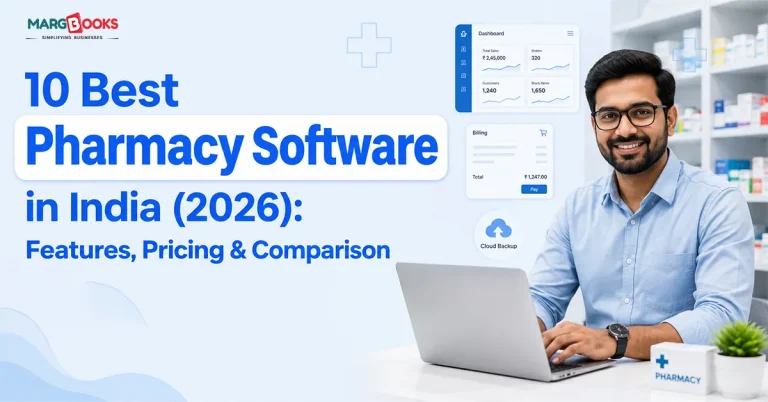
10 Best Pharmacy Software in India 2026: Features, Pricing & Comparison

Most likely, no one is shocked by the answer they get once they ask a pharmacist what a typical day looks like for them. A customer hands over a prescription for six items; two are out of stock, one expired, and nobody noticed until the customer pointed it out, and meanwhile there’s a line forming because the bill is still being written out by hand or fumbled through some clunky old software from 2014. This is basically why pharmacy software exists as a category, not because owners woke up wanting more apps in their life, but because the alternative is losing money quietly, every single day, in ways that are hard to see until you add it up at year-end.
The annoying part is picking one. Search “best pharmacy software India,” and you get a dozen articles that all somehow rank the same product first, usually whoever’s paying for the placement. So here’s an attempt at something closer to honest: what these tools actually do, what they cost (where that’s even findable), and who they’re realistically built for. Nothing here is the “best” for everyone. If you run a single medical store in a small town, you need different things than someone running a five-branch chain in Pune, and both of you need something different again from a hospital pharmacy dispensing off a ward.
Quick version, if you don’t want to read the whole thing: for most retail pharmacies, one shop or a handful of branches, MargBooks is probably the strongest starting point, mostly because it’s cloud-based, reasonably priced, and doesn’t require you to install anything or maintain a server. If you’re doing serious wholesale or distribution volume, Marg ERP goes deeper. If you’re attached to a hospital, look at MocDoc or Medeil instead. Keep reading for why.
What we actually checked
Before ranking anything, we tried to be specific about what “good” means here, because half the articles on this topic just list generic buzzwords. The things that matter:
Does it handle GST invoicing properly, and this is the part most generic billing software skips entirely: does it track Schedule H1 drugs the way pharmacies are legally required to? Does batch and expiry tracking actually warn you before stock goes bad, not just log it afterward for your records? Is a busy pharmacy counter able to move through the lines quickly, or does the software become an issue? Is there an option for those who own multiple drugstores to see what happens in each of them from one account instead of establishing separate user IDs and passwords for all of them?
Comparison Between Pharmacy Softwares
Here is a tabular format showcasing all the important aspects of some of the major software.
| Software | Best For | Starting Price | Cloud or Desktop | GST + Schedule H1 | Free Trial |
| MargBooks | Retail pharmacies, small chains | Free plan, paid tiers scale up | Cloud, mobile, desktop, tablet | Yes | 7 days |
| Marg ERP | Distributors, wholesalers | ₹14,990–₹39,990 one-time, by edition | Mostly desktop, cloud add-on exists | Yes | Demo only |
| GoFrugal | Multi-outlet chains | Not published | Cloud | Yes | Available on request |
| eVitalRx | Online ordering/patient engagement | Not published | Cloud | Yes | Demo only |
| Vyapar | Small, budget-first stores | Low annual cost | Mobile-first | Basic | Available |
| RetailGraph | Chain inventory control | Not published | Desktop | Yes | Demo only |
| MocDoc | Hospital-integrated pharmacies | Not published | Cloud | Yes | Demo only |
| Medeil | Hospital ward dispensing | Not published | Desktop/cloud hybrid | Yes | Demo only |
| PharmaPOS | Avoiding subscriptions | One-time fee | Desktop | Basic | Demo only |
| Swilmart | First-time digitizers | Budget | Desktop | Basic | Demo only |
Worth saying upfront: half these vendors don’t put real numbers on their websites, and the numbers that do circulate online for the same product often contradict each other from one blog to the next. Treat this table as a rough map, not gospel, and get current pricing from the vendor directly before you sign anything.

Detailed Analysis
1. MargBooks
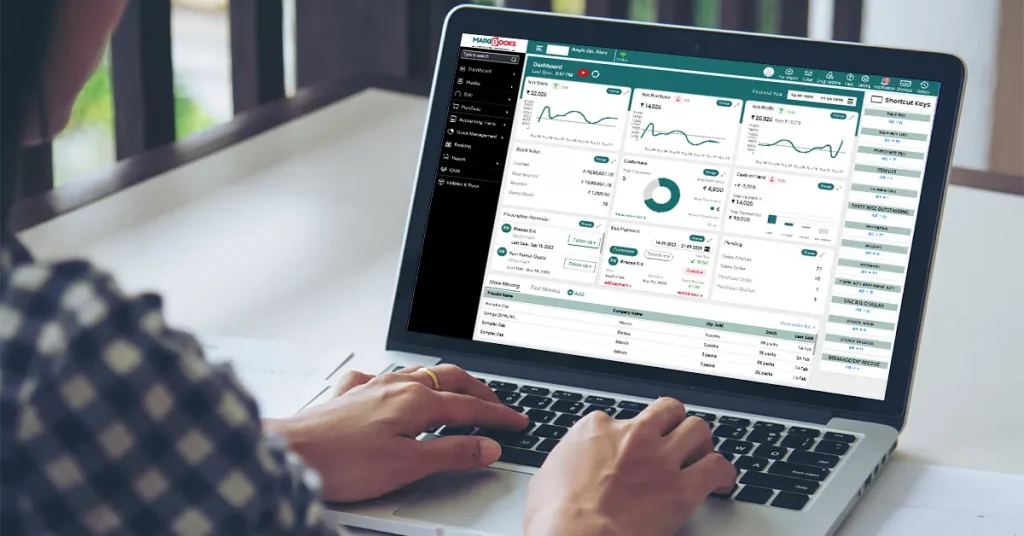
MargBooks comes out of Marg ERP’s stable but is built as its own, lighter thing, cloud-first, and designed so the same account works whether you’re on the shop’s desktop, your own phone, or a tablet at the back counter. That sounds like a small detail until you’re actually running a pharmacy and want to glance at today’s numbers from home, or approve a purchase order while you’re stuck in traffic. It’s the kind of thing that either matters a lot to you or not at all, depending on how hands-on you like to be.
On the feature side: batch-wise inventory with expiry alerts that come early enough actually to do something about it, GST invoices that can go straight to a customer’s WhatsApp instead of needing a printer, rack-wise mapping so staff aren’t hunting shelves for a product, prescription validation alerts, and automatic reorder nudges when stock drops below whatever threshold you’ve set. There’s a free plan to get started and a 7-day trial before any money changes hands, which is more than most of the competitors on this list offer.
The catch is the obvious one for any cloud tool: you need a working internet connection. Not really an issue in most cities and towns anymore, but if your store’s in an area with patchy connectivity, it’s a fair thing to test before committing.
Best fit: Independent pharmacies and small multi-store setups that want something modern without paying for ERP depth they’ll never touch. Worth a look at the pharmacy billing software, or the dedicated pharmacy software and pharma software pages, if you want to see the current feature list and trial details for yourself.
2. Marg ERP
Marg is the name most pharmacists have already heard of before they even start looking; it’s been around long enough, with something like 800-plus support centers around the country, that name recognition alone gets it into a lot of conversations. It’s the heavier sibling to MargBooks: full desktop ERP, over a thousand report types if you want to go down that road, and genuine support for distribution and manufacturing, not just a retail counter ringing up sales.
That depth is also the tradeoff. The application is mostly desktop software, where mobile use isn’t the normal experience. The upfront cost is higher than a monthly subscription cost, although it may be cheaper overall in a few years.
Best fit: Distributors and wholesalers who need serious reporting depth more than they need to check the shop from their phone.
3. GoFrugal
GoFrugal has built a real reputation with multi-outlet pharmacy chains; the kind of feedback you see is less “great app” and more “we run 22,000 SKUs across multiple stores, and this actually holds up,” which says something. Customer-wise product mapping and supplier-wise expiry summaries come up a lot as the features people actually rely on day to day.
Pricing isn’t published anywhere obvious, so budgeting for it means picking up the phone and asking, which is a genuine downside if you’re the type who likes to compare quietly before talking to a salesperson.
Best fit: Growing chains that need centralized control across several outlets and don’t mind a sales conversation to get pricing.
4. eVitalRx
eVitalRx’s whole pitch leans toward the customer-facing side rather than the back-office side: online ordering, patient engagement tools, analytics layered on top of the usual billing and stock basics. If your pharmacy is trying to build an online or delivery presence alongside the physical counter, this is more built for that than most of the others on this list.
Best fit: Pharmacies actively expanding into online orders or home delivery, not just running a walk-in counter.
5. Vyapar
Vyapar gets dismissed sometimes as “just a billing app,” and that’s not entirely fair anymore. It genuinely handles batch and expiry tracking, not just plain invoicing, which puts it a step above what people assume from the name. It does not deliver like specialized pharmacy software might in features such as Schedule H1 tracking. It hits some of the main points but does not go as deep into pharmacy-specific compliance as MargBooks and Marg ERP.
Best fit: Small-budget stores that want more than just a basic billing app but do not want to pay the complete costs of an entire pharmacy ERP.
6. RetailGraph
RetailGraph has been consistently succeeding as a software solution for pharmacy chains that require effective inventory management across their outlets.
Best fit: chains prioritizing inventory management over mobile access or flashy extras.
7. MocDoc
MocDoc is built with hospital and clinic integration in mind, and being cloud-based with GST-ready updates baked in from the start, it tends to implement faster than older desktop systems retrofitted with modern features later. Makes sense given it was designed for the Indian market specifically rather than adapted from something built elsewhere.
Best fit: Pharmacies attached to a hospital or clinic system, not standalone retail counters.
8. Medeil
Medeil is purpose-built for hospital pharmacies, prescription-linked dispensing, and ward-wise supply tracking- the kind of workflow a standalone medical store never needs but a hospital pharmacy can’t operate without.
Best match: ward dispensing by hospital pharmacies in place of selling drugs at the store.
9. PharmaPOS
The prime advantage of PharmaPOS is that it is a one-time payment program and has no recurring charges for users. It is ideal for someone who does not want to pay monthly forever. However, the downside of desktop software is that it generally doesn’t receive updates as often as other cloud-based software solutions.
Best fit: Owners specifically trying to dodge recurring subscription costs.
10. Swilmart
Swilmart is about as entry-level as this list gets, built for small stores taking their very first step away from pen-and-paper billing.
Best fit: first-timers who just need to get off manual billing without a steep learning curve.
MargBooks vs. Marg ERP vs. GoFrugal
These three get compared a lot, so worth addressing directly instead of burying it in the reviews above.
MargBooks versus Marg ERP really comes down to how heavy you need things to be. MargBooks is the cloud-native, lighter option, good for a single store or small chain wanting phone access and no server to maintain. Marg ERP is the deeper tool for anyone running actual distribution or wholesale operations who needs the full reporting suite, and is fine trading mobile convenience for that depth.
MargBooks versus GoFrugal is more about how much friction you’re willing to deal with before you even know the price. GoFrugal is genuinely strong for multi-outlet chains, but you won’t find a number on the site; you’ll be talking to sales before you know if it fits your budget. MargBooks lays out a free-to-paid path you can look at on your own time first.
What to actually check before you commit
A short list, not because shorter is better but because most of what matters here really does fit in a few lines: expiry alerts that warn you rather than logging problems after the fact, GST and Schedule H1 handled properly rather than bolted on later, one login across all your stores if you have more than one, WhatsApp or digital invoicing since fewer customers want a paper bill anyway, automatic reorder alerts so nobody’s manually counting shelf stock, and pricing you can actually find without booking a call first.
How to Pick the Best Pharmacy Software
If you’re running one store or a small handful, MargBooks or Vyapar cover most of that ground, with MargBooks going deeper on compliance and Vyapar being cheaper. If you’re a chain, GoFrugal and RetailGraph are the two worth a demo. If you’re hospital-linked, skip straight to MocDoc or Medeil; the rest of this list isn’t really built for that workflow. And if you specifically want to avoid a monthly subscription no matter what, Marg ERP or PharmaPOS are your one-time-cost options.
Conclusion
There isn’t one piece of software that’s right for every pharmacy in India, and anyone claiming otherwise is probably trying to sell you something. But if you’re running a retail store and tired of losing money to expired stock and slow billing, MargBooks software is worth trying first; it’s cloud-based, works from your phone, handles GST properly, and you can test it for a week before spending anything. Book a free demo here, and if you want more on what to look for before comparing it against anything else, this breakdown of pharmacy software features is a decent place to start.
FAQs
Q1. What’s the best pharmacy software in India?
Depends heavily on what kind of pharmacy you run. For most retail stores, MargBooks tends to hit the best balance of price, GST compliance, and mobile access. Distributors usually lean toward Marg ERP, and hospital pharmacies do better with MocDoc or Medeil.
Q2. Is there free pharmacy software in India?
MargBooks has a free plan to start with, and Vyapar and Swilmart are both priced for very small stores on tight budgets.
Q3. Does MargBooks work for a small, single-location pharmacy?
Yes, that’s largely who it’s built for; the setup is simple enough that you’re not fighting the software just to get it running.
Q4. What should GST-compliant pharmacy billing software actually include?
Automatic GST invoice generation with correct tax slabs, and specifically for pharmacies, Schedule H1 drug tracking. A lot of general-purpose billing software skips this entirely, which is a problem if you’re selling scheduled drugs.
Q5. Cloud or desktop, which is actually better for a pharmacy?
Cloud gives you remote access and faster updates but needs a stable connection. Desktop works fine offline but keeps you tied to a specific machine or server. Most single stores and small chains are better off on cloud tools like MargBooks these days; bigger distributors with heavy reporting needs still often prefer desktop ERPs like Marg.
Q6. Can pharmacy software track medicine expiry on its own?
The better ones do, batch by batch, with alerts that come early enough to act on. MargBooks, Marg ERP, GoFrugal, and MocDoc all do this properly. Budget tools like Vyapar and Swilmart handle it, just less thoroughly.

Aman Kannojia is the Digital Team Lead at MargBooks. He started out as an SEO Specialist and never lost his love for words. With 5 years of experience across banking, SaaS, and finance, both domestic and international, he brings strategy, leadership, and storytelling together. He doesn’t just manage a team, he builds one that creates.