Retail Software
 Distribution Software
 Retail Chain

How Accounting Software Reduces GST Errors: 10 Ways It Improves Accuracy

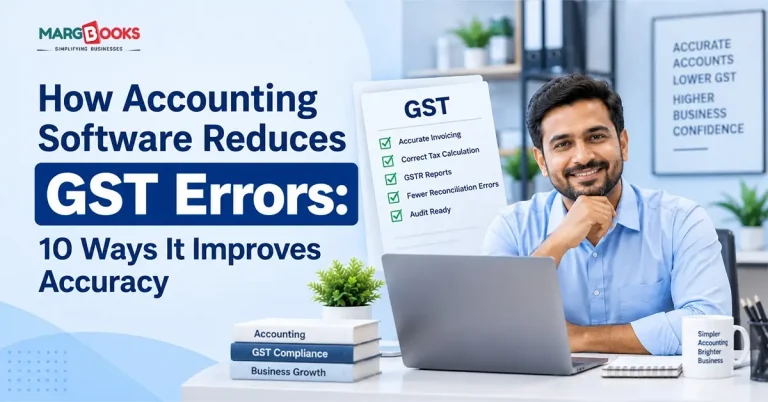
If you were to try to reconcile 300 purchase invoices by hand on a Friday night, you will see why there are so many mistakes regarding GST. It’s not laziness. It’s not incompetence. It’s just that GST asks for a level of precision: right GSTIN, right HSN code, right rate, right split between CGST/SGST and IGST; that’s genuinely hard to sustain over hundreds of transactions when a human is doing the checking.
Accounting software doesn’t remove GST’s complexity. What it does is take the parts that don’t need a human judgment call- calculations, invoice formatting, matching purchase records against GSTR-2A/2B- and run them the same way, every time, without getting tired or distracted. Below is a rundown of why GST mistakes happen in the first place, and then the specific ways decent accounting software cuts them down.
Why Do Businesses Make GST Errors?
There are specific patterns that keep appearing in these cases.
Incorrect GST calculations top the list. Someone applies 12% where it should’ve been 18%, or forgets that a transaction crossing state lines needs IGST instead of CGST/SGST. Simple mistake, expensive consequence.
Invoice and GSTIN errors are almost as common: a digit off in a GSTIN, a duplicate invoice number, a field left blank. Doesn’t sound serious until your customer can’t claim ITC on that invoice and calls you asking why.
Wrong tax classification or rates tend to creep in at businesses with a broad product catalog, where HSN/SAC-linked rates change, and nobody catches the update in time. Multiply one wrong rate across a few hundred invoices, and it adds up fast.
ITC and reconciliation mistakes happen when purchase records and supplier filings drift apart; you either claim credit that isn’t actually available yet, or you leave legitimate credit unclaimed because nobody checked.
And then there are errors in GST return filing, which is really just everything above showing up at once, right when you’re trying to file GSTR-1 or GSTR-3B and the numbers refuse to match.
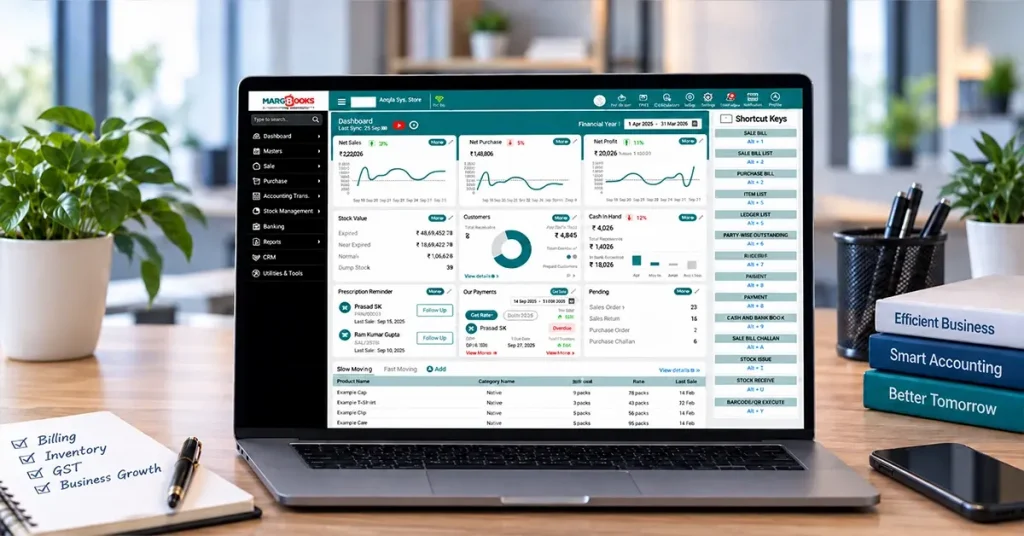
How Accounting Software for GST Reduces Errors
None of this is magic. It is thus necessary to eliminate manual processes to ensure that such operations of the kind are performed precisely, as systems ensure the necessary rules are applied consistently.
1. Automates GST Calculations
Doing GST math by hand requires knowing the rate, knowing whether the sale is intra-state or inter-state, and applying the correct combination of CGST, SGST, and IGST every single time, without a slip.
Billing Software sidesteps this entirely. Configure the rate and the place-of-supply logic once, and every invoice after that gets taxed correctly without anyone reaching for a calculator or a rate chart. It’s a small thing on one invoice. Across a thousand invoices a month, it’s the difference between a clean filing and a mess.
2. Creates Accurate GST Invoices
A compliant invoice should have the correct GSTIN, correct tax rate, correct HSN/ SAC code, and should illustrate the amount taxed accordingly. If one of these points is incorrect, the invoice may be treated as non-compliant, which is not very good when one wants to reclaim credits from this invoice.
Because the GST Invoice software pulls this data from saved records instead of someone typing it fresh each time, there’s simply less opportunity for a typo or a wrong code to slip through. GSTIN gets validated automatically. HSN/SAC comes from the product master. The rate is based on what has been set up rather than what is being remembered by someone.

3. Automates E-Invoicing and E-Way Bills
E-invoicing and e-way bills mean pushing data to a government portal, often within minutes of the sale happening, in an exact format the portal expects. Do that by retyping numbers from one screen into another, and you’re just asking for a mismatch.
When the E-Invoicing software is connected to these systems directly, the invoice data goes straight through, no retyping, no second entry point where something could go wrong. Also, it means that the e-invoice, e-way bill, and original sales invoice are in sync with each other, which makes a lot of difference for transportation checks or audits.
4. Simplifies GST Reconciliation
This is the part that eats the most time manually. You’re matching your purchase records against GSTR-2A/2B, invoice by invoice, trying to figure out what your suppliers actually reported versus what you recorded on your end.
Accounting Software does this comparison automatically, pulls in GSTR-2A/2B, checks it against your ledger, and hands you a list of what doesn’t match. Instead of spending your whole afternoon working on a spreadsheet, you will just get a list of discrepancies that require follow-ups.
5. Helps Prevent Incorrect ITC Claims
Claim input tax credit on an invoice your supplier hasn’t actually filed yet, and you’re looking at a notice sooner or later. It’s one of the most scrutinized areas in GST, for good reason.
Cloud-based accounting software that ties ITC to reconciled data can hold back a claim until the matching invoice actually shows up in the supplier’s filing. This prevents companies from exaggerating their claims and offers finance departments a legitimate figure to work with instead of a wild guess.
6. Reduces GST Return Filing Errors
GSTR-1, GSTR-3B, and the rest are where every upstream mistake finally surfaces. Pull the numbers together manually from separate registers and ledgers, and inconsistencies are almost guaranteed.
Since the return comes straight from transaction data already in the system, rather than a separate compilation exercise, the numbers on the invoice, the ledger, and the return actually match. Turnover mismatches and wrong liability figures become far rarer.
7. Keeps GST Rates and Tax Rules Updated
Rates change. Rules change. New compliance requirements get introduced without much warning. Track this manually, and it’s easy to keep billing at a rate that stopped being correct three weeks ago.
Most Billing software vendors push rate and rule changes into the system as soon as they’re notified, so businesses stay compliant without someone having to monitor government circulars for a living.
8. Manages Multiple GSTINs Accurately
Operate in more than one state, and you’re juggling a separate GSTIN for each. Keeping every transaction attributed to the correct one by hand is where things get messy fast; a Karnataka sale accidentally lands in the Tamil Nadu return, that sort of thing.
Software built for multi-GSTIN businesses keeps each registration’s records separate while still giving you one dashboard to see everything. Invoices, reconciliation, filings, all correctly tagged, no cross-contamination between states.
9. Maintains Centralized GST Records and Audit Trails
Spreadsheets here, email attachments there, a folder of scanned invoices somewhere else; reconstructing what was filed and when becomes its own project when records are scattered like this.
A single system holding invoices, returns, payments, and reconciliation history, with a trail of who entered what and when, solves that. Moreover, responding to inquiries from departments is much easier because everything points to a concrete number.
10. Provides Real-Time GST Reports and Error Checks
The worst time to find a mistake is right before you file. Real-time reporting means the software flags problems- a missing HSN code, an incomplete GSTIN, a rate that looks off- as they happen, not weeks later.
That shift from catching errors after the fact to catching them as they occur is arguably the single biggest reason software-based GST accounting beats manual methods.
Accounting Software vs. Manual GST Accounting: Which Is More Accurate?
Manual GST accounting suits firms that issue only a few invoices per month. Someone careful enough can keep up.
The trouble starts as volume grows. More invoices means more chances for a rate to go unupdated, a purchase to go unreconciled, an ITC claim to slip through on something that was never actually filed by the supplier.
Software doesn’t remove the need for oversight; someone still has to review reports and sign off on filings. But it does eliminate most of the repetitive manual work where mistakes actually originate. Past a certain size, it’s really not a close comparison.
How to Choose the Best Accounting Software for GST
Before choosing a solution, check to see if it really offers:
- In order to prepare valid invoices, it is necessary to use the corresponding GSTIN, tax rate, and HSN/SAC code.
- GST reconciliation, meaning that it cross-checks purchases against GSTR-2A/2B without requiring manual verification.
- ITC tracking, flags or holds back credit claims that aren’t backed by reconciled data
- Return preparation, builds GSTR-1, GSTR-3B, and other returns from actual transaction records
- E-invoicing/e-way bill support, connects to government portals directly instead of requiring re-entry
- Multi-GSTIN support, keeps state-wise registrations separate while giving a combined view
Software that covers all of this is what actually moves the needle. A basic ledger app with “GST” in the name won’t get you there.
Conclusion
Many mistakes in GST can be attributed to the root issue of carrying out a lot of manual work related to calculation, invoicing, reconciliation, and filing. This problem is eliminated by using MargBooks Accounting software, which automates the process and ensures the correct flow of data from the first invoice to the last return. Companies that experience fewer mismatches and issues with tax are those that transitioned to using this technology some time ago. Thus, this is a simple action to take if the objective is to achieve accuracy in accounting operations.
FAQs
Q1. Can accounting software reduce GST errors?
Yes. The automation of taxation processes is done by software in areas where human errors happen in manual accounting.
Q2. Can accounting software perform all the necessary tasks for GST compliance?
This type of software ensures the right tax code is applied, produces properly formatted invoices, links their systems to e-invoicing and e-way bill centers, and checks transaction data against GSTR-2A/2B so that they can prepare returns efficiently.
Q3. Does accounting software assist in GST reconciliation?
Accounting Software performs GSTR-2A/2B automatic generation and discrepancy checks before filing.
Q4. Can accounting software help with GST reconciliation?
Yes! Software can automatically pull up GSTR-2A/2B for comparison with your purchase documents.
Q5. What functions should tax-deduction reporting software ensure?
Invoice generation, reconciliation, tax credit reclaim, and return generation services, among others.
Q6. Can accounting software reduce GST errors?
Yes. It automates calculations, invoicing, reconciliation, and filing, the exact areas where manual GST accounting tends to go wrong.
Q7. What should businesses look for in GST accounting software?
Compliant invoicing, automated reconciliation, ITC tracking, return preparation, e-invoicing/e-way bill integration, and multi-GSTIN support if you operate in more than one state.

Aman Kannojia is the Digital Team Lead at MargBooks. He started out as an SEO Specialist and never lost his love for words. With 5 years of experience across banking, SaaS, and finance, both domestic and international, he brings strategy, leadership, and storytelling together. He doesn’t just manage a team, he builds one that creates.