Retail Software
 Distribution Software
 Retail Chain

Why Are Some Daily-Use Items Kept Under GST Exemptions?

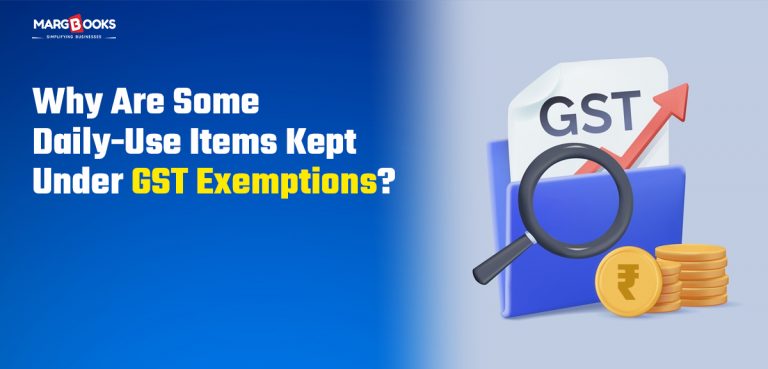
Under GST, many of the household-based essential goods are not taxed in India. These GST exemptions are aimed at making essential commodities affordable to the common ma,n but at the same time enable the businesses to benefit their respective communities without an extra tax burden.
These exemptions affect the operations of traders, kirana stores, and small retailers directly regarding food staples to some healthcare goods. By lowering the prices of necessities, the government not only makes them available but also equitable in the marketplace. We will discuss why certain products are not subject to use, and how that will affect the Indian companies and consumers.
What Do GST Exemptions Mean?
An exemption under GST simply indicates that some goods or services will not be levied in the Goods and Services Tax system. The companies that sell these types of products do not collect GST charged to clients. For example, when you purchase a pack of rice or fresh vegetables at a local kirana shop, you do not pay GST as these are exempted categories.
Common daily-use exempt goods include:
- Fresh fruits and vegetables
- Rice, wheat, and pulses
- Unbranded flour and bread
- Milk and curd
- Salt
- Textbooks and learning content.
- Healthcare and certain medicines.
These exemptions are relevant to regulating the overall cost of living for households.
Why does the Government provide exemptions on Essentials?
Exemption as propounded by the government is founded on social welfare and cost-effectiveness. Here are some key reasons:
- Defending basic needs: Food and milk are the basic needs of any family. The government makes them tax-free to make them affordable.
- Helping the poor: Daily wage workers and rural people live on such things. They should not be taxed, as this would add suffering.
- Promoting education and health: Books and some health services are free to spur literacy and basic access to health care.
- Making compliance easier on small traders: Often, small traders selling these exempt items do not need to collect GST, which makes compliance less difficult.
Impact of GST Exemptions on Businesses
In the case of SMEs, kirana stores, and other small distributors, exemptions may produce both positive and negative effects.
Positive side:
- Sell necessities more easily without forcing up customer costs.
- Exempt items are simply billed.
- Doing more in rural and semi-urban areas.
Challenges:
- Companies that sell taxable and exempt commodities must ensure that they keep their books properly.
- When dealing with a variety of product categories, compliance can be complicated.
- Differentiating between exempt and taxable inventory must be tracked systematically.
This is where the GST billing software will come into play, which will assist traders to create clear invoices and, at the same time, provide the correct tax treatment to each product.
Indian Business Examples
- Kirana Stores: Kirana shop deals in rice, pulses, and biscuits. Rice, pulses are not subject to tax, but biscuits are taxable. The shop owner also has to create the correct bills, differentiating these items.
- Small Textile Traders: There are minimal categories in which handloom products are not exempted. A merchant dealing with the sale of exempt and taxable textiles should divide the sales accounts.
- FMCG Distributors: Major distributors offer an assortment of taxable packaged merchandise and non-taxable staples. To them, inventory record-keeping is of the essence.
In these scenarios, MargBooks can assist by enabling real-time inventory tracking, proper classification, and enabling business owners to rest easy knowing their businesses comply.
Key Exempt Items at a Glance
- Food Staples: rice, wheat, pulses, fresh vegetables, fruits, unbranded flour, salt.
- Dairy products: Milk, curd, buttermilk.
- Education: Books, and some educational services of education.
- Healthcare: Ambulatory medical care, selected drugs.
- Others: Handloom products, charitable services.
Through these exemptions, the necessities will be available to all parts of society as businesses continue to operate seamlessly.
How Businesses Can Manage Exempt and Taxable Items Smoothly?
These two categories of exempt and taxable products demand bookkeeping and compliance discipline. To illustrate, a shopkeeper will not be able to charge GST on exempted goods wrongly. Correspondingly, it may be subject to penalties related to underreporting taxable items.
Here is how MargBooks Accounting software can be of help. It aids in classifying sales, handling the two sorts of items, and creating precise reports to file.
MargBooks also has its part to play in this, as it makes it easy to file GST, lowers compliance headaches, and assures small traders to expand. Billing, tracking inventory, keeping up with the tax regulations, or any other aspect of the business, MargBooks keeps businesses in check.
The Bigger Picture of GST Exemptions
GST exemptions do not simply deal with the matter of tax minimization, but it is rather the issue of balancing. To the customers, it implies low-cost availability of daily necessities. To traders, it is the sale of necessities without them having to make complex tax calculations. To the government, it serves as a means to promote social equity and encourage the weaker economic classes.
Meanwhile, exemptions require close business administration. SMEs and traders utilizing digital instruments like MargBooks can manage these differences with ease and no confusion.
Conclusion
Daily-use commodities under the GST exemptions are the government’s attempt to preserve the basic needs and ensure that life is affordable to millions of Indian households. In the case of kirana stores, small traders and distributors, the exemptions enable them to supply communities fairly at even lower costs without compromising them. This is where the difficulty is in organizing both categories of salaries or payments effectively.
More time is also available to expand the businesses when using MargBooks software, which helps in easing the filing and management of GST, controlling the inventory, and ensuring compliance. Indian SMEs are supposed to be competitive, compliant, and customer-friendly, with the application of relevant systems in a rapidly changing tax environment.