Retail Software
 Distribution Software
 Retail Chain

What Documents Can Help Reduce Penalty for Incorrect Invoicing Under GST?

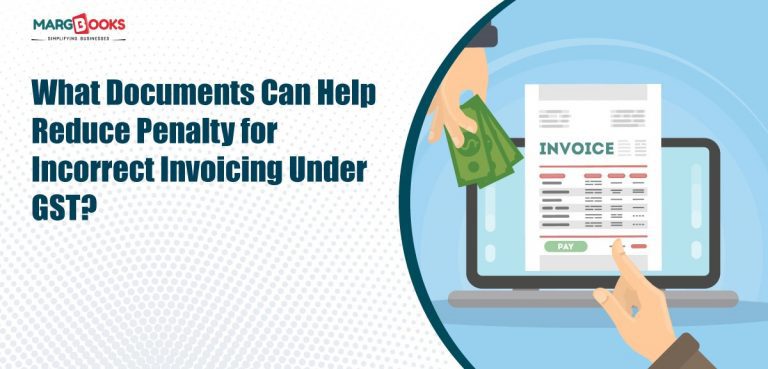
Incorrect invoices under GST can become a costly affair, especially for small businesses. A single slip-up can attract a heavy penalty for incorrect invoicing under GST, and repeated mistakes can even trigger audits. But here’s the good news, maintaining the right documents and following a few smart practices can help you avoid or reduce these penalties.
Whether you’re a wholesaler in Delhi, a retailer in Jaipur, or a service provider in Chennai, this guide is for you. Let’s talk about how you can safeguard your business with better habits, practical tools, and just a bit of paperwork done right.
Why Accurate Invoicing Matters in GST?
Under GST, invoices are more than just bills. They’re the legal basis for tax liability, input tax credit, and audit trails. A missing GSTIN, wrong tax rate, or incorrect HSN/SAC code can instantly make an invoice non-compliant. This is where the penalty for incorrect invoicing under GST comes in.
As the GST law allows for penalties up to ₹25,000 for each incorrect invoice. That’s not a small number if you’re doing hundreds of transactions every month!
Important Documents to Keep to Reduce Penalty for Incorrect Invoicing Under GST
To avoid getting caught in non-compliance, here are some key documents you should maintain consistently:
- Correctly generated tax invoices with serial numbers, GSTINs, HSN/SAC codes, tax breakup, and signatures.
- Purchase registers with supplier details and invoice references.
- Sales registers map every B2B and B2C transaction.
- Credit/debit notes for returns or corrections with linkage to original invoice numbers.
- Payment receipts, especially for advance payments that need GST reporting.
- E-way bills for goods moved beyond the defined distance threshold.
- Reconciliation statements (monthly/quarterly) comparing GSTR-1, GSTR-3B, and books.
- Maintaining a paper trail is not about being paranoid with Accounting software, it’s about being prepared.
Avoid Penalty for Incorrect Invoicing Under GST in the First Place
Now that you know what to keep, here’s how to ensure you don’t make invoicing mistakes in the first place:
1. Use a Reliable Invoicing System
Relying on Excel sheets or manual billing increases your risk. Instead, many SMEs are switching to our software to auto-generate GST-compliant invoices, maintain item-wise tax details, and sync data to GSTR filing. For example, a retail chain in Ahmedabad started using MargBooks, and within three months, their mismatch notices dropped to zero.
2. Train your billing staff
Sometimes the problem is not your system but human error. Train your team on:
- HSN/SAC classification
- Correct tax rates for different goods/services
- Reverse charge rules, if applicable
3. Regular internal audits
Block out one day each month to reconcile sales data with GST returns to the penalty for incorrect invoicing under GST. A shopkeeper in Bhopal caught a recurring rounding-off error this way and saved himself from a future notice.
Role of Technology in Reducing Compliance Risks
Here’s where smart tech can help. Using good Accounting software can cut down your risk of error drastically. Modern tools:
- Auto-populate tax rates
- Flag mismatched GSTINs
- Generate compliant invoices with proper numbering
- Help with return filing and reconciliation
One such tool is widely used by Indian SMEs. From a textile wholesaler in Surat to a hardware dealer in Kochi, businesses across India are turning to MargBooks to stay on top of GST compliance without the headache.
What About GST Billing Software?
If you’re specifically struggling with creating clean invoices, a dedicated GST billing software might be your best bet. It’s made for GST formats, supports QR codes (as mandated), and even helps with invoice e-way bill generation in one go. One such business in Pune, an electronics distributor, switched from manual invoicing to MargBooks, and they now finish monthly filings in hours instead of days.
Small Checklist to Stay GST-Safe
Here’s a simple checklist to stick on your billing desk:
- Always include GSTIN of buyer (for B2B).
- Use correct HSN/SAC codes.
- Mention taxable value and GST breakup (CGST/SGST/IGST).
- Don’t skip the invoice number or date.
- Attach supporting documents for credit/debit notes.
- File GSTR-1 and GSTR-3B on time.
- Keep a soft copy and a hard copy of all invoices.
Following this can help you reduce or even avoid any penalty for incorrect invoicing under GST.
Conclusion
Incorrect GST invoicing is not just a clerical issue. It’s a compliance risk that can cost you money and peace of mind. But with a little diligence and the right documents in place, you can avoid the penalty for incorrect invoicing under GST entirely.
Use a platform like MargBooks, follow a disciplined filing routine, train your team, and don’t let GST paperwork become a stress point. Whether you use a full-featured other software or a simple billing software, staying compliant is much easier than dealing with penalties later. Be smart, stay safe, and invoice right!

MargBooks, a product of Marg ERP Ltd., is a revolutionary cloud-based billing & accounting solution for every business where the business owner can manage the business from anytime anywhere on any device. MargBooks is your one-stop platform for managing your accounting, organizing your transactions, controlling your finances and managing your inventory. It’s a single secure platform to keep up with your company’s bills and invoices, reconcile your transaction, file GST return easily, experience connected banking etc.