
 Retail Software
 Distribution Software
 Retail Chain

Top Benefits of Barcode Management Systems in 2026

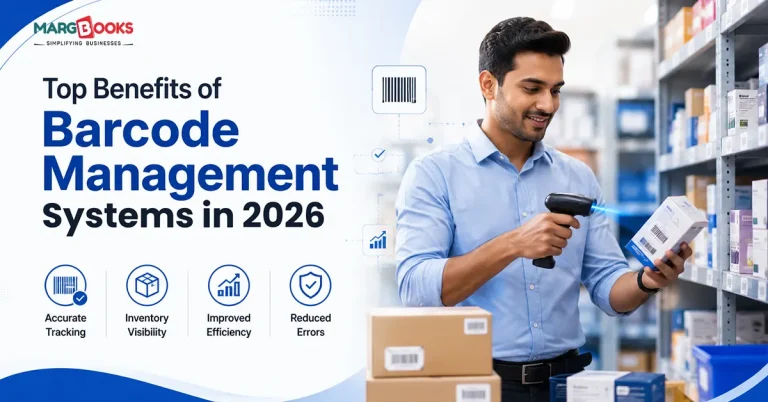
Ask any shop owner who’s done a physical stock count at 11 pm on a Sunday whether they trust their own inventory numbers, and you’ll usually get a pause before the answer. That pause is the whole reason barcode management keeps coming up in conversations about running a business properly. The technology of barcodes has existed for years; grocery items have been using barcode scanning since the ’70s. Businesses in the year 2026 are utilizing barcodes differently from the methods we used to know, which involved using barcodes in conjunction with Excel spreadsheets – most of us remember it very well. What has changed after all, and is it worth switching to a new barcode management system?
What Is a Barcode Management System?
If we look at it clearly and concisely, a barcode management system generates, scans, and tracks product information automatically and efficiently, without the necessity for employees to enter any figures into spreadsheets.
Where it gets useful is in how that connects to everything else. Every scan, at receiving, on the shelf, at the till, becomes a data point that updates your live stock count. Sitting on top of a decent inventory management software, that turns three conflicting numbers (the notebook, the spreadsheet, and whatever’s actually on the shelf) into one number everyone can trust.
Why 2026 Is Different
A handful of things pushed barcode adoption from optional to close to essential.
Margins tightened across retail, pharma, and FMCG, so a single stock discrepancy costs more than it used to; there’s less room to absorb the mistake. GST reporting also got stricter about traceable records, which is hard to fake your way through with paper receipts and memory. And then there’s the customer side of things: people expect a product to be available online and in-store at the same time, which only works if both channels are reading off the same stock number.
Manual tracking was never built to handle all three of those pressures at once. That’s really the short version of why so many businesses made the switch this past year.
Top Benefits of Barcode Management Systems in 2026
Real-Time Inventory Accuracy
This is the one everyone mentions first, and for good reason. Scan every unit coming in and going out, and your system’s number stops being an estimate; it becomes a fact. No more discovering you’re out of stock only after a customer’s already asked for it.
I’ve heard business owners describe this as the first time their system and their shelf finally agreed with each other. Sounds small until you’ve run a shop without it.

Faster, Error-Free Billing
A scan pulls the price and any active discount in under a second, which is a different world compared to someone hunting through a printed price list or typing an SKU by hand. For supermarkets and pharmacies especially, where a long queue or a wrong price at the till costs real trust, this matters more than people give it credit for. Most decent supermarket billing software is built around exactly this.
Reduced Human Error & Labor Cost
Manual entry is where most inventory mistakes start: a typo in a quantity field, a duplicated line, an update someone forgot to make. When it comes to inventory management, the ability to scan products has eliminated a lot of potential sources of error, as the information is taken directly from the barcode rather than relying on the person’s memory or ability to type accurately after a long day of work. If you ask anyone who has implemented a new inventory system what the most surprising aspect was, you will find that the reduction of errors was among the top answers.
Better Multi-Location & Multi-Store Visibility
If you’re running more than one location, a couple of stores, a warehouse alongside the shop floor, several pharmacy branches, barcode data feeding into one central system, it means you can see stock everywhere without picking up the phone. This is particularly true for pharmacy chains, where knowing which branch has a medicine in stock cannot wait for someone to physically check.
GST & Tax Compliance Made Easier
When barcode-linked billing feeds straight into your accounting records, filing GST becomes a matter of pulling a report rather than reconstructing three months of sales from receipts and memory. It’s a quieter benefit than “faster checkout,” but ask anyone who’s filed late because their records were a mess, and they’ll tell you it’s the one that actually saves sleep. It’s a big part of why barcode-based pharmacy billing has become the norm rather than a nice extra.
Batch, Expiry & Serial Number Tracking
For pharma and FMCG businesses, tracking which batch a product came from and when it expires used to mean a second system someone had to remember to update. Barcodes can carry that data directly, so the system flags stock before it becomes a write-off instead of after. Garment retailers get a version of this too: a barcode-driven garment setup tracking size and color variants means nobody’s guessing whether you’ve still got that shirt in medium.
Scalability for Growing Businesses
A barcode setup that works for one shop with a few hundred products should keep working when that shop turns into three branches with thousands of SKUs. The scanning itself doesn’t change what changes is the reporting sitting on top. That’s the real difference between software built to scale and something you’ll need to throw out the moment the business grows past it.
Seamless E-Commerce & Omnichannel Sync
Sell through a store, and a website (or a marketplace listing), and barcode-linked SKUs are what keep both in sync. Sell a unit in person, and the online listing should reflect that within seconds; otherwise, you’re promising something you don’t actually have. This is the backbone of most e-commerce seller tools built for Indian sellers juggling more than one sales channel.
Data-Driven Decision Making
Every scan contributes to creating the data. Over months, that becomes a pattern: which products move, which sit around too long, and when to reorder before you’re caught short. That’s when a barcode system stops being just an operational tool and starts actually informing decisions, especially for businesses juggling raw materials alongside finished stock.
How to Choose the Right Barcode Management System
It’s easy to get talked into a long feature list that sounds impressive on a sales call. In practice, what tends to matter day-to-day is narrower than that: whether you can check stock from your phone rather than just the shop computer, whether GST compliance is actually built in rather than bolted on afterward, whether it’ll handle more than one location even if you’ve only got one today, and whether support picks up the phone when something breaks rather than replying three days later.
There’s a more detailed breakdown of this in what to Look for in a stock management program, and a separate guide on choosing inventory software if price is the main constraint.
Barcode Management Trends to Watch in 2026
Some companies are developing systems that combine barcode technology with RFID technology and are using these systems to manage business processes in large warehouses. Demand forecasting is starting to lean on actual scan history instead of gut instinct. And stock alerts are increasingly showing up on WhatsApp rather than sitting unread in a dashboard nobody opens. It is worth noting that these improvements don’t replace the basic operations; rather, they enhance the visualization of the data for users.
Conclusion
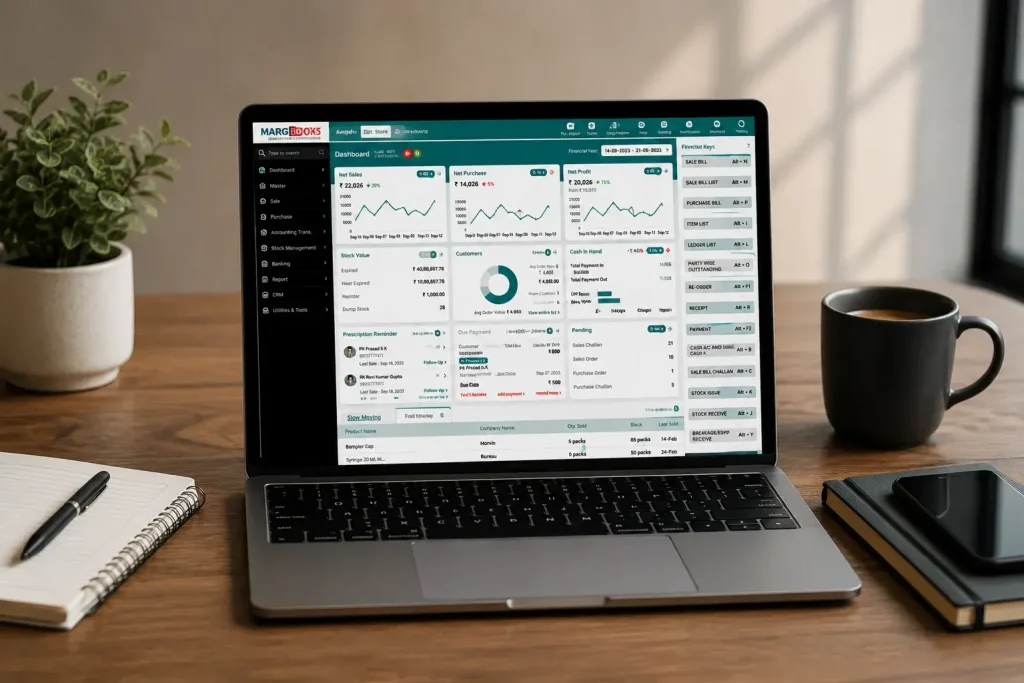
MargBooks integrates features such as barcode scanning, tracking of batches and expiry, billing in compliance with GST, and the ability to view operations in multiple locations in a single cloud-based software. MargBooks Software was developed specifically for Indian businesses, and therefore, it takes into account aspects such as compatible GST filing, support for local languages, and a user-friendly interface for users with slow internet in small towns.
Whether you’re running one pharmacy counter or five warehouses, the need underneath it all is the same: know what you have, know where it is, and don’t find out you were wrong at the worst possible moment. That’s the whole job of a barcode management system.
FAQs
Q1.What is a barcode management system?
Software that uses barcodes to monitor the movement of goods as they pass through different stages of the businesses from the point of receipt to the point of sale, thus making inventory auditing automatic.
Q2.How does barcode management cut down on inventory errors?
Instead of being keyed in, the product and pricing information is pulled directly from the scan, drastically reducing the likelihood of errors in the process.
Q3.Should small business owners invest in this type of technology?
Usually, yes. Most systems, MargBooks included, are built to work for a single small shop just as well as a five-branch operation, so there’s no “outgrowing” the basics later.
Q4.Does MargBooks handle GST-compliant barcode billing?
It does, barcode-based billing feeds straight into GST reporting, so there’s no separate manual reconciliation needed at filing time.
Q5.Which industries get the most out of barcode management?
Pharma, FMCG, garment retail, and supermarkets tend to see the biggest gains, mostly because they’re dealing with high SKU counts, batch tracking, or expiry dates, the exact places where manual tracking falls apart fastest.
Q6.Do barcode systems integrate with online stores?
Yes, as barcode-linked SKUs allow online and offline inventory to synchronize with each other, such that any sale made via one channel is registered in the other as well.

Aman Kannojia is the Digital Team Lead at MargBooks. He started out as an SEO Specialist and never lost his love for words. With 5 years of experience across banking, SaaS, and finance, both domestic and international, he brings strategy, leadership, and storytelling together. He doesn’t just manage a team, he builds one that creates.