Retail Software
 Distribution Software
 Retail Chain

Best Tally Alternatives in India for GST Billing & Accounting

There’s a conversation happening in a lot of Indian businesses right now that is in trading firms, retail shops, pharma distributors, and CA offices — and it usually starts the same way. Someone asks: A person says, “Is there really a need for us to continue using Tally?”
That is certainly a valid inquiry. After all, Tally has been in existence for many years and has historically been the only reputable choice. However, many years are also a significant duration of time to not re-evaluate something. This isn’t a post to bash Tally. It’s done a lot of good for Indian accounting. But if you’re running a business in 2026 and you’re still tethered to a desktop, manually uploading GST data to portals, and paying extra just to get basic remote access, it’s worth asking whether there’s a better way. There is a better tally alternative, and the answer is “yes”. It’s called MargBooks.
The Real Problem with How Most Businesses Use Tally
Speak with just about any Tally customer, and you’ll get the exact same response. If that computer has a problem, your entire accounting system stops. If you’re travelling or at another branch and need to check something, you’re either calling someone back at the office or setting up a remote desktop that’s slow and unreliable. Your accountant has to physically come in to update the books. Month-end GST filing becomes its own project, exporting data, logging into the government portal, uploading files, and hoping nothing mismatches.
And then there’s the cost. The base Tally license is one thing. But e-invoicing needs setup. Multi-user access costs more. If you want something customised, you’re paying for TDL development. It adds up. None of this is unusual. Yes, this is how many Tally users take Tally Operational support by accepting what they feel is simply an accepted practice. There is no need to do this. You can switch to a better alternative any day, any time.
What MargBooks Actually Does Differently
MargBooks has been an accounting software for Indian businesses for over 30 years. So this isn’t a startup that figured out cloud software and bolted GST onto it. The GST compliance, the inventory logic, the way the software handles Indian business workflows, all of it comes from decades of understanding how traders, distributors, manufacturers, and retailers in this country actually operate.
The biggest difference is that MargBooks is genuinely cloud-based. Not “cloud-enabled” or “cloud-compatible with a server setup”, that is actually cloud-based. You log in from any browser, on any device, and your data is there. Your accountant in Delhi and your warehouse manager in Ludhiana are looking at the same stock levels in real time. As you fly from one destination to another, while checking your e-mail, a customer calls regarding an outstanding invoice, and you can access the information in less than 10 seconds on your phone.
GST Compliance Without the Headache
This is probably where MargBooks saves businesses the most time. When you raise an invoice in MargBooks, the GST is calculated automatically based on the HSN code, the party’s state, and the transaction type. CGST, SGST, IGST, it figures it out. No need to think.
e-Invoicing works the same way. If your turnover requires it, MargBooks generates the IRN and QR code without you opening a separate portal. e-Way Bills are generated directly from the invoice; the data is already there, so there’s nothing to re-enter.
For filing, GSTR-1 is populated from your sales invoices. GSTR-3B is summarised automatically. The 2A/2B reconciliation, which is where a lot of businesses lose money by missing mismatches, happens inside MargBooks itself. You’re not exporting Excel sheets and doing VLOOKUP comparisons. For a business doing even moderate GST volumes, this alone probably saves 10 to 15 hours a month.
Inventory That Actually Keeps Up With Your Business
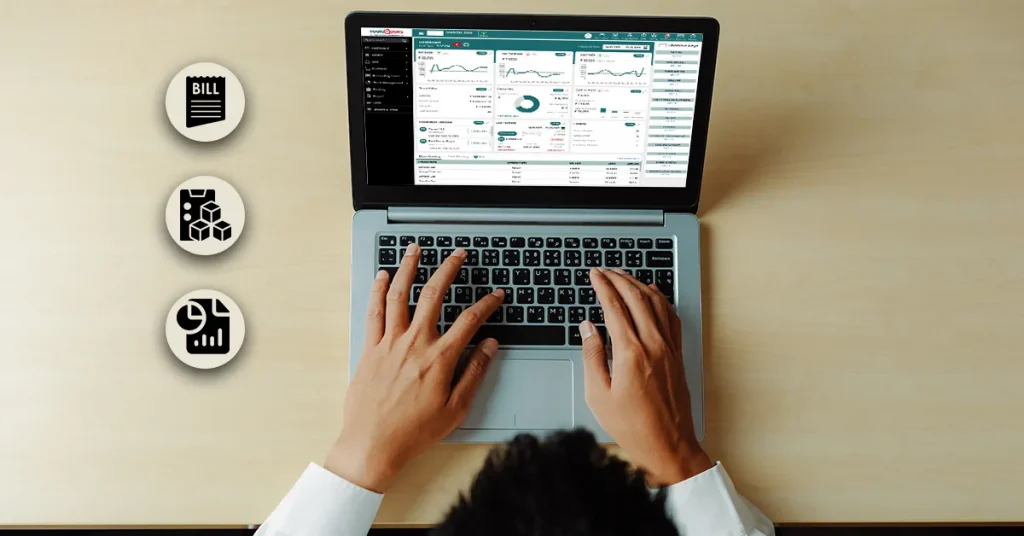
A lot of cloud based GST billing software treats inventory as an afterthought, just a count somewhere in the system. MargBooks treats it as seriously as the accounts, because for most Indian businesses, stock is where the money is.
You can track inventory across multiple locations, warehouses, branches, and showrooms and move stock between them with proper documentation. For pharma and FMCG businesses, batch numbers and expiry dates are tracked at every stage. Reorder alerts tell you when a fast-moving item is running low before it becomes a problem.
If you’re in retail, barcode scanning at the billing counter updates the stock count instantly. No manual entry, no errors.
Manage Multiple Branches, Multiple Users
This is something Tally genuinely struggles with, and where businesses often end up spending a lot of extra money. MargBooks handles multi-branch operations from a single account. Each branch has its own stock, its own sales data, and its own P&L, but you can see across all of them from one login. The owner gets a consolidated view. The branch manager sees only their branch. The accountant sees the accounts. Access is controlled by role, not by who happens to be sitting at which computer.
For CA firms managing multiple clients, this is especially useful. All client companies under one login, proper separation of data, and proper access controls. No switching between different software installations or carrying data on a pen drive.
The Billing Experience Your Customers Will Notice
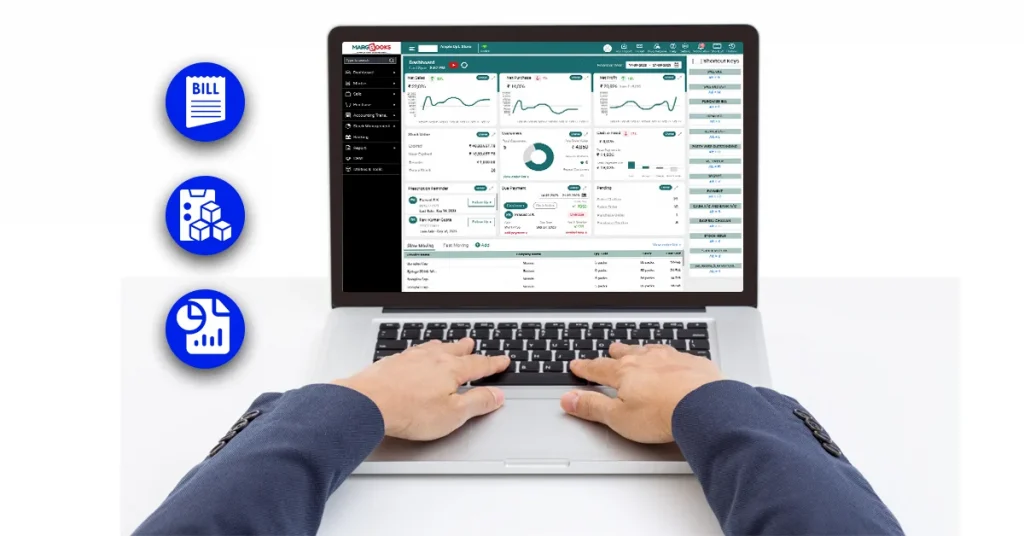
Raising an invoice in MargBooks takes about a minute. Once it’s raised, you can send it to the customer on WhatsApp directly from the software with one click. Or email it. Or share a payment link so they can pay immediately.
The invoices look professional. You can add your logo, your terms, and your bank details. You have the ability to configure the template as it relates to your company’s overall identity and brand presentation.
All four core financial documents (quotes, purchase orders, delivery notes, and credit/debits) are controlled by one application; therefore, you will always have an accurate history from the initial quote to the time the final payment is made without needing to piece together numerous sources/documents.
Reports When You Need Them, Not at Month-End
One of the underrated things about having cloud accounting is that your reports are always current.
In MargBooks, you can check your outstanding receivables right now. You can see today’s sales by item or by salesperson. You can look at how much you owe your vendors and what’s due this week. Profit and loss isn’t something you wait for your accountant to prepare; it’s there whenever you want it.
For business owners who’ve been used to getting financial information weeks after the fact, this changes how you make decisions.
Moving from Tally to MargBooks
At this stage, most people’s first concern regarding Tally is: What will happen to my current data? MargBooks has a migration process specifically for Tally users. Your master’s parties, items, and ledgers come across. Your opening balances come across. The team walks you through it so you’re not starting from scratch or losing years of records. Most companies can be fully operational in less than a week because of the easy-to-use interface, and the staff can learn how to operate the program with minimal training (typically less than one week).
Is MargBooks Right for Your Business?
If you operate a trading, retailing, distribution, manufacturing, or service industry in India, it is worth your while to give MargBooks significant consideration if you are currently either using Tally or not using anything at all!
MargBooks is especially applicable when you have multiple locations or multiple users needing to perform accounting transactions.
- You have more than one location or more than one person who needs to access the accounts
- GST compliance is eating up significant time every month
- You want to be able to check on your business from your phone
- You’re paying for Tally add-ons that should have been included in the first place
- You want your billing, inventory, and accounting in one place rather than three
If you’re a sole proprietor doing very low volumes with simple accounting needs, even MargBooks might be more than you need right now. But for any business with real complexity, stock across locations, multiple staff, and regular GST filing, it makes a strong case.
Conclusion
Switching accounting software feels like a big decision, and in some ways it is. But staying on software that slows you down has a cost too, in time, in errors, in what you can’t see because the data isn’t easily accessible.
MargBooks Software isn’t a perfect product, and no software is. But it’s built for the way Indian businesses work today, cloud-first, GST-first, with the inventory and billing depth that trading and retail businesses need. If you’ve been on Tally for years and haven’t seriously evaluated anything else, it’s probably time to take a look.

Aman Kannojia is the Digital Team Lead at MargBooks. He started out as an SEO Specialist and never lost his love for words. With 5 years of experience across banking, SaaS, and finance, both domestic and international, he brings strategy, leadership, and storytelling together. He doesn’t just manage a team, he builds one that creates.
Aman Kannojia is the Digital Team Lead at MargBooks. He started out as an SEO Specialist and never lost his love for words. With 5 years of experience across banking, SaaS, and finance, both domestic and international, he brings strategy, leadership, and storytelling together. He doesn’t just manage a team, he builds one that creates.