Retail Software
 Distribution Software
 Retail Chain

Purchase Frequency vs Customer Value: Which Matters?

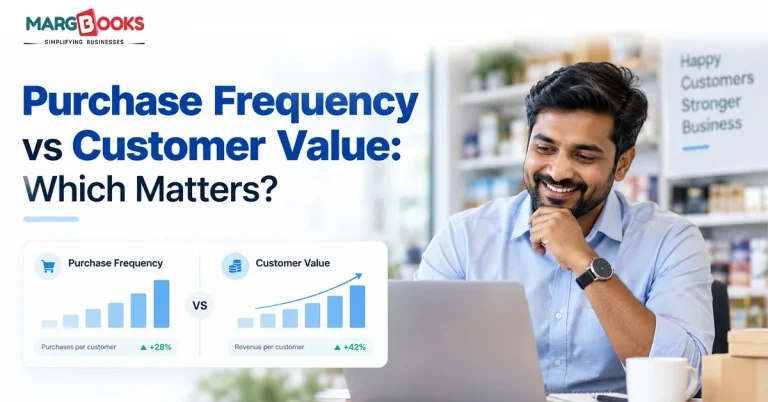
Picture two customers. The first customer visits your store 12 times per month, with each visit leading to a purchase of ₹150. The second customer visits the store twice per year and spends ₹25,000 per visit. How do we determine which customer is better? This question is answered very quickly, depending on how the stores look. The grocer will say that the first customer is better, while the furniture dealer will say the second customer. Both of them will give partially correct statements, which is the problem. This is because the answer to the question is not a matter of frequency of purchases or value of the customer. The decision will be determined by various factors, including the margins of the business, stock availability, and other conditions.
What Is Purchase Frequency?
Purchase frequency is the average number of orders a customer places in a given period. The formula is simple:
Purchase frequency = Total orders ÷ Unique customers
If 400 customers placed 1,600 orders in a quarter, your frequency is 4 orders per customer for that quarter.
This metric matters most in grocery, pharmacy, daily-need, and FMCG businesses, where people buy small and buy often. Frequent buyers give you predictable cash flow, which makes stock planning much easier. You know roughly how much atta, milk, or paracetamol will move this week. Habit does the rest. Customers who stop by every second day rarely compare prices on every item.
Fast-moving retail runs on repeat visits, and that’s why shops handling hundreds of bills a day lean on dedicated supermarket billing software to keep the counter quick and the records clean.
What Is Customer Value?
Customer value asks a different question: what is this person worth to you? You can look at it two ways.
Average order value (AOV) is what a customer spends per order.
AOV = Revenue ÷ Orders
Customer lifetime value (CLV) is what they’re worth across the whole relationship.
CLV = AOV × Purchase frequency × Customer lifespan
Multiply by your margin if you want profit-based CLV, which is the version that actually matters. Say a customer has an AOV of ₹1,200, orders 18 times a year, and sticks around for 3 years. That’s ₹64,800 in revenue. At a 15% margin, it’s ₹9,720 in profit.
Customer value is the natural focus for electronics, appliances, furniture, and B2B distribution, where each sale is large and sales are less frequent. A bigger ticket means less acquisition cost per rupee earned.
The catch for high-ticket sellers is capital. One unsold refrigerator or a shelf of old LED TVs ties up serious money, so it helps to know how to manage slow-moving inventory in electronics stores before chasing bigger baskets.
Purchase Frequency Vs Customer Value
In the table given below, there is a comparison between Purchase Frequency and Customer Value-
| Factor | Purchase Frequency | Customer Value |
| Best for | Daily-need, low-ticket | High-ticket, occasional |
| Cash flow | Steady, predictable | Lumpy, larger inflows |
| Main risk | Thin margins | Long gaps between buys |
| Lever to improve | Reminders, loyalty, convenience | Bundling, upselling, premium range |
Think of frequency as the engine and value as the fuel. A lot of visits with tiny baskets still lose money once you count rent, staff, and electricity. And a big basket that shows up once every two years won’t pay this month’s salaries.
The Risk of Focusing on Only One Metric
When you put too much emphasis on either of the measures, it comes with some negative consequences. Finding customers the frequency way is the easiest. You simply offer them discounts so that they return to buy again. It works for some time; soon enough, customers understand the trick and start to wait for discounts.
As a result, you may have a busy storefront but lower profits, which is the situation for many retailers who have plenty of visitors but little profit. On the other hand, focusing on “value” may make you too dependent on a few clients. One of them might choose to do business with a competitor and take away most of your income base. You should also pay attention to the fact that you lose plenty of small income-producing sales when keeping your focus on securing large deals.
How to Measure Both Without a Spreadsheet Headache
You don’t need a data team. You need customer-wise records and a few hours of attention. Specifically, you need invoices linked to customers, order dates, bill values, and returns (returns matter, because they quietly eat into both metrics).
Here’s a simple way to go about it:
Pick one action for each box, then run the numbers again every quarter:
- High frequency, high value: look after these customers first.
- High frequency, low value: push them toward bigger baskets.
- Low frequency, high value: give them a reason to come back sooner.
- Low on both: don’t spend much time here.
- Every quarter: check who has moved between boxes, since that shows whether your efforts are working.
That last step is the useful one. Your high/high customers are the ones to protect. The high-frequency, low-value group needs a nudge toward bigger baskets. The low-frequency, high-value group needs a reason to come back sooner. The low/low group shouldn’t take much of your time. To see which customers are actually profitable and not just busy, you’ll want accounting software tied to the same data.
Tactics to Raise Purchase Frequency
If your business depends on repeat visits, these are worth trying:
- Loyalty points tied to repeat visits- Reward the third and fifth visit in a month, not just the size of the bill.
- WhatsApp and SMS reminders – A short message about a refill or reorder is often enough. Pharmacies and pet stores do well with this.
- Faster checkout- Customers forgive a lot, but not a 10-minute queue for two items. Friction kills repeat visits quietly.
- Standing orders for distributors- If a retailer orders the same items every fortnight, set it up as a routine so they don’t have to think about it.
Speed and loyalty both come down to your counter, and a modern retail POS system can handle fast billing and points in one flow. If you or your staff follow up on payments and orders while out of the shop, a mobile billing app keeps that going on the move.
Tactics to Raise Customer Value
When each sale is large, the goal is to make every interaction count for more.
- Bundle and cross-sell at billing- Someone buying a washing machine should be offered a stabiliser, a stand, and an extended warranty before they reach the counter, not after.
- Tiered pricing and volume slabs- A small discount for buying 10 pieces instead of 5 can lift your average order without hurting margin.
- Premium and private-label ranges- These usually carry better margins than branded goods that every other shop also sells.
- Credit terms and fast quotes for B2B buyers- A distributor who gets a quote in an hour and an invoice the same day is more likely to give you the bigger order.
None of this works if you stock the wrong things. Higher-margin items need good inventory management software behind them so you know what’s selling and what’s gathering dust.
Which One Should You Prioritise?
There’s no universal answer, but there’s a fairly reliable rule of thumb.
Prioritise frequency if your margins are thin, your products are consumed and replaced quickly, and competition is local and dense. In that situation, the shop that’s visited most often wins.
Prioritise value if your products are durable, your margin per sale is healthy, and customers cost a lot to acquire. Here, squeezing more out of each buyer pays better than chasing footfall.
Balance both if you sell many kinds of products or run multiple stores. A retailer with a grocery section and an electronics corner, for example, is playing both games at once.
If you own several branches, the tricky part is seeing how the same customer behaves across them. A retail chain management system makes that visible in one place.
Conclusion
The frequency at which customers shop indicates who is a loyal customer. Customer value indicates who is the most valuable of these loyal customers. Both grocery stores packed with shoppers and dealers with a small number of wholesale clients only get half the picture, while growing businesses keep track of both metrics.
You don’t have to change what you are doing first. This week, figure out your 20 top customers, get their invoices for the last six months, and determine the frequency and the average amount that each customer spends in each order. Group them into the four groups described earlier. You may be surprised to find a frequent buyer you were unaware of or a big buyer who has not purchased from you in some time. The manual approach will become tiring soon, which is the reason MargBooks Software can be of help. The program automatically keeps track of every invoice charged to a client and calculates any needed information about their purchase frequency, average order value, and sales by client.
FAQs
Q1. Is purchase frequency more important than customer lifetime value?
Both methods have their benefits. Frequency is key to low-cost, frequent businesses, while CLV is useful for high-value purchases that happen infrequently. CLV integrates frequency into its calculation, meaning it uses both techniques together.
Q2. How do I calculate purchase frequency for a retail store?
To find out the frequency of orders, divide the total number of orders placed in a certain time frame by the number of unique customers. For example, if 500 people made 2000 orders over three months, then the frequency is 4.
Q3. What is a good CLV to CAC ratio?
A standard measurement to use is a ratio of 3 to 1. This means that the customer provides value three times higher than the cost of acquiring them. In the case of a small neighborhood store with low paid marketing value, the ratio is irrelevant without some regular clientele.
Q4. Can small shops track customer value without CRM software?
Sure! All you need is an ordinary notebook or simple piece of paper to take notes of the names, dates, and transactions. The process will get more complicated after working with a few hundred clients, but at that point, billing programs dealing with billing-wise invoices can come in handy.
Q5. What is a good purchase frequency for a retail store?
It is not feasible to pinpoint a particular figure since it varies according to the type of business. On one hand, customers of a grocery store or a pharmacy tend to shop up to three or four times a month, while those purchasing electronic appliances may visit the shop only once a year, if not even less frequently than that. Therefore, it is advisable to compare your current numbers with the ones for the previous months and those of the competing shops selling similar goods.
Q6. How can I increase average order value without raising prices?
Consider offering additional merchandise at payment, like a stand or warranty when selling appliances, which will work in combination with establishing certain price levels that will make buying 5 pieces more expensive than buying a bigger quantity of goods. In addition, it would help businesses to remove less popular goods from stock while raising the cost of purchase in case of bundling them with the popular items.
Q7. How often should I review customer purchase data?
In the majority of cases, evaluating shoppers’ lifestyle would be enough for several quarters. As for the periods of evaluation, they should be the same every time to fully regard the progress when making comparisons.
Q8. Does a loyalty program really improve repeat purchases?
Although it is possible, this will only be effective if rewards are related to repeat visits and don’t have a detrimental effect on profits. Generally, rewarding customers on the third/fifth visit in a month makes a better impact than giving a general discount on every bill, which is expected by customers in due course.

Aman Kannojia is the Digital Team Lead at MargBooks. He started out as an SEO Specialist and never lost his love for words. With 5 years of experience across banking, SaaS, and finance, both domestic and international, he brings strategy, leadership, and storytelling together. He doesn’t just manage a team, he builds one that creates.