Retail Software
 Distribution Software
 Retail Chain

Which Software Is Best for a Garment Business?

If you’ve ever spent your Sunday evening manually matching invoice numbers to a stack of paper bills, you already know the real problem in the garment trade isn’t the fashion; it’s the paperwork. Sizes, colours, articles, GST slabs, credit customers who will pay next week. it adds up fast, and most general-purpose billing tools just weren’t built to handle it.
So, which software is the best fit for a clothing business? In brief, it is the software that does not treat product as just a line item. A garment is not just one SKU; it is a shirt with three colour variations, five size variations, and two fabric variations, which is something the software needs to recognize. Most Indian garment retailers, distributors, and manufacturers find that MargBooks does this adequately because it was designed for garment-specific billing rather than a generic retail software modified for the purpose. Let’s break down why that distinction matters, and how to actually evaluate your options.
What Do We Even Mean by Garment Business Software?
It’s a broad term, and honestly, that’s part of why business owners get confused when they start shopping around. Under this one umbrella, you’re usually looking at some combination of:
- Billing and POS– the counter software your staff use every day
- Inventory management– tracking stock across size, colour, and style
- GST and accounting– tax compliance, invoicing, returns
- Distribution tools– for wholesalers moving stock in bulk to retailers
- Production software– for manufacturers tracking cutting, stitching, and finishing stages
A small boutique might only need the first two. A distributor juggling hundreds of SKUs across multiple retailers needs a lot more. Worth checking out: Garment Distribution Software, which is built specifically for that middle layer of the supply chain, handling bulk orders, credit limits, and dispatch timelines that a basic retail till simply can’t manage.
The Real Problems Garment Businesses Run Into Without the Right Tools
Talk to anyone who’s run a clothing store for more than a year, and you’ll hear some version of the same complaints.
Sizes and colours turn into a nightmare- A blue cotton shirt isn’t one item; it’s twelve, once you factor in every size and shade. Track that on paper, or in software that doesn’t support variants, and stock counts drift out of reality within weeks.
GST mistakes creep in – different fabrics and garment categories can fall under different tax treatment, and doing this by hand invites errors, the kind that show up during a compliance check, not before.
Nobody actually knows what’s selling – fast-moving sizes run out while slow colours pile up in the backroom, because there’s no real-time visibility into what’s actually moving off the shelf.
Production and retail don’t talk to each other – For manufacturers, this is often the biggest one: the factory floor has no idea what the shop floor needs, and vice versa.
If any of that sounds familiar, it’s less about how organized your team is and more about whether your software was ever designed for this business in the first place.

What Should You Actually Look For in Garment Business Software?
Skip the feature-list marketing pages for a second and think about this practically. Here’s what tends to separate software that works for garments from software that just says it does:
- Variant-level billing, the ability to bill and track by size, colour, and article number without creating a separate product entry for every combination
- Built-in GST compliance, tax calculated correctly and automatically, not bolted on as an afterthought
- Real-time inventory syncing, especially if you’re running more than one store
- Cloud or mobile access, so the owner isn’t tied to one system in one back office
- Solid financial reporting, profit and loss, cash flow, and outstanding dues, without needing a separate accounting tool
- A link between production and retail, if you manufacture as well as sell
This isn’t a checklist to memorise; it’s really a filter. Run any software you’re considering against these six points, and you’ll quickly see which ones were designed for apparel and which ones were adapted from a general retail product. For a deeper walkthrough of these features in the context of billing specifically, this 2026 guide on billing and accounting software for apparel businesses is worth your time.
Matching Software to Your Type of Garment Business
Not every garment business needs the same tool, and this is where a lot of buying decisions go wrong: someone buys a solution built for a single boutique and tries to run a five-store chain on it, or vice versa.
| Business Type | What You Actually Need | Why |
| Single retail store or boutique | Variant-based billing with GST support | Keeps day-to-day operations simple without unnecessary complexity |
| Multi-store retail chain | Centralised software with role-based access | Owners and managers need visibility across every location, not just one |
| Wholesaler or distributor | Software built for high SKU volume, credit tracking, and dispatch | Bulk orders and credit terms behave very differently from single-item retail sales |
| Manufacturer | Production software that syncs with retail data | Prevents the factory and the shop from operating on two separate realities |
If you fall into the retail chain category, it’s worth looking at Garment Retail Chain Software directly; it’s built around exactly this multi-location, multi-user access problem.
Where Does MargBooks Actually Fit In?
Since it’s come up a few times already, it’s worth being specific about what MargBooks brings to the table rather than just naming it.
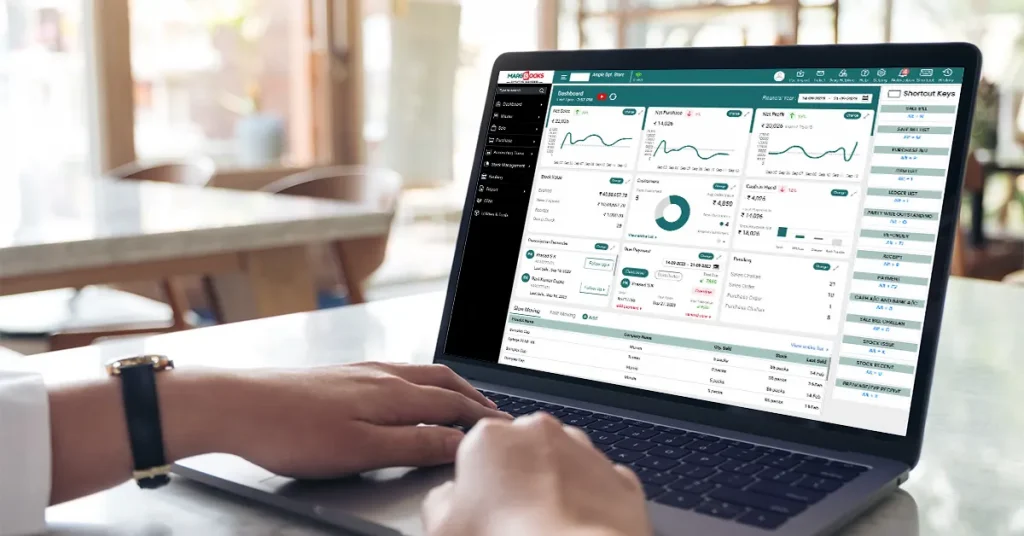
It’s cloud-based, so owners and staff can check sales, inventory, or financial reports from a phone or a desktop, useful if you’re not physically in the store every day. Tax is calculated automatically, including GST, which removes a chunk of the manual error that creeps into apparel billing given how many rate variations exist across garment categories. Inventory can be organised by fabric type, brand, season, and price range rather than being forced into a flat product list. And because it’s built for multiple users, staff can have different access levels depending on their role, without owners losing oversight of the bigger picture. You can look at the retail-focused version of this in more detail in the Garment Billing Software section if you want to see what a day-to-day setup actually looks like.
Why Production and Retail Software Need to Work Together
This part gets overlooked constantly, especially by growing brands that started as a small manufacturing unit and are now also selling directly. If your production system and your retail system are two separate islands, you end up making decisions on outdated information, restocking a colour that’s actually overstocked, or running out of a size that was selling well two weeks ago but nobody flagged it. When these two sides are synced, purchase orders, invoices, and payments stay logged in one place instead of three different registers or spreadsheets.
Does Better Software Actually Increase Sales?
It’s a fair question, because software can sound like a back-office concern that has nothing to do with what’s happening at the till. However, the link is actually quite straightforward. More rapid payments lead to shorter lines and fewer departing customers at times of peak traffic. Correct inventory means that you are not declining customers who were looking for an item that is simply not in the records. And having real sales data means you can push the right combo offers on stock that’s actually not moving, instead of guessing. There’s a more detailed case for this in How Garment Store Software Can Increase Sales, if you want the fuller picture.
Conclusion
There’s no single best software in the abstract; there’s the best software for what your garment business actually does day to day. If you’re running variant-heavy inventory, dealing with GST complexity, and need visibility across one or more locations, that narrows the field considerably. MargBooks Software is built around exactly that combination for Indian garment retailers, distributors, and manufacturers, which is why it comes up so often in this space.
If you’re at the point of comparing options seriously, it’s worth booking a free demo and testing it against your actual billing scenarios rather than just reading a features list; that’s really the only way to know if a tool fits how your business runs.
FAQs
What is the best software for a garment shop in India?
It depends on your scale, but the common thread across good options is variant-level billing (size, colour, article), automatic GST calculation, and real-time inventory tracking. MargBooks is one option built specifically around these needs for Indian garment retailers.
Is MargBooks good for both garment retailers and distributors?
Yes, MargBooks has separate offerings for retail chains and for distribution, since the two have different operational needs around order volume, credit limits, and dispatch tracking.
Does garment software handle GST automatically?
Good garment software should, yes. Tax rates can differ across garment categories, so automatic calculation reduces the manual error that often shows up during compliance checks or return filing.
Can one platform manage both production and retail for a garment business?
It can, and for manufacturers who also sell directly, it’s genuinely worth having. Syncing the two prevents mismatches between what’s being produced and what’s actually needed on the shop floor.
Is cloud-based garment software better than desktop-only software?
For most modern garment businesses, yes, mainly because it gives owners and managers access from anywhere, useful if you’re overseeing more than one location or simply aren’t in the store every day.

Aman Kannojia is the Digital Team Lead at MargBooks. He started out as an SEO Specialist and never lost his love for words. With 5 years of experience across banking, SaaS, and finance, both domestic and international, he brings strategy, leadership, and storytelling together. He doesn’t just manage a team, he builds one that creates.