Retail Software
 Distribution Software
 Retail Chain

Why Is It Important for Retailers to Stay GST Compliant?

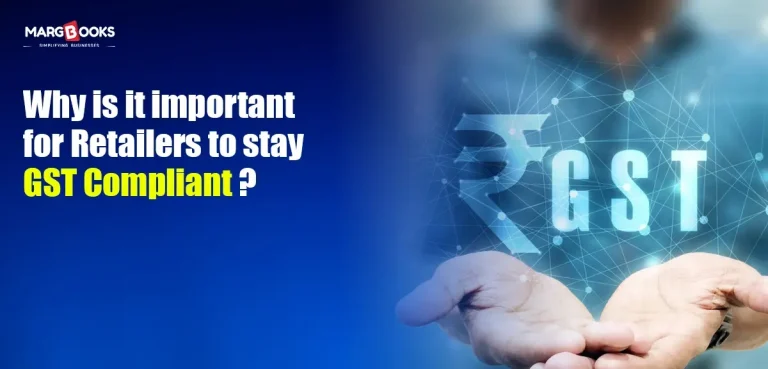
For a retailer, GST compliant is not merely about avoiding the penalties. It’s about running your store without interruptions, keeping the confidence of customers, and being able to maintain long-term business stability.
Whether you are a store owner of a garment shop in Delhi, or a grocery store in Surat, or running a chain of stores across states, compliance will not only keep you on the right side of the law, but will also help to build a reputation for you. From filling returns to creating appropriate invoices, each little activity makes a difference. With the proper systems in place, compliance isn’t a complicated proposition.
What Does GST Compliance Mean for Retailers?
There is more to being GST compliant than just collecting tax at the counter. It includes:
- GST registration as per the turnover threshold.
- Responsible for producing GST compliant invoices from all sales.
- Prompt filing of monthly, quarterly, or annual forms.
- Keeping proper purchase and sales records.
- Valid calculation and claiming of Input Tax Credit (ITC).
Let us consider the following example: a small shop that sells garments in Ahmedabad. If he issues invoices that do not provide GST details, fines, unhappy customers, and broken supplier chains. On the flip side, proper billing will allow him to claim fabric cost ITC and keep suppliers inclined to work with him again.
Risks of Ignoring GST Compliance
Non-compliance potential is rarely well understood by retail businesses. Some of the common difficulties include:
- Severe Penalties – For situations of delay and non-compliance, these penalties can be harsh. A small shop can wind up paying thousands of dollars.
- Business Interruption – Non-compliance can result in notices or audits, which can result in business interruption.
- Denied ITC – Improper filing leads to the retailer losing valuable ITC, which directly impacts profits
- Loss of Trust – These days, customers want to shop with a retailer issuing GST bills. For instance, you would not see a supermarket that does not have one, as they might lose loyal customers.
Many examples could be taken, but let us take the example of a chain outlet in Mumbai that had not filed returns on time. Fines ate into its working capital, and suppliers refused to deal with it until it was fixed. That is, one overlooked step can be disastrous for the whole process.
Related Blog – Why is GST Compliance Software Important for Businesses in 2026?
Benefits of Staying GST Compliant
On a more positive note, there are many advantages of being GST compliant:
- Control and Compliance – No fear of audit, notices, or fines.
- Improved Reputation – Customers have increased confidence in businesses that provide GST invoices.
- Smooth Supply Chains – Compliance will help retail trade parties easily collaborate with suppliers and distributors.
- Credit Worthiness – Creditworthiness of GST payee is established by banks and creditors based on GST returns.
- Tax Savings: Tax savings are a direct result of successful ITC filings.
One grocery store proprietor in Pune faced inaccurate ITC claims. He shifted to GST billing software, where he started getting faster reconciliation, timely filing of returns, and saving taxes, which were going in vain due to loss-making returns.
Real-World Indian Retail Examples
- Garment Retailer in Jaipur – MargBooks integration for return filing made things wonderful with regard to compliance.
- Kirana Store, Surat – With our software reporting features, he could reconcile the sales and purchase records so that there were no errors.
- Electronics Store in Suraj Nagar, Bengaluru – Notice due to overdue returns. Putting the MargBook system in place helped him to stay on top of deadlines for compliance.
- Chain of Bakeries in Delhi – With MargBooks, the billing functionality has simplified invoicing and less errors in the process.
The following examples illustrate how implementing the right solution will alleviate compliance headaches.
Key Actions Retailers Should Take
To ensure you remain GST compliant, retailers should develop a simple checklist as part of their daily operations:
- Bill corrects GST invoices in respect of every sale.
- Consolidate the purchase and sales information periodically.
- Send a timely monthly, quarterly, and annual report of files.
- Using technology to reduce human errors.
- Always give a bill, even if you can get the customer’s trust.
Today, many retailers are also going for Online billing software, which will have sales, inventory, and GST filing worked out in a single location. This way, you save time without having to rush everything to meet deadlines.
How Tools Simplify GST Compliance?
The tax regulations can be a scary place, especially for small businesses that are more concerned about making sales from day to day than filling out the appropriate forms for filing income tax. But newly developed tools are meant to bridge this gap.
- Automated – Invoices are being generated by software automatically and are GST compliant.
- Simple filing – Support filing is stepwise to reduce errors.
- Reports – Simple reporting to understand cash flow, ITC for the retailer.
- Peace of Mind – Less paperwork, more time to do what you love to do while expanding your business.
This is where MargBooks has come into play. From billing to reporting, from compliance reminders to streamlining returns filing, it enables individual retailers to focus on customers even as they keep up with the law. Rather than working across different spreadsheets, they have all of their data in one source.
Related Blog – How to Make Sure Your Sample GST Bill Is GST-Compliant?
Conclusion
For Indian retailers, the GST compliant is not optional anymore. Rather, it is a survival and growth requirement. Whether it’s a stand-alone outlet or a minority of branches, compliance is an absolute must for ease of working methods, avoiding fines, and building customer confidence.
With solutions like MargBooks software, retailers can streamline the process of returns filing, reporting, and billing, and worry less about compliance overall. The findings couldn’t be more evident; regardless of whether you are on the right or wrong side of the law, it is futile to risk your reputation and future-proof your business.

MargBooks, a product of Marg ERP Ltd., is a revolutionary cloud-based billing & accounting solution for every business where the business owner can manage the business from anytime anywhere on any device. MargBooks is your one-stop platform for managing your accounting, organizing your transactions, controlling your finances and managing your inventory. It’s a single secure platform to keep up with your company’s bills and invoices, reconcile your transaction, file GST return easily, experience connected banking etc.